
The RSA (Royal Society for the encouragement of Arts, Manufactures and Commerce) is “an enlightenment organisation committed to finding innovative practical solutions to today’s social challenges”. The RSA orgnizes various public events. Videos, animation and short films of these inspiring talks are published at the website. Such as the talk by Michael Pollan “Food Rules for Healthy People and Plan“. Of this talk a very nice, awarded winning, short animated film has been made by Marija Jacimovic and Benoit Detalle:
Author Archives: Dirk Roep

Introduction into Sociology and Anthropology of Place Shaping – optional course and free choice minor
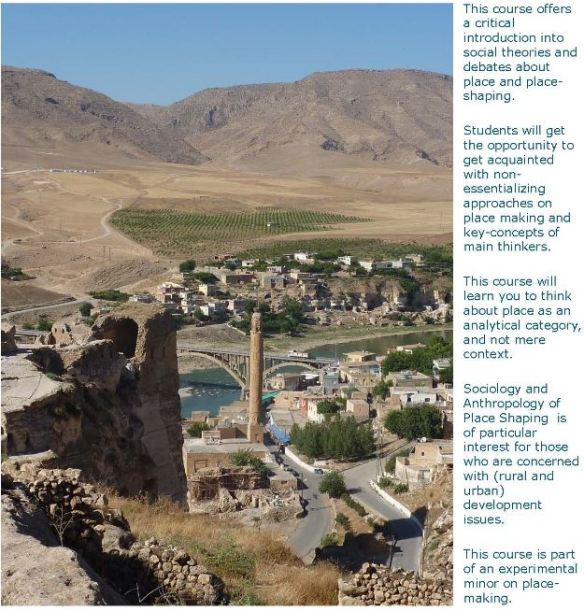 Starting Monday 17 Februray 2014, in the 4th educational period of Wageningen University, the optional course RSO-56806 Introduction into Sociology and Anthropology of Place Shaping will be offered again in collaboratyion with Cultural Geography Group and Land Use Planning Group. For more information on the course contact the course coordinator Joost Jongerden: joost.jongerden@wur.nl
The course can be the first of four succeeding courses in period 5 and 6 up to a total of 24 ects as part of the free choice minor ‘Place and space in planning and development‘ open to BSc-students from WU and other high education institutes, such as the Van Hall Larenstein University of Applied Sciences.
The course offered as part of the minor are:
- Period 4: RSO-56806 Sociology and Anthropology of Place-Shaping, whole days
- Periode 5: RDS-30306 Sociological Theories of Rural Transformations, morning or GEO-23306 Cultural and istorical Geography, afternoon
- Period 6: LUP-33306 Methods for strategic planning, whole days in week 34-39 and LUP-32306 Studio strategic planning, whole days in weeks 40-43
For more information contact minor coordinator Dirk Roep: dirk.roep@wur.nl
Global nutrient fight: micronutrients and geopolitics – lecture and debate December 10
Will monopolies, cartels and export restrictions define the future of your food?
RUW foundation will explore the world of the micronutrients in a lecture and debate featuring Wouter van der Weijden (director of CLM), Ellis Hoffland (WUR) en Petra Berkhout (LEI).
Venue: December 10, 2013 in the Grand Café of the Forum building, starting at 19.30.
Free entrance and drinks afterwards.
 Micronutrients are irreplaceable and are essential for plant, animal and human health. Only about 4% of the world’s micronutrient stocks can be found in the EU (Platform LIS,2012). In the near future Europe will become dependent on other countries, including China, Chili, US, Turkey and Peru for the supply of micronutrients such as selenium and zinc for its agriculture. Find out how borders and international relations influence the struggle for micronutrient supply, how it will affect our food production and what options the EU has to ensure the availability of micronutrients.
WASS-seminar: (Re-)Assembling Rural Places? by Prof dr Michael Woods
Wageningen School of Social Sciences (WASS) seminar: (Re-)Assembling Rural Places?
A presentation by Prof. dr Michael Woods (Aberystwyth University, UK) and prof. dr Sally Shortall (Queen’s University Belfast) as first discussiant.
Tuesday, December 3, 2013, 15.30-17.00, room C67 Leeuwenborch building of Wageningen University
In recent work Prof. Michael Woods explores the prospective application of Assemblage Theory as a framework for analysing the recomposition of rural places through social and economic change. Assemblage Theory builds on the influences of Gilles Deleuze, Manuel DeLanda and actor-network theory to understand social formations as assemblages of heterogeneous elements that can be human or non-human, natural or technical, material or expressive, but which are held together in temporary entanglements which are constantly changing and which cannot be contained but reach out to intersect with other assemblages. The approach has attracted increasing interest among others human geographers that started thinking about places as assemblages. Assemblage theory presents a way of extending the relational approach to rurality pioneered by Jonathan Murdoch, connecting material relations to performative and discursive aspects of rurality. Assemblage theory supports investigation of the re-making of rural places in globalization, resonating with Woods’s description of the ‘global countryside’ as an emergent and contested space and globalization as proceeding through processes of negotiation, manipulation and adaptation within place. In the seminar Prof. Micheal Woods will present his state of the art in working with these notions supported by illustrative examples.
SOLINSA and FarmPath – joint Final conference in Brussels, December 3 2013
 December 3 the EU-funded reserach projects FarmPath and SOLINSA will jointly present their findings at a final conference in Brussels. A detailed programme is available at the www.solinsa.net website. Location: Thon Hotel, Rue de la Loi / Wetstraat 75, B-1040. From 9.00 am till 4.30 pm.
 Rural Sociology Wageningen University