Beyond farming women: queering gender, work and family farms

The issue of gender and agriculture has been on the research agendas of civil society organisations, governments, and academia since the 1970s. Starting from the role of women in agriculture, research has mainly focused on the gendered division of work and the normative constitution of the farm as masculine. Although the gendered division of work has been questioned, the idea of binary gender has mostly been taken as a given. This explorative research shifts the attention from the production of (traditional) gender roles to the making and unmaking of binary gender. An ethnographic study of four farms in Switzerland is drawn on to explore queer farming practices and investigate how queer farmers navigate gender normativity and what this tells us about gender in agriculture more broadly. After considering the mechanisms through which queer farmers are discouraged from farming as a livelihood on the basis of their sex, gender or sexuality, this article argues that queer farmers de- and re-construct gender and farming identities differently, which has research and policy implications for a more diverse and resilient rurality.

Keywords Performativity · Agricultural practices · Swiss faming · Ethnographic research · Gender · Queer farmers

Read the full article by Prisca Pfammatter and Joost Jongerden here: https://doi.org/10.1007/s10460-023-10449-z
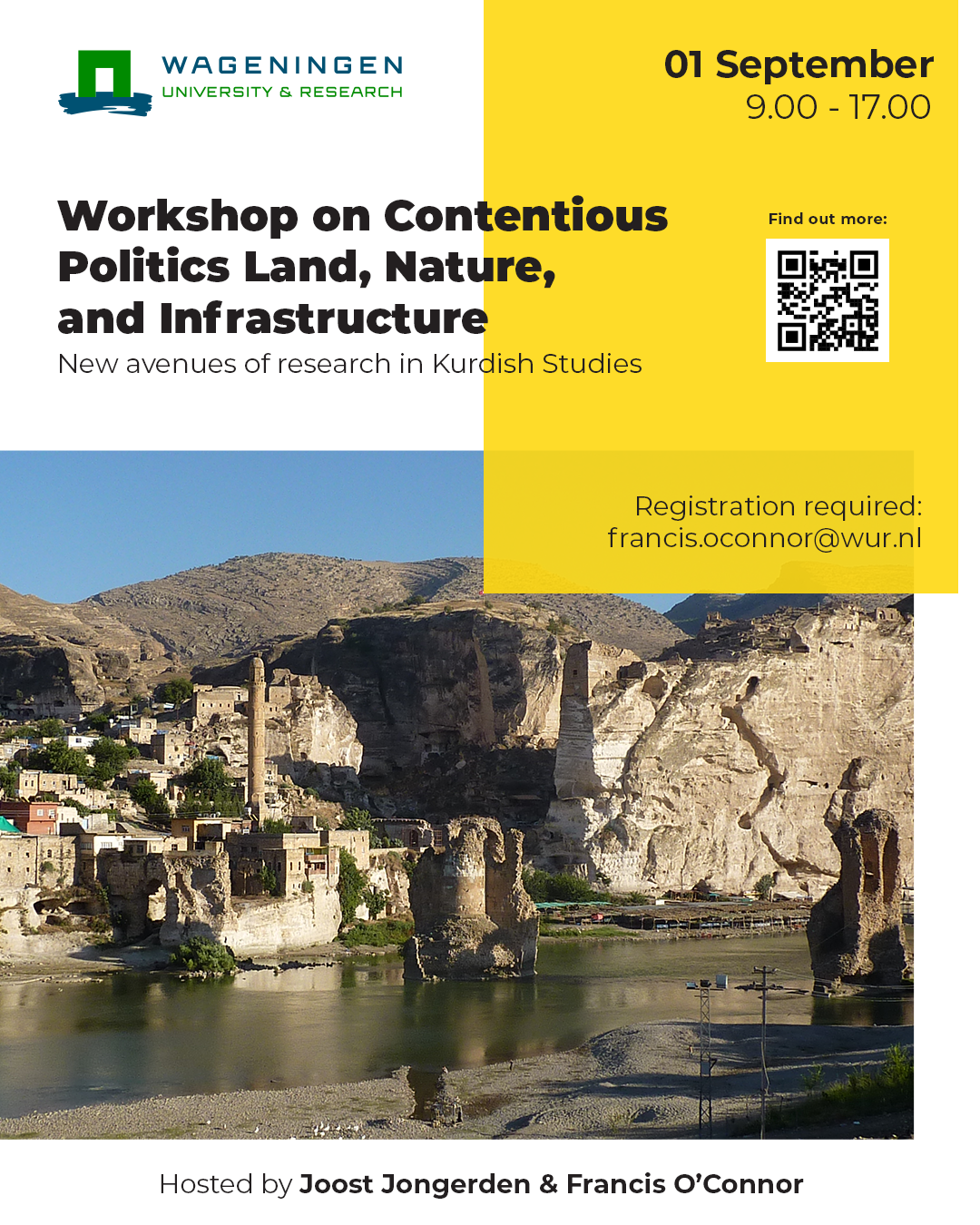
Workshop on Contentious Politics in Kurdish Studies: Land, Nature, and Infrastructure

Hosted by the Rural Sociology Group, Wageningen University and Research, September 1, 2023

In Kurdistan occupations and demonstrations by landless workers and peasants demanding land reform have taken place on a large scale since the middle of the 20th century. In more recent years, this contestation over land has overlapped with the rise of environmental activism. The workshop Contentious Politics in Kurdish Studies: Land, Nature, and Infrastructure addresses a number of theoretical debates and questions related to land.

Affiliations of the participants

Kamuran Akin is an independent researcher who recently defended his PhD at the Institut für Europäische Ethnology, Humboldt Universität zu Berlin.

Seda Altuğ is a lecturer at the Atatürk Institute for Modern Turkish History at Boğaziçi University, Istanbul.

Aysegul Aslan is a Ph.D. candidate in geography at Fırat University, Turkey, and a visiting fellow at the Environmental Policy Group at Wageningen University, the Netherlands

Eray Çaylı is a professor of Human Geography with a Focus on Violence and Security in the Anthropocene, Hamburg University, Germany

Pinar Dinc  is a researcher at the Centre for Advanced Middle Eastern Studies at Lund University.

Ayhan Işık is a Postdoctoral Researcher at Centre de Recherche Mondes Modernes et Contemporains, Université libre de Bruxelles.

Adnan Mirhanoğlu is a researcher in the Department of Earth and Environmental Sciences at KU Leuven, Belgium.

Zeynep Oguz is a lecturer in Social Anthropology at the University of Edinburgh.

Murat Öztürk is associate professor at the  Department of Economics at Kırklareli University in Turkey. 

Marcin Skupiński is a Ph.D. candidate at Warsaw University, Poland.

Necmettin Türk is a PhD Candidate in the Working Group “Critical Geographies of Global Inequalities” at the Institute of Geography, Hamburg University, Germany.

Filyra Vlastou-Dimopoulou is a Ph.D. candidate in Human Geography (NTUA & Paris 1 Panthéon-Sorbonne University.

Dobrosława Wiktor-Mach is professor of Economics, Cracow University, Poland.

Organizers

Joost Jongerden – Associate professor at the Rural Sociology Group, Wageningen University, the Netherlands joost.jongerden@wur.nl

Francis O’Connor – is a Marie Curie Skłodowska Post-Doctoral Fellow in Rural Sociology at Wageningen University in the Netherlands. Francis.oconnor@wur.nl

Analysing the PKK’s Rebel Governance: Data Limitations and some Potential Solutions

Francis O’Connor, Postdoc at the Rural Sociology Group and Kamuran Akin, Independent Researcher

The content of insurgent movements’ publications can be telling, yet the issues which they exclude or deny can be of even greater illustrative value. Downplaying violence against civilians or sources of illicit funding can be expected, but what of movements who ignore practises of rebel governance, which are not only popular with their supportive constituencies but also bestow legitimacy with the international public? This paper looks at the puzzling case of the PKK whose publications systematically neglected forms of governance – in particular its alternative justice systems –  it implemented at the height of its insurgency in Turkey through the 1980s and 1990s.

Continue reading

Researching in Zapatista Communities: Listen more, ask less

Beatriz Lopes Cerqueira, Master’s Student, Environmental Sciences – Environmental Policy at Wageningen University

For my MSc thesis research, I decided to travel to the home of one of my special interests, the Zapatista movement, which has been fighting with and for the dignity of the indigenous peoples of Chiapas, Mexico, and learn their particular views and practices towards Nature, natural resources and the preservation of the environment.

The relationship established between the Zapatistas and me followed what I believe to be the fundamental properties of emotional relations(hips) – those based on the mutual exchange of ideas and feelings, trust, and respect. For me, these kinds of connections require a careful management of our thoughts and feelings as emotional beings and the ways in which these are interchanged. Thus, for my research with the Zapatistas, I engaged in a long and complex process of analysing and evaluating the best way to create a relationship based on reciprocity and trust. Later on, I tried to apply these reflections in my own research process. Which methods and methodology would allow me to build trust with the Zapatistas, to conduct research without blindly extracting their knowledge? Which would be the best tools for telling the story of the Zapatistas’ ecological consciousness and the values, emotions and worldmaking processes that make up their cosmovision? For academic research, I believe that methodological choice(s) are the most important foundation for a steady and lasting relationship.

When I started to think about my fieldwork, I decided to do exploratory work in Oventik, one of the Zapatistas’ autonomous centres, in the highlands of Chiapas, before beginning.

Continue reading

The diaries of a bus buddy: Fieldwork observations as immigrants navigate Spain’s agri-food industry

Merissa Gavin, Master’s Student, International Development Studies at Wageningen University

My daily ‘commute
Beyond the methods and ethics of data collection, something we were taught in fieldwork preparation is that the field is full of surprises. Often you arrive to a reality much different to what your a priori desk research may lead you to expect. 

I came to Huelva expecting to observe and participate with Jornaleras de Huelva en Lucha (JHL), a self-organised feminist and anti-racist group of day labourers in the strawberry industry. My intention, in the best-case scenario, was to live and work alongside the fruit harvesters. Failing this, I was willing to accept visiting where the workers lived, hanging out with them after work and joining unionist action organised by JHL. However, due to the delicacy of immigrant workers’ statuses and the protectionist front of employers, this avenue proved unviable. Employers commonly provide accommodation on site and they are reluctant to facilitate external interactions. In place of JHL, the entry point for my research has been Asociación Nueva Ciudadanía por la Interculturalidad (ASNUCI). ASUNCI is an association that offers its members hostel beds, internet connection and hygiene services, all of which are in high demand amongst workers not housed by their employers, but instead living in roadside settlements without electricity or water.

Continue reading