Prof. Anne van den Ban is generally regarded as the founding father of the Wageningen communication sciences. He was appointed as Professor of extension communication (‘Voorlichtingskunde’) in 1964, which became the cradle for a rich and influential array of academic endavours at the intersection between communication, innovation and change in the sphere of health, environment and agriculture. These activities have continued until today and now take place across several chairgroups and sections at Wageningen University.
Hofstee and Van der Ban
While Prof. Van den Ban certainly deserves a lot of credit for developing the new discipline and building an internationally recognized group, it is important to acknowledge the contribution of Prof. E.W. Hofstee in getting Van den Ban started. Hofstee was promotor of Van den Ban’s 1963 PhD dissertation on the communication of new farm practices in the Netherlands, and he no doubt inspired Van den Ban in choosing his topic. In fact, already in 1953 Hofstee wrote about the importance of studying ‘sociological aspects of agricultural extension’ in the first (!) ‘Bulletin’ that was published by his group (Hofstee, 1953). He was also in touch with the public extension services that had been established by the Ministry of Agriculture a few decades earlier, and gave lectures to Ministry staff on the significance of group-based agricultural extension approaches (e.g. Hofstee, 1960). Reading these early works by Hofstee made me -as one of the successors of Van den Ban- realize how much we still owe to Hofstee today.
In essence, Hofstee criticizes the then prevailing extension services and practices for assuming that farmers take decisions according to an individualistic economic rationale. He points to the importance of social, collective and cultural dynamics in shaping what farmers do or do not, and also to the importance of social differentiation and regional ‘farming styles’ in explaining farmers’ economic activity. In order to be effective, extension organisations and professionals should -according to Hofstee- understand the importance of such ‘sociological aspects’ and anticipate these in their work (Hofstee, 1953). This implies that extension workers should look at extension and knowledge transfer as an inherently social process rather than as a series of communicative ‘tricks’ and also be reflective about their own social positions (Hofstee, 1960) The concern with the ‘effectivess of extension’ (or better: the lack of it) demonstrates Hofstee’s commitment to the post second world war modernisation project and his own normativity in this regard. Despite his sensitivity for social and normative issues, he continued to talk in terms of ‘good, progressive’ and ‘bad, backward’ farmers (Hofstee, 1953), thereby (re)producing the paternalistic connotations of the Dutch word for extension communication: ‘Voorlichting’. This term literally means something like ‘holding a light in front of someone to lead the way’ assuming apparently that people are ‘in the dark’ and need to be ‘enlightened’ by those with scientific training.
While today’s studies on communication, innovation and change have arguably left this ‘enlightenment’ and ‘deficit’ thinking behind, we also see traces of Hofstee coming back in our current work. We still criticize simplistic individualist conceptualizations of change, as is reflected in today’ attention for ‘social-technical configurations’, ‘system transformation’ and ‘responsible innovation and scaling’. Similarly, Wageningen trained communication scientists are known for their interactional and socio-political conceptualization of both professional and everyday communication and meaning making, and for their interest in the social challenges to facilitating dialogue among different interpretative communities. These sociological perspectives on communication and change have now spread to other Universities in the Netherlands and elsewhere. The continued prevalence of sociological connotations is not surprising if one considers that most of Van den Ban’s successors indeed had a sociological training as well. Clearly, that is not accidental but part and parcel of Hofstee’s legacy.
*Cees Leeuwis is Personal Professor at the Knowledge, Technology and Innovation group, Section Communication, Philosophy and Technology
References
Hofstee .E.W. (1953) , Sociologische aspecten van de landbouwvoorlichting. Bulletin 1, Afdeling Sociale en Economische Geografie, Landbouwhogeschool, Wageningen.
Hofstee .E.W. (1960) Inleidende opmerkingen over de voorlichting: Groepsbenadering in de voorlichting. Voordracht gehouden op de Tuinbouwdagen 1960. Mededelingen van de Directeur van de Tuinbouw, 23, 10, pp 621-624
Van den Ban, A.W. (1963) Boer en landbouwvoorlichting: De communicatie van nieuwe landbouwmethoden. Pudoc, Wageningen.
In our November blog, prof.dr.ir. Bettina Bock looks back at her 44 years of research around gender and rural development. While issues of gender and agriculture have been on the research agenda since the 1970s, only recently has rural sociology started shifting its attention from the production of traditional gender roles, or the recognition of the role of the women-farmer, to an exploration of the farming cultures of queer farmers.
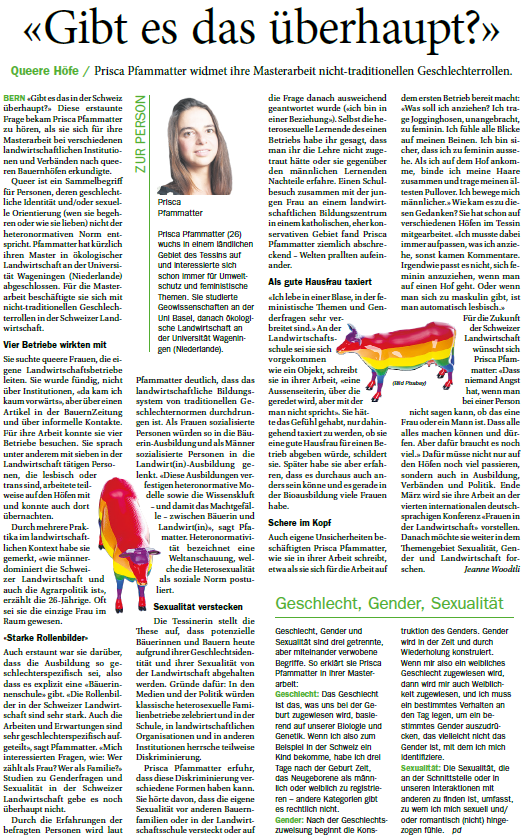
News article about Prisca Pfammatter’s master thesis, published in the Swiss BauernZeitung on December 10, 2021
Master student Prisca Pfammatter traced back how on traditional family farms in Switzerland, gender is the main axis along which labour is divided and power relationship shaped. Then, drawing from the approaches of performativity theory and weak theory, she investigated how queer farmers understand their farming performances and how these interact and intermingle to create gender and sexual identities that, in turn, inform their farming practices.
Drawing from ethnographic fieldwork and seven interviews with queer farmer, Pfammatter evidences how through their performances queer farmers not only redefine male and female and masculinity and femininity, but also challenge the gendered division of labour on the farm. As a result, their subversive gender performances have the potential to redefine agriculture as gender-neutral and contribute to a filling of the scholarly gap on how to move agriculture away from the (re)production of the traditional gender binary and its inequalities.
Pfammatter’s research makes three main contributions to the literature. First, it evidences the glaring lack of research around and the invisibility and non-recognition of queer farmers in Switzerland. This lack that is exposed extends to the mechanisms through which farmers are turned away from farming as a livelihood on the basis of their gender, sex and/or sexuality – for example, through the celebration in Switzerland of heterosexual cisgender family farms. Second, the thesis highlights subversive performances and how these challenge the production of binary gender, sex, sexual, and farming identities as well as the attribution of skills on the basis of these socially constructed categories to imply alternative possibilities, roles and futures. Third and finally, it is suggested that farming can be an accommodating space where people can become who they feel they want to be.
Prisca Pfammatter. 2021. Beyond Farming Women: Queering gender, work and family farms, Master Thesis: https://edepot.wur.nl/557032
On 23 – 25 March 2022, the study will be presented at the International German-language conference “Frauen in der Landwirtschaft”.
Gert Spaargaren[i] (with illustrations by Emily Liang)
‘Modern Environmentalism’
Environmental problems are of all ages, but in historical perspective one could argue that the awareness that something can and must be done about the deterioration of soils, water and air quality is of rather recent origin. In his book on ‘modern environmentalism’, David Pepper (1984, 1996)[ii] identified three landmark publications that expounded the principle ideas of ‘modern environmentalism’ as emerging from the 1970s onward.
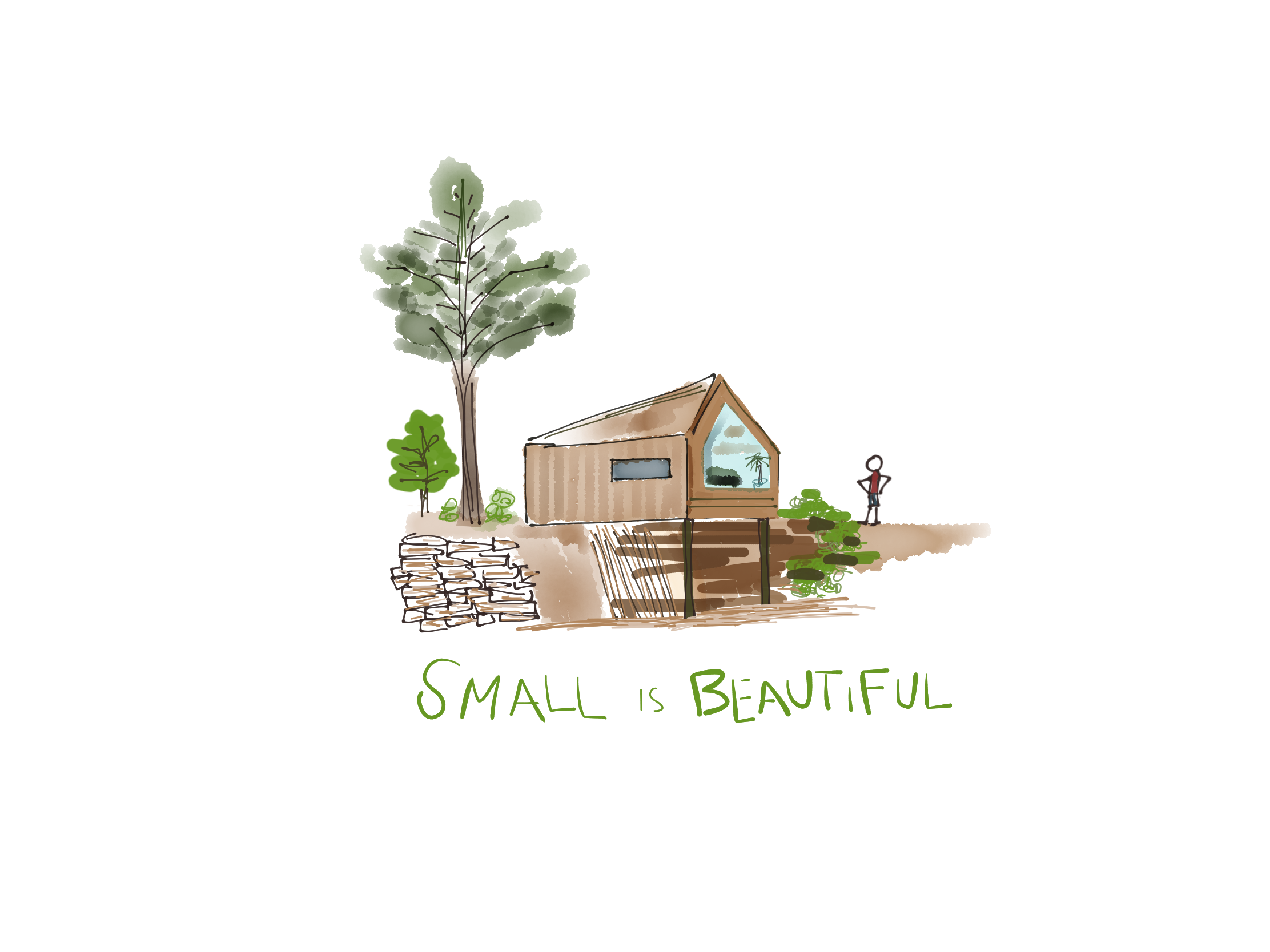
First and most important has been the ‘Limits to Growth’ report to the Club of Rome (Meadows et al, 1972)[iii]. With hindsight, this MIT[iv]-based modelling of the planetary limits to industrial societies must be regarded as the single most important trigger for environmentalism to become a permanent issue both for politicians and citizens around the world. It was ‘modern’ environmentalism since the report was science based and because it urged key actors in society to take their responsibility for a common future at risk. Secondly, the ‘Blueprint for Survival’ (Ecologist, 1973), a special issue of a journal published by the emerging environmental social movements in the UK, has been an important trigger. The ‘new social movements’ in the UK and Germany in particular aimed at translating the Club of Rome message to the local (UK; EU) situation. They did so by translating the call for ‘limits to growth’ into a design for a strictly closed loops oriented, local, de-central, bounded network of eco-communities, sharing and caring for natural resources in a way we would later on come to refer to as ‘sustainable’ or ‘circular’. To underpin their design of the Blueprint Society with socio-cultural, economic and political arguments, they heavily relied on the third major source of modern environmentalism: Fritz Schumachers’ ‘Small is Beautiful’ book series (Schumacher, 1973; 1979)[v]. Schumacher was an enlightened British economist who resigned from a leading position in the energy (coal) sector to dedicate the rest of his life to the promotion of a radically different kind of society. His books became popular around the world and in the late 1980s, Schumacher himself came over to Wageningen to address a lecture hall[vi] filled with eager and critical students to discuss his core idea that recognizing limits to growth should lead one to consider new, small-scale, local, size-limited forms of (agro)industrial production and consumption from now on.
Three publications with a different character – one scientific modeling report, one NGO-article and one popular book series for a broad audience – but on a similar topic: the ‘environmental future of modern industrial societies’. From a contemporary point of view, they were positioned more on the sideline of society, were more Eurocentric, and did not confront climate and biodiversity issues in ways we are familiar with today. But the idea of radical change, the framing of the planet as resource for future generations, and the sense of urgency and unconventional forms of action I would argue to be pretty much the same. It is the engagement with transitions and transformation as we know of them today, but at the background you should imagine the sound of the pop-music of the second half of the 1960s (Dylan, the Beatles, folk-music) and pictures of student revolts and the rise of the so-called counter-culture in the 1970’s.
E.W. Hofstee and ‘Modern Environmentalism’ at WUR in the 1980s
When I started my academic career in Wageningen in the late 1970s, all ‘engaged students’ were more or less familiar with the wake-up call that was represented by the three publications introduced in the above. So were staff members and even some professors…. Evert Willem Hofstee (1909 – 1987) being one of them.
Professor Hofstee was a social scientist who very early on recognized the urgency of environmental problems and the fact that the future of modern societies would be affected by problems of (air, water, soil) pollution and the exhaustion of resources. As early as mid-1971, he drafted an advisory Report for the Dutch Royal Academy of Science Committee on the task for social sciences to confront “Milieubederf en Milieubeheersing als maatschappelijke verschijnselen” (environmental deterioration and environmental control as societal phenomena)[vii]. During the period of redrafting this advisory report, the Club of Rome Report was published, and Hofstee in his preface to the final version of his KNAW report noticed that one of the remarkable characteristics of the Club of Rome report was the fact that it “hardly mentions the social scientific aspects of the environmental problem” (Hofstee, 1972, preface).
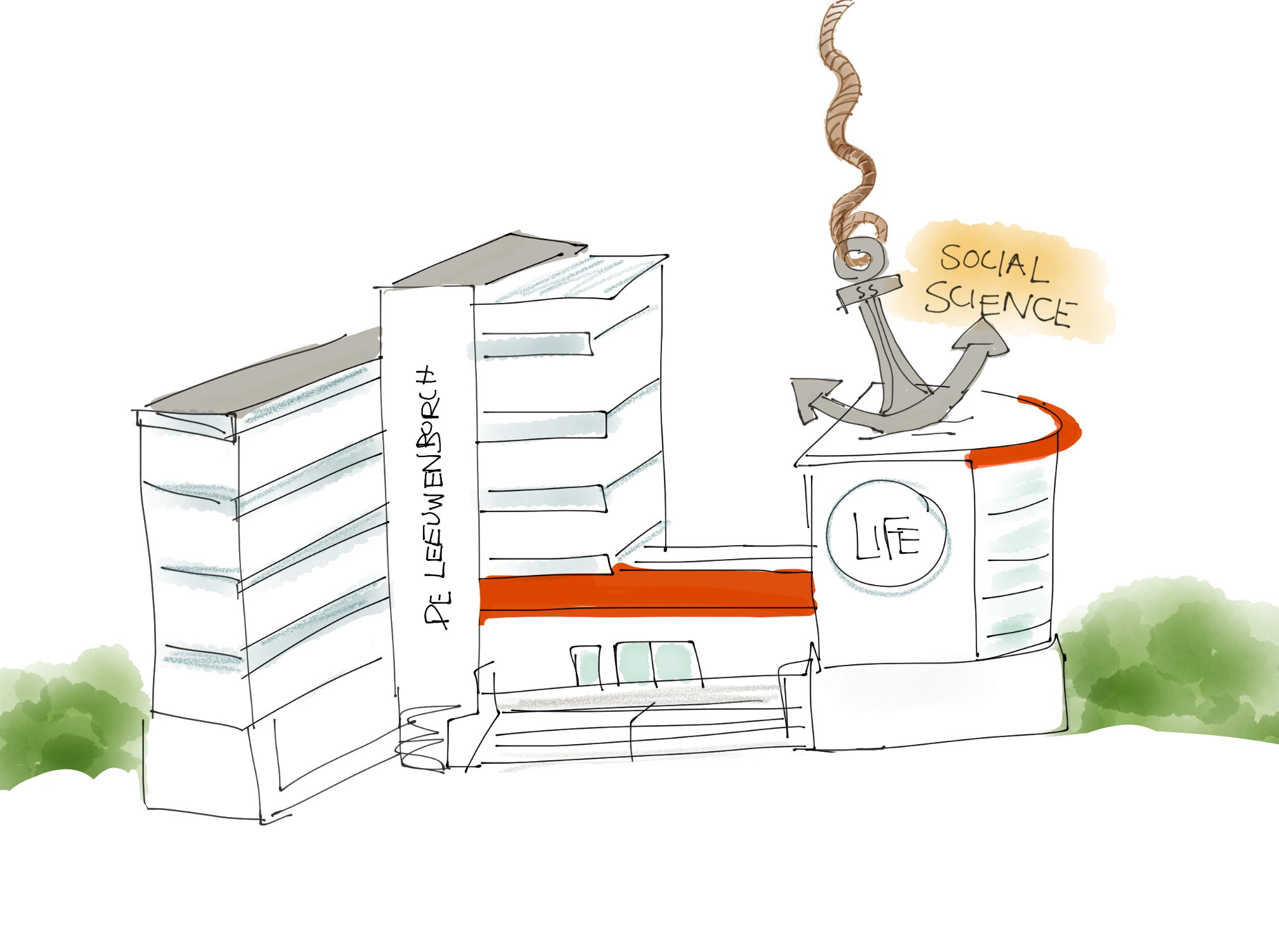
Hofstee himself was in a position to do something about that. He was a respected professor in (rural) sociology at the Landbouw Hogeschool (the predecessor of WUR) and one of the driving forces behind the construction of the Leeuwenborch-building as an anchor point for the social sciences. Hofstee was an empirical sociologist, raised in the tradition of demography and sociography e.g. historically informed, applied and policy relevant social science research. I was told that Hofstee was standing member of more than 150 committees and advisory boards that were involved in the socio-spatial redesign of the Netherlands after the second World War. So he knew ‘from within’ that policy makers were confronted with all kinds of expected and not expected negative consequences of the accelerating modernization process as it was happening in rural and urban spaces in the Netherlands and in Europe at the time. Hofstee noticed as well that in the Netherlands ecological/environmental issues were not eagerly taken up and given any serious theoretical or empirical consideration by sociologists. Only Nico Nelissen in Nijmegen and Egbert Tellegen – in collaboration with Peter Ester and later on with Maarten Wolsink- in Amsterdam were publishing on ecological issues. Nelissen was building on the ecological sociology of the Chicago school in the USA, while Tellegen and colleagues depicted environment and energy as new societal issues, thereby providing support for the new social movements without much theorizing. In his theoretical work however also Hofstee himself did not pay much attention to environmental issues. His (three volumes) reader we as students were instructed to read, was titled “Differentiële Sociologie” (Sociology of Differentiation) and it did not consider the modernization process from an environmental point of view. Wageningen sociology was first and for all agrarian, rural sociology, focusing on the differential adoption of modern ideas (on religion, family life etc.) and (life)styles – interior design, diets, styles of farming – by different segments of the population in different parts of the Netherlands.[viii]
Sociology, Environment and Modernization at WUR after Hofstee
Because Hofstee was aware of the need for environmental sociology and because he was still leading the ‘vakgroep sociologie van de Westerse Gebieden’, it was decided that someone in Wageningen should be appointed as ‘environmental sociologists’ to confront the challenges put forward by the Club of Rome and the emerging Environmental/Energy movements in the Netherlands and Europe. Henry Hilhorst – specialized in the sociology of religion – was asked to take environmental issues on board. He tried to make a start with a course in environmental sociology in 1985, building upon the study of Hofstee (1972) on ‘Environmental Deterioration and Control’. Along the way however, he discovered that his heart was not in environmental sociology and the ‘material matters’ (flows of energy, water, waste, nitrogen, phosphate) associated with it. Henry left for a job in the sociology of religion in Utrecht, and in 1986 I was assigned the task of developing for the (chair)group ‘Sociologie van de Westerse Gebieden” a Wageningen relevant version of environmental sociology[ix].
Since the course had to start right away and I only just took office as staff member, a guest lecturer from the USA was attracted to join me/guide me in giving the first course on ‘environmental sociology’/milieu-sociologie in Wageningen. Rabel Burdge came over to stay with me for a month, telling the students about ‘social’ (SIA) next to ‘environmental’ impact assessments (EIA) as happening in the USA. He used the classes to discuss with the students his survey results of SIA-studies, but as well for sharing his family holidays pictures of lake Michigan and the natural beauty it represented…..The students liked his American style, his story telling and his holiday pictures in particular. I was however not convinced that impact assessment would be the (restricted empirical) way forward for environmental sociology at Wageningen University. I used the first years to reflect on the society-nature interactions from a sociological perspective, using social ecology as well as ‘eco’- neo-Marxism as sources of inspiration.
In the years to follow, a team of environmental sociologists was build. Kris van Koppen and Arthur Mol became close colleagues, and the first PhDs were attracted to build not just a relevant theory but to develop at the same time a body of empirical knowledge on Environmental Deterioration and Control. Ecological Modernization, with an emphasis on the environmental damage stemming from material flows running through socio/ecological systems, was the general heading of this theoretical and empirical work. It resulted from a critical confrontation with ‘small-is-beautiful’ (romantic?) thinking as the dominant paradigm in the grassroot environmental NGOs in Germany in particular. Instead of de-modernization, we argued that the environmental side effects of simple modernization should be dealt with by redesigning/reforming the agro-industrial structures of production and consumption. Enlightenment thinking versus Romantic thinking; Europeanization and Globalization versus localization; market dynamics next to policy dynamics etc. The debate on ‘how to green modern societies’ had begun.
The number of students and staff members were (gradually) growing. In the meantime other social science groups in the Leeuwenborch started with research and specialized courses on environmental topics. Next to economics, also history, law, extension sciences and spatial planning developed their own portfolios in the environmental field, with their activities being coordinated in the context of the so called Leeuwenborch Milieu Overleg (LMO).
By the end of 1990s, it was decided that the environmental sociology section of the Western Sociology Group should become a separate group, including not just sociologists but political scientists and cultural geography scholars as well. The Environmental Policy Group (ENP) – from 2000 onwards headed by Arthur Mol and since 2015 in good hands of Simon Bush – became one of the leading groups both within WUR and in the national and international social science (RC-24 of the ISA) arena’s. The excellent reputation of the ENP-group is based on characteristics that I would argue to go well along with Hofstee’s worldview, and they run as follows. First,look at differentiation (now at different regions of the global network society in particular). Second, combine innovative theoretical work always with sound empirical research. Third, try to investigate why social groups at different levels of society do or do not want to engage themselves with processes of change for a more sustainable world in the future. The present ENP-work on energy/water/sanitation transitions in different continents, and on global (fish) food system transformations can be regarded as adequate responses to Hofstee’s wake up call for the environmental social sciences in the 1970s. Their education and research are examples of social science knowledges that help shape the ‘great transition’ towards a more ecological sound, reflexive, and global modernity.
[i] I would like to thank Anton Schuurman for his useful comments on the draft version of the present text
[ii] D.Pepper (1984) The Roots of Modern Environmentalism. London, Croom Helm
[iii] The Limits to Growth (1972) D.H. Meadows et al. Potomac Associates.
[v] E.F. Schumacher (1973) Small is Beautiful. London, Blond and Briggs; E.F. Schumacher (1979) Good Work. New York. Harpers & Row
[vi] The big lecture-hall of the Leeuwenborch building was named the ‘Hofstee-room’ at the time, but unfortunately this name is no longer in use to refer to the main lecture hall of the social science building of WUR.
[vii] E.W. Hofstee (1972) Milieubederf en Milieubeheersing als maatschappelijke verschijnselen; poging tot een overzicht van de maatschappij-wetenschappelijke problematiek van een actueel onderwerp. Amsterdam. Noord-Hollandsche Uitgevers Maatschappij
[viii] The concept of differentiation was offered by Hofstee as a critique of ‘generalizing, functionalist’ analyses of modernization as dominant in the USA (Parsons) at the time. Mainstream drivers have to be specified – so Hofstee argued – in terms of time-space specific trajectories and dynamics
[ix] The chairgroup (at the time named ‘vakgroep’) Sociologie van de Westerse Gebieden already had several thematic sections to organize the empirical work. Next to the dominant rural sociology section, there were section on the sociology of family life, on the sociology of leisure, and on methodology.
De naam Hofstee was mij bekend. Iets over sociologie in Wageningen ook. Toen ik mijn afstudeeronderzoek deed in een klein plattelandsdorp in Noord-Holland, Twisk, las ik de studie van de Wageningse socioloog Jaap Groot over de leefbaarheid van een plattelandskern. Verder leerde ik, nadat ik aan de Universiteit van Amsterdam was afgestudeerd in de sociologie van bouwen en wonen, de Vakgroep Wonen van Prof. Van Leeuwen in Wageningen kennen. Desondanks bleef ik lang vrezen dat voorbij Utrecht de werkelijke academische wereld ophield.
Een advertentie voor een coördinator van de Werkgroep Recreatie van de Landbouwhogeschool Wageningen had desondanks mijn aandacht getrokken. Na mijn afstuderen had ik een aantal jaren onderzoek gedaan naar de relatie wonen en welbevinden bij het Instituut voor Preventieve Gezondheidszorg in Leiden. Daarna was ik beland in Den Haag bij een platform van organisaties op het gebied van vrijetijdbesteding, openluchtrecreatie en behoud van een gezonde leefomgeving, genaamd Stichting Recreatie. Daar kwam ik in direct contact met een levendige beleidssector op deze terreinen van de verschillende overheden. Bovendien ondersteunde de stichting een netwerk van onderzoekers aan de Nederlandse en Vlaamse universiteiten. Recreatie en vrije tijd waren belangrijke maatschappelijke thema’s geworden. Ik wilde graag terug naar de universiteit, vandaar dat ik solliciteerde naar de geadverteerde positie in Wageningen.
In Wageningen was openluchtrecreatie als onderzoeksthema nadrukkelijk op de kaart gezet als onderwerp van naoorlogse zorg voor een leefbaar en beleefbaar platteland, dat onder de snelle modernisering onder druk was komen te staan. De aanleg van grote recreatiegebieden in de buurt van en tussen grote steden naar voorbeeld van het Amsterdamse Bos was een substantiële oplossing geworden voor het verdwijnen van ruimtelijke kwaliteit en bruikbaarheid in de naoorlogse nota’s voor de ruimtelijke ordening. Intergemeentelijke samenwerkingsverbanden, de zogeheten Recreatieschappen, dienden zorg te dragen voor uitvoering en beheer. Sociaalgeograaf Theo Beckers was in 1976 aangesteld bij de vakgroep Sociologie van de Westerse Gebieden en had zich beijverd om recreatiegedrag en -beleid op te nemen in het curriculum. Hij schreef in 1983 een prachtig proefschrift waarin het belang van recreatie werd duidelijk gemaakt, als een vorm van vrijheid, en bracht deze vrijheid in verband met de recente geschiedenis van het overheidsbeleid en met een solide theoretische kijk op planning. Bovendien stond hij aan de wieg van een samenwerkingsverband van Wageningse studievelden waarin openluchtrecreatie een aandachtsgebied werd of moest worden, van sociologie, landgebruiksplanning, ecologie, economie, psychologie en landschapsarchitectuur. Het samenwerkingsverband werd wettelijk (Wet Universitaire Bestuurshervorming) verankerd in de Werkgroep Recreatie. Ik kreeg de baan.
Voor de functie was ik ondergebracht als medewerker bij de Vakgroep Sociologie, met een kamer op de Leeuwenborch. Daar trof ik een gezelschap collega’s die onder Hofstee waren aangesteld, Ad Nooy had de leiding ervan, Jelle Lijfering, Berry Lekanne dit Deprez, Iteke Weeda, Rien Munters, en een recente lichting met Jaap Frouws, Gert Spaargaren, Jan-Willem te Kloeze en Henk de Haan. Jaap Groot en gezinssocioloog Gerrit Kooy waren zojuist vertrokken of gingen met pensioen. Mijn herinnering aan die tijd is niet helemaal zuiver meer na zesendertig jaar. Mijn belevenissen bij de vakgroep zullen daarom eclectisch en impressionistisch zijn. Terwijl ik me met medewerkers van verschillende vakgroepen bezighield, bleef mijn kijk op de collega’s van sociologie beperkt. Een helder ijkpunt vormde het hoofd van het secretariaat, Ada Hink. Zij beleed haar trots en trouw aan de groep en aan Hofstee in het bijzonder door mij te vertellen dat ze altijd op haar post zou zijn om Hofstee, als hij graag nog dagelijks in zijn kamer kwam, bijtijds zijn koffie te brengen. Niet duidelijk werd me wie een oudere man was, die ook ergens in een kamer zich door data heen zat te werken. Een assistent van Hofstee of zo iemand?
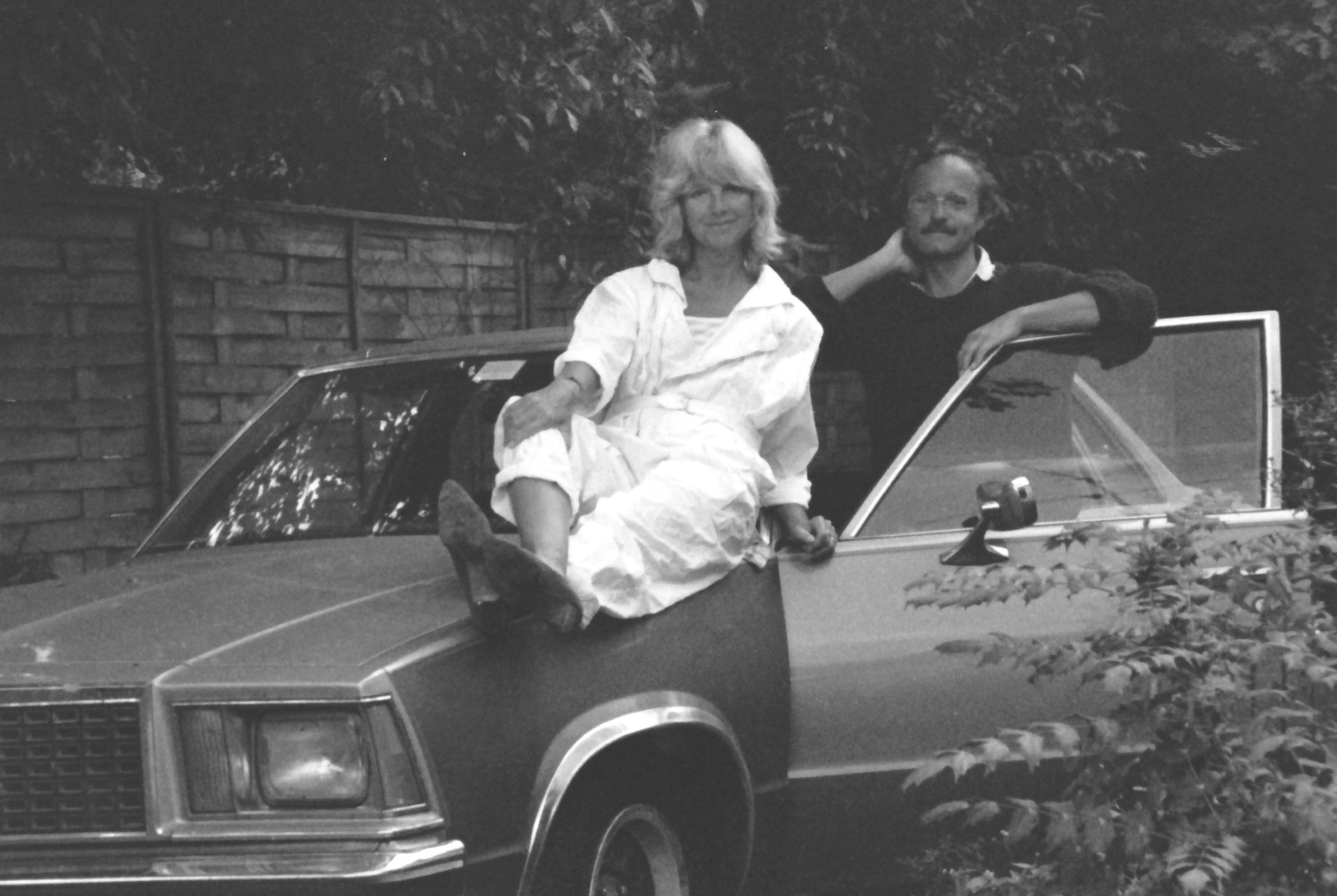
In de ochtend van mijn eerste werkdag in Wageningen parkeerde ik mijn auto op het parkeerterrein van de Leeuwenborch. Ik was benieuwd naar wat ik daar aan vervoersmiddelen zou aantreffen. De faam van milieuvriendelijkheid van de Landbouwhogeschool was tot mij doorgedrongen en ik vermoedde eenvoudige auto’s aan te treffen, deux-chevauxs, simpele Opels, een bescheiden Renault, of zoiets, en natuurlijk veel fietsen. Ik zelf was sinds kort in het bezit van een zescilinder, zilverkleurige Chevrolet Malibu, met roodlederen banken in plaats van stoelen. Ik verwachtte daarmee een ernstige dissonant te vormen. De auto slurpte benzine, verbruikte liters olie en maakte het geluid van een oceaanstomer. Maar de leden van de Werkgroep Recreatie pasten er precies in. Op weg naar geschikte onderzoeksgebieden reden we door het land en de stemming in de samengepakte wagen was opperbest. De Chevrolet heeft waarschijnlijk mijn beste bijdrage aan teambuilding betekend.
“Auto, echtgenote en ik“
Helaas moest die al vrij snel worden ingeruild omdat van de zes cilinders bij een scherpe bocht naar rechts er steevast twee uitvielen.
De Landbouwhogeschool werd Landbouwuniversiteit en de vakgroep sociologie trok een nieuwe generatie medewerkers aan. Van de oudere medewerkers was Rien Munters degene die hen vooral theoretisch inspireerde. Hij had zich verdiept in het werk van de Britse socioloog Anthony Giddens, waarvoor hij twee van zijn studenten had weten te enthousiasmeren, Hans Mommaas en Hugo van der Poel. Deze twee hadden zich na afstuderen naar de universiteit van Tilburg gespoed als zendelingen van Giddens, die hun missie daar met succes toepasten op het terrein van de vrijetijdwetenschappen. Na enige tijd, in 1987, volgde Theo Beckers hen naar Tilburg als hoogleraar Vrijetijdswetenschappen. Rien Munters bleef hun goeroe op afstand.
Rien was één van de medewerkers waar ik meer mee optrok. We gingen met enige regelmaat na afloop van het werk samen naar Nol in ’t Bos, om daar een jenevertje te drinken, met bitterballen, waarbij ik hem ook af en toe een klein sigaartje mocht aanreiken. We spraken weinig over het werk, wel over amusantere onderwerpen. Zo vertelde hij anekdotes over Prof. Den Hollander, die ik als hoogleraar sociologie in Amsterdam had meegemaakt en die zijn studenten grote schrik placht aan te jagen, bijvoorbeeld door namen van de presentielijst op te noemen om de betreffende persoon tijdens het college een spitsvondig antwoord te laten geven. Menig student dook onder de bank. Ook liet hij een studente met gips om haar been uit de collegezaal verwijderen omdat ‘dat been’ hem stoorde. Deze handelwijze is hem bij de grote revolutie van de late jaren zestig duur komen te staan. Tevens memoreerde Rien dat hij ooit in het ziekenhuis was beland nadat hij een boomtak afzaagde waar hij zelf op zat. Over de wonderlijke hallucinaties die hij daarna kreeg raakte hij niet uitgesproken.
Ook met Albert Mok had ik goed contact, die als deeltijdhoogleraar organisatiesociologie was aangetrokken. Ik kende zijn naam van een boek over sociologie, dat hij samen met De Jager had geschreven en dat gewoonlijk werd aangeduid werd als ‘de mokkendejager’. Ikzelf was opgevoed met het boek van Van Doorn en Lammers en later het werk van Norbert Elias. Ik volgde Mok’s colleges en nam er af en toe één voor hem waar. Hij was een liefhebber van jenever. Bij mijn promotie gaf hij me een hele doos met flessen exquise Belgische jenever.
De nieuwste lichting medewerkers bij de vakgroep oriënteerde zich sterk op Jürgen Habermas, die het werk van Max Weber verder had uitgewerkt en actueel gemaakt. Het terrein waarop deze jongere generatie zich begon te bewegen raakte enigszins verwijderd van het agrarische. Milieusociologen werden ze. En, in mijn ogen, met een bewonderenswaardige inzet en begeestering. Ze mengden zich actief in de onderzoekscommissie voor milieuvraagstukken van de International Sociological Association (ISA). Voor een ISA-conferentie stelden ze een ‘marsroute’ op, zo vernam ik, waar elk van hen naar toe zou gaan om een bijdrage te leveren. Ikzelf nam met meer gemakzucht deel aan de commissies voor vrije tijd en voor toerisme en vond me vergeleken met hen een lapzwans.
Intussen bedreigde het College van Bestuur de studierichting Sociologie met bezuinigingen of zelfs opheffing. Hetzelfde lot trof Landschapsarchitectuur, een succesvolle en in Nederland unieke academische studierichting. Ad Nooy, zo hoorde ik, stelde voor een deel van zijn leerstoel in te leveren om financiële ruimte te creëren. Hij en hoogleraar landschapsarchitectuur Vroom waren volgens mij integere hoogleraren van het oudere stempel, die hun posities vanzelfsprekend achtten. Geen doordouwers of gewiekste strategen. Landschapsarchitectuur ging op in een gezamenlijke studie met landinrichtingsplanning. Doodzonde. Hoe het met sociologie ging weet ik niet meer. Wel, dat Jan Douwe van der Ploeg als hoogleraar werd aangesteld en hoofd werd van de vakgroep. Hij vatte zijn rol op met veel elan en voortvarendheid, met een sterke visie op agrarische regionale ontwikkeling en met een gedegen netwerk binnen en buiten de universiteit. In een landelijk tijdschrift beschreef hij zijn plannen en merkte op dat er onder de medewerkers, die hij geërfd had, veel ‘dood hout’ zat, dat nodig weggekapt moest worden om gezonde groei mogelijk te maken. Een mens kan zich vergissen, ook een hoogleraar. Het dode hout dat hij ontwaarde bleek een verzameling wandelende takken te zijn. Wandelende takken leven en eten zo nodig zelfs hun eigen kinderen op. De bedoelde medewerkers, waaronder ik, zijn later hoogleraar geworden, één zelfs Rector Magnificus. De nieuwe hoogleraar Van der Ploeg was hoe dan ook van zins snel flinke beslissingen te nemen, wat stuitte op argwaan en actief verzet van de milieusociologen. Ze vonden dat, in habermasiaanse termen, niet voldoende ‘communicatief werd gehandeld’. Inmiddels was ik secretaris van de vakgroep en mij werd gevraagd om in het ontstane conflict te bemiddelen. Het is allemaal wel opgelost, al weet ik niet meer hoe.
De recreatiesociologie ontwikkelde zich verder. Aanvankelijk werd veel onderzoek verricht in opdracht van rijks-, provinciale of gemeentelijke overheden naar recreatiegedrag. Theo Beckers entameerde en begeleidde onderzoek naar vrijetijdsgedrag van huisvrouwen in de stedelijke omgeving. Stedelijke recreatie was een hot item. Zelf kon ik een aantal onderzoeken op dat terrein uitzetten en begeleiden.
Bovendien liet ik studenten onderzoek doen naar de provinciale recreatieve ontwikkelingsplannen. In die tijd was er veel geld beschikbaar van de overheid om onderzoek uit te voeren, met een duidelijk praktisch doel. Later ging het onderzoeksgeld naar de DLO-instituten. Aan publiceren in buitenlandse of in landelijke wetenschappelijke tijdschriften werd nauwelijks gedacht. De wetenschappelijke belangstelling ervoor was in Nederland ook niet groot. Zoals Theo Beckers het ongeveer verwoordde ‘de recreatiestudie bewoont geen hoofdvertrek in het gebouw van de alma mater’. Ook internationale tijdschriften van allure verschenen in het buitenland nog maar mondjesmaat. Een eigen reeks publicaties van de werkgroep leek al heel wat. Omdat ik de theoretische invalshoek van sociologen en antropologen in de studies van het toerisme interessant, zo niet als mondiaal verschijnsel interessanter vond dan vrije tijd en recreatie was ik begonnen op mijn kamer werkgroepen sociologie van het toerisme te geven, met vijf alleraardigste en gemotiveerde studenten. Na het vertrek van Theo Beckers werd een bijzondere leerstoel Recreatiekunde ingesteld, waarop sociaalgeograaf Adri Dietvorst werd benoemd. Hij nam de leiding van de Werkgroep Recreatie over en ik bleef als secretaris ervan bij de vakgroep sociologie. Om het aspect toerisme meer gewicht en aandacht te geven werd René van der Duim aangetrokken, die in Tilburg sociologie had gestudeerd, docent was geweest aan het Nederlands Wetenschappelijk Instituut voor Toerisme en Recreatie in Breda en vervolgens mij had opgevolgd bij de Stichting Recreatie. In 1994 promoveerde ik op een studie naar het belang van Recreatie en Toerisme. Eén van mijn paranimfen vond het predicaat van de promotie ‘met lof’, tenslotte een gezonde groente, voor een landbouwuniversiteit wel te verwachten.
De positie van Adri Dietvorst werd geformaliseerd in een gewoon hoogleraarschap. De Werkgroep Recreatie werd een zelfstandige eenheid en gevestigd in gebouw De Hucht, waar ook Planologie, Landgebruiksplanning en Landschapsarchitectuur verbleven. De studie van recreatie en toerisme werd een interdisciplinaire aangelegenheid. Jan-Willem te Kloeze, René van der Duim en ik verhuisden van de Leeuwenborch naar De Hucht. De leeropdracht Recreatiekunde werd Sociaal-ruimtelijke Analyse (veel later veranderd in Cultural Geography). Het vervolg is inmiddels geschiedenis waar met tevredenheid op terug kan worden gekeken. Ik volgde Adri Dietvorst op, met een eigen leerstoelgroep, een masteropleiding Leisure, Tourism and Environment (één van de twee eerste opleidingen in Wageningen volgens het BaMa stelsel) en later nog een gemeenschappelijke Bachelor Tourism, samen met de University of Applied Sciences Breda.
De bakermat van dit alles blijft de vakgroep Sociologie van de Westerse gebieden. Wat ik tastbaar ervan bewaard heb hoort bij de professorale parafernalia. Van de weduwe van professor Kooy kocht ik diens toga en baret. Omdat de toga veel te groot was nam ik ook de toga over van professor van Mourik, emeritus planoloog, die deze weer had gekregen van hoogleraar Bijhouwer, de eerste hoogleraar landschapsarchitectuur. Dat ensemble vertegenwoordigt treffend mijn werkzaamheden in Wageningen, tussen sociologie, planologie en landschapsarchitectuur. De baret van Kooy, met zijn naam nog binnenin, ben ik eerbiedig blijven gebruiken.
We are excited to announce that three world-class academics will co-teach in our PhD course on Agrarian and Food Citizenship: Prof. Hannah Wittman, Prof. Aya H. Kimura and Prof. Haroon Akram-Lodhi. For participants in this course this provides a unique opportunity for learning and exchange.
Hannah Wittman is professor at the University of British Columbia in Canada. Her research examines the ways that the rights to produce and consume food are contested and transformed through struggles for agrarian reform, food sovereignty, and agrarian citizenship. Her projects include community-based research on farmland access, transition to organic agriculture, and seed sovereignty in British Columbia, agroecological transition and the role of institutional procurement in the transition to food sovereignty in Ecuador and Brazil, and the role that urban agriculture and farm-to-school nutrition initiatives play in food literacy education. http://ires.ubc.ca/person/hannah-wittman/
Aya H. Kimura is professor of sociology at the University of Hawai`i-Manoa. Her research analyzes the intersections of technoscience, gender, and sustainability. She has had research projects in Indonesia, Japan, and Hawai`i, and has written on agrobiodiversity, fermentation, food safety, nutrition science and the idea of “smart food.” Among others, she examines diverse practical experiences with citizen science on a range of food and farming issues, from seed development to toxicants to biodiversity. https://ayakimura.weebly.com/
Haroon Akram-Lodhi is professor of economics and international development studies at Trent University, Canada. His research interest is in the political economy of agrarian change, the future of smallholder peasant communities in the world food system, on the sustainability of rural social structures, relations and institutions, and gender and rights based economics. https://sites.google.com/site/aharoonakramlodhi/home
The course is organized as a one-week intensive discussion seminar.


 Rural Sociology Wageningen University