New article co-published with RSO thesis student on the politics of food loss in Indonesian value chains

!!New publication based on the RSO thesis of Astrid Olaerts!!

Food loss in horticultural values chains is a key challenge for regional development in Global South. Yet, existing literature tends to focus on the instrumental factors behind food loss, posing technical interventions. In this new article published in Australian Geographer, we argue that we need to understand food loss through a socio-political lens. Applying such a lens to a case study of horticulture values chains in Lembang, Indonesia, the article argues that food loss is shaped by the power dynamics between different actors in interconnected market channels, including the unfair quality standards and trading practices imposed by powerful firms like supermarkets. Producers and other less powerful actors demonstrate resilience in navigating these power imbalances, however they also struggle to mitigate food loss. The article suggests several strategies that could be adopted to empower marginalised actors and reduce and prevent food loss.

You can find the article here https://www.tandfonline.com/doi/full/10.1080/00049182.2025.2597081

Congratulations to Astrid for the publication of this important work!

New paper: An everyday political economy of food insecurity in Myanmar’s Central Dry Zone

In this new paper co-authored by RSO member Mark Vicol, the authors argue that the everyday experience of food insecurity is highly differentiated in village contexts in Myanmar (and the Global South more broadly), and develop an everyday political economy approach as a fruitful way to interrogate and understand this difference. The analysis is based on a large scale mixed-methods study of rural villages in Myanmar’s Central Dry Zone conducted between 2016 and 2019. You can read the paper for free here https://rdcu.be/d5bci, or download here (paywall) https://doi.org/10.1007/s12571-024-01506-4.

Postscript: On 1 February 2021 the Myanmar military (Tatmadaw) deposed the democratically elected National League for Democracy government of Myanmar in a coup d’état before returning power to a military junta. At the time of writing, the military junta has thrust Myanmar back into a period of violence, arbitrary arrest, oppression, uncertainty and de facto civil war. Many villages in the Central Dry Zone have been arbitrarily burned by the military, and residents forced to flee, including the villages in this study. Similarly, many Myanmar researchers, academics and activists have been arrested or forced to flee the country. It is likely that the dynamics analyzed in this paper have shifted dramatically and unevenly, however further research remains impossible at present. The authors of the paper are distressed that the people interviewed for this paper are now the bearers of state-sanctioned violence and express our solidarity with those wishing to return democracy to Myanmar.

Farm labourer in Myanmar's Central Dry Zone
Farm labourer in Myanmar’s Central Dry Zone. Photo credit: Mark Vicol

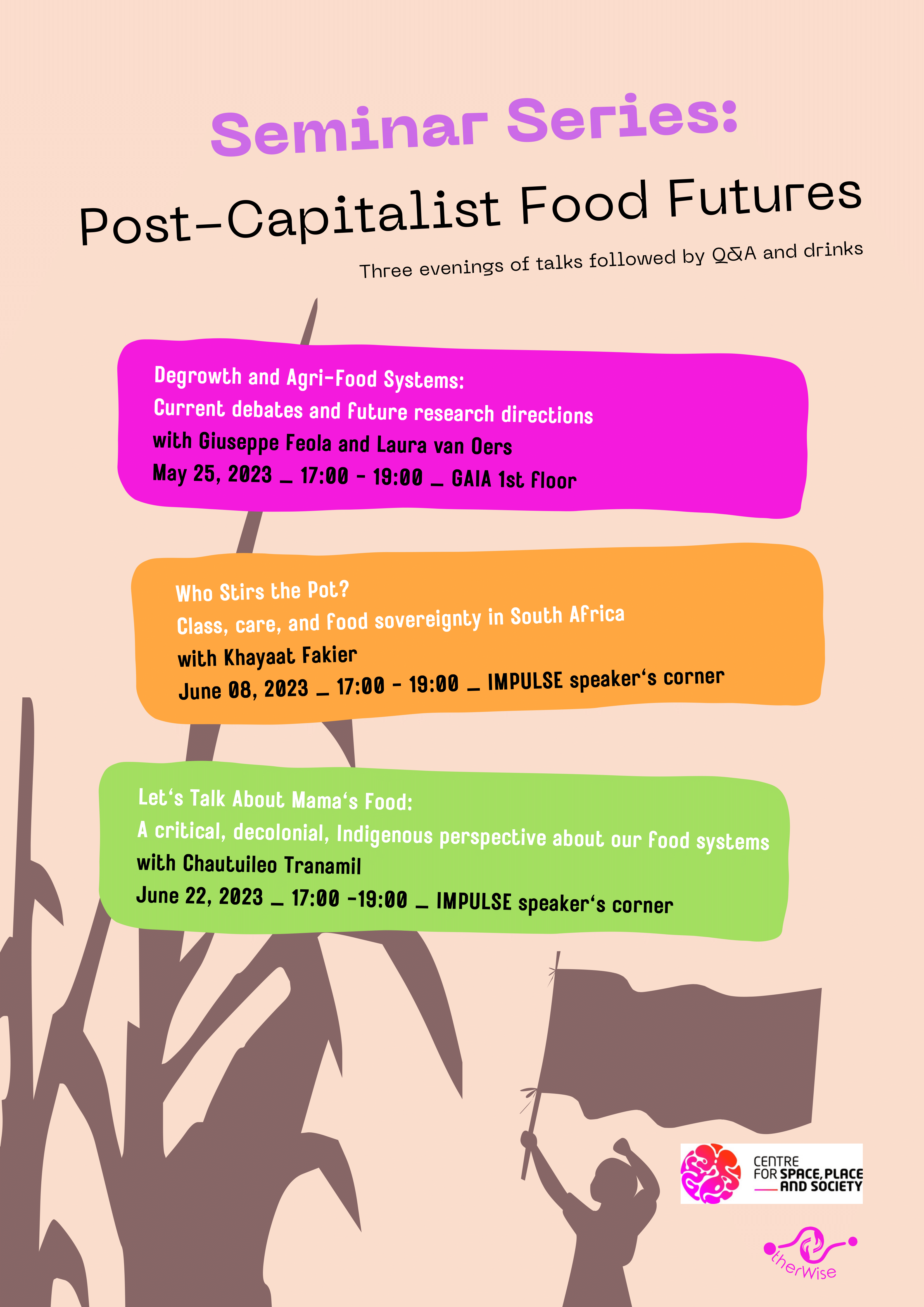
Postcapitalism seminar series

As part of our new course ‘Beyond Sustainability: Theorizing post- and anti-capitalist food futures’ (RSO58806), we are curating an evening seminar series where we will welcome scholars and activists engaged in reimagining food and society more generally. You are cordially invited to join us for the seminars!

New RSO student authored article on Ayurveda and commodification in Europe

Former RSO thesis student Marine Viale has had an article based on her thesis published in the Journal of Ayurveda and Integrative Medicine. The article’s title is Conserving traditional wisdom in a commodified landscape: Unpacking brand Ayurveda, and is co-authored with Mark Vicol from RSO. Fantastic to see a very good thesis leading to a peer-reviewed publication. You can read the full article here https://authors.elsevier.com/sd/article/S0975-9476(22)00126-7 and the abstract is pasted below.

Abstract

As Ayurveda continues to gain global recognition as a sanctioned system of health care, the essence of Ayurveda’s identity has become prey to commoditization and commodification for commercial undertakings in the holistic health milieu of India, but also in emerging markets such as Europe. This paper critically assesses the commodification of Ayurveda as a cultural signifier within Europe that separates the indigenous artefact from its Vedic origins. Often presented as an elite commodity in Western settings, Ayurveda has become embedded as a cultural artifact within consumer society as the epitome of holistic care with an emphasis on its spiritual attributes, yet simultaneously isolating it from the customary elements that motivated its inception. The paper argues that Ayurveda’s discursive detachment from its ontological tenets facilitates its rearticulation as a malleable experience as it crosses national boundaries, and in this process fosters the misinterpretation of the ancient healing tradition. This process may provide Ayurvedic treatments and principles with increased visibility in Europe’s health sector. However, brands are exploiting this niche with push-marketing strategies to capitalize on the budding Ayurveda industry, turning traditional medicines into emblematic commodities. To advance this argument, we examine product diversions in the commodification of classical Ayurvedic medicines in the Netherlands and Germany, focusing on the over-the-counter (OTC) segment. We present an interpretive analysis of the processes that are (de)constructing traditional practices and principles as Ayurveda travels beyond India, and how this complicates issues of authenticity and expertise as herbal medicines diverge from the indications ratified in Ayurveda’s classical compendiums.

NEW COURSE: Theorizing Post and Anti-Capitalist Food Futures (Period 6, 2022-2023)

Study handbook link https://studyhandbook.wur.nl/modules/RSO58806?mainTab=module&year=2022

Poster art: Luuk and Cristina from OtherWise.