Unknown's avatar

About Han Wiskerke

Chair and Professor of Rural Sociology at Wageningen University (The Netherlands) Research domains: rural development, multifunctional agriculture, city-region food systems

Foodprint Sitopia

Foodprint logoOn Monday 3 November Stroom Den Haag (an independent centre focusing on the urban environment from the visual arts, architecture, urban planning and design) organized a small workshop as part of its program entitled ‘Foodprint – food for the city”. Foodprint takes place over the course of several years and focuses on the influence food can have on the culture, shape and functioning of the city, using The Hague as a case study. With a series of activities Stroom aims to increase people’s awareness of the value of food and to give new life to the way we view the relationship between food and the city.

The Hungry CityThe Foodprint program commenced on 25 March 2009 with a lecture by Carolyn Steel, author of the book “The Hungry City: How Food Shapes Our Lives“. In this book she gives a beautiful account of the role of food in shaping urban development. In a nutshell she shows that the size and shape of cities were directly related to the amount and kinds of food that the rural hinterland could provide. For a long time this implied that there was a food provision related barrier to urban growth. However, with the introduction of modern production, transportation, processing, preservation and storage technologies, global agriculture became the city’s hinterland and thus the ‘natural barrier’ to urban growth disappeared. According to Carolyn Steel on her blog:

“One important consequence of this was that urban authorities began to loosen their grip on the food supply, relying more and more on commercial companies to feed the urban population. That might have seemed a good idea at the time, but the result today is that we are totally reliant on trans-national corporations to feed us, who have no civic responsibility and no interests at heart other than making money. That puts them in an extremely powerful position – especially when you consider how difficult it is to feed cities as large as those we now live in.”

Carolyn Steel shows, like others have done as well from complementary and partly overlapping perspectives (e.g. Tim Lang, Michael Pollan, James Howard Kunstler), that most contemporary urban dwellers have become disconnected from and ignorant about food provision and are too a large extent, if not completely, dependent on a global industrialized food provisioning system that is intrinsically unsustainable.

The Hungry City ends with a chapter about the future, in which the author asks how we can use food as a tool for re-thinking cities and the way we live in them. For this, she introduces the term Sitopia (a word based on a combination of the Greek words Sitos, meaning food, and Topos, meaning place, hence food-place):

“The world is already shaped by food, so we may as well start using food to shape the world more positively.”

At the workshop we (i.e. Carolyn Steel, people working at Stroom Den Haag, scientists of different universities, architects, etc…) mainly discussed ideas and exchanged information about ongoing activities that are in one way or the other related to the notion of Sitopia. For me it was very interesting to exchange visions and experiences with disciplines (in particular visual arts and architecture) I normally do not interact with in education or research. And there was a shared desire to find ways to really collaborate, for instance by participating in each other’s projects. Although no concrete future plans were made, I do believe that workshops like this as well as the sustainable food planning conference I organized a month ago are the seeds of new interdisciplinary networks focusing on sustainable urban/regional foodscapes.

To learn more about Carolyn Steel’s vision on food and the city, I highly recommend her recent talk at the TED conference in Oxford.
Sustainable Food Planning Conference

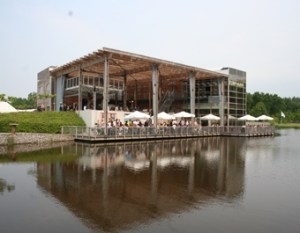
De KemphaanIn her recent blog, Petra already reflected on the Sustainable Food Planning Conference that was held in Almere (at De Kemphaan) on 9 and 10 October. My personal impression is that it was a very successful kick-off of the AESOP thematic group on sustainable food planning. In addition to lots of interesting presentations, there were interesting discussions and the strong will and desire among the participants to continue collaboration. One of the ways to continue collaboration is by means of an annual conference. Another is to create an electronic platform to facilitate exchange of experiences, examples, articles, reports, etc… Soon we will launch such a platform by means of a weblog similar to this one. For the time being, this post provides the links to the dowloads of the presentations and the discussion.

De Kemphaan, 9 and 10 October 2009, Almere, The Netherlands

The program
The participants
Presentation 1 Mr. Henk Mulder Including food and agriculture in urban planning: The Almere approach
Presentation 2 Prof. Han Wiskerke An integrated and territorial perspective on food studies, policy and planning
Presentation 3 Mr. Henk de Zeeuw Feeding the city: Practices, challenges and lessons from developing countries
Presentation 4 Prof. Gianluca Brunori Reconnecting consumers and producers: Dynamics, diversity and potentials of alternative food networks
Presentation 5 Dr Roberta Sonnino Urban food and public spaces: Planning for security and sustainability
Presentation 6 Dr Marin Caraher Food and the city: The links between food, public health and sustainable urban development
Presentation 7 Mrs. Lenie Dwarshuis Food and agriculture in Europe’s peri-urban regions
Presentation 8 Dr. Nevin Cohen The practice of food planning in New York City
Presentation 9 Mr. Bart Pijnenburg, MSc Amsterdam’s food strategy (“Proeftuin Amsterdam”)
Presentation 10 Prof. Jerry Kaufman Including food in planning studies and planning practices: Experiences from the USA
Report of the discussion

Delivering Animal Welfare and Quality: Transparency in the Food Production Chain

conference_audience[1]Last week (8 and 9 October) in Uppsala (Sweden) a conference about animal welfare was held. This event was the final stakeholder meeting of the EU-funded research project entitled ‘Welfare Quality’. Taking part in the project are researchers from many EU countries as well as Australia, Chile, Uruguay and other countries. Since 2004, they have been working on developing a system that will enable measurements of animal welfare levels. The conference focused on how the results of the project could be translated into practical action and how animal welfare can be improved at global level. In this project the Rural Sociology Group was responsible for the subproject on producers’ attitudes and practices with regard to animal welfare. The results were presented by Bettina Bock.

Food and urban planning

MorgenTomorrowLast week the municipality of Amsterdam, together with the Netherlands Institute for Planning & Housing and the Ministry of  Housing, Spatial Planning & the Environment, organized and hosted the International Urban Planning Conference entitled MorgenTomorrow. The two-day conference was a combination of plenary sessions in the morning and parallel workshops in the afternoon. I had the honour and pleasure of convening a workshop entitled ‘Food and the City’. Although the food system is, as Pothukuchi and Kaufman (2000) rightfully state in their article in the Journal of the American Planning Association, a stranger to the field of urban planning it was good to see that the conference organizers had put food very prominently on the conference agenda. Not only by means of the workshop I convened but also by means of keynote lectures in the plenary sessions by LaDonna Redmond and Tim Lang. Both are extremely critical about the prevailing food system.

LaDonna is a community activist as well as founder and CEO the Institute for Community Resource Development (ICRD) in Chicago (Illinois). The ICRD’s mission is to rebuild the local food system by building grocery stores that bring access to sustainable products to urban communities of color, organizing farmers markets, converting vacant lots to urban farm sites and distributing local grown produce to restaurants. I was unable to attend LaDonna Redmond’s keynote, but she participated in my workshop and reflected on the different presentations.

Tim is Professor of Food Policy at the Centre for Food Policy of City University London. He has authored and co-authored many articles and books about food policy, especially focussing on the relation between food, health, social justice and the environment. His current work is about ‘omni-standards for sustainable diets’. I attended his keynote lecture and what I very much appreciated about his vision is that, despite the food system being a major contributor to climate change, devising sustainable food systems is not simply a matter of creating ‘climate neutral’ food systems. It will only be truely sustainable if it is able to meet a whole range of sustainability standards (a set of omni-standards as he calls them) in which social and health aspects are as important as economic and environmental ones. What struck me most in his presentation, and which will undoubtedly become the new issue in food debates, is the water footprint of the conventional food system.

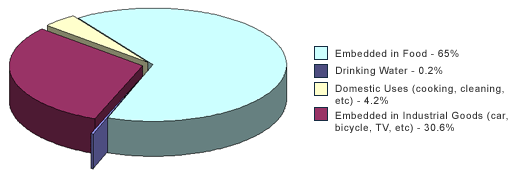
Around 65% of all fresh water is used for food production and with growing water scarcity and an increase in water-stressed countries, water use is likely to become the main threat for food production. The table below, of which Tim displayed a part in his presentation, is rather shocking. It shows how much water is needed to produce one portion of a whole range of mainly food products and drinks. It surely makes one (at least is does make me) aware of the urgent need for change.

Portion Litres Portion Litres Portion Litres
Pint of beer, 568ml 170 Cup of coffee, 125ml 140 Glass of orange juice, 200ml 170
Glass of milk, 200ml 200 Cup of instant coffee, 125ml 80 Glass of apple juice, 200ml 190
Cup of tea, 250ml 35 Glass of wine, 125ml 120 Orange, 100g 50
Slice of bread, 30g 135 Bread with cheese, 30g + 10g 90 Bag of potato crisps, 200g 185
Egg, 40g 135 Tomato, 70g 13 Hamburger, 150g 2400
Potato, 100g 25 Apple, 100g 70 Bovine leather shoes 8000
Sheet of A4, 80 g/m² 10 Cotton tee-shirt, medium 500g 4100 Microchip, 2g 32
Source: http://www.igd.com/index.asp?id=1&fid=1&sid=5&tid=48&cid=326

Eten van dichtbij

Werkplaats 10 - Eten van dichtbij

Werkplaats 10 - Eten van dichtbij

Vorige week verscheen een nieuwe uitgave van het blad “Werkplaats voor de Leefomgeving” van de Koninklijke Nederlandse HeideMaatschappij (KNHM). Deze 10e uitgave van dit blad heeft als thema “Eten van dichtbij” en gaat onder meer over stadsboeren, pergolabedrijven, stad-plattelandrelaties en publieke sector catering. Verder bevat het tal van korte beschrijvingen van en web-links naar initiatieven over regionale voedselvoorziening uit zowel Nederland als andere landen. De diversiteit aan activiteiten en benaderingen is zonder meer indrukwekkend. Voor een ieder die geïnteresseerd is in verschillende vormen en aspecten van regionale voedselvoorziening en/of stad-platteland relaties biedt dit themanummer een informatief en toegankelijk overzicht.