Unknown's avatar

About Han Wiskerke

Chair and Professor of Rural Sociology at Wageningen University (The Netherlands) Research domains: rural development, multifunctional agriculture, city-region food systems

Know your farmer, know your food

Recently I joined a Dutch internet Sustainable Food group. Today the convenor of this group informed the members about a new initiative of the USDA (United States Department of Agriculture): “Know your farmer, know your food”. The aim of this USDA initiative is to help more Americans understand where their food comes from and how they can support local food economies in their communities. The initiative was announced by USDA secretary Tom Vilsack in a YouTube video:

“An American people that is more engaged with their food supply will create new income opportunities for American agriculture. Reconnecting consumers and institutions with local producers will stimulate economies in rural communities, improve access to healthy, nutritious food for our families, and decrease the amount of resources to transport our food.”

While the White House kitchen garden and Obama’s idea to have a weekly farmers’ market at the White House (see my blog posted on 4 September) could have been perceived as ‘window dressing’, this USDA initiative surely gives the impression that the Obama administration is seriously attempting to fundamentally change US agrofood and rural development policy. Will, in this case, Obama’s campaign slogan – “Yes, we can” – become true?

Sustainable food planning conference – reminder & update

As mentioned in my blog of 28 August 2009 the Association of European Schools of Planning (AESOP), the International Studygroup on Multiple Use of Land (ISOMUL) and the Rural Sociology Group are hosting the first European Sustainable Food Planning conference. The conference will take place at De Kemphaan in the city of Almere in the Netherlands on 9 and 10 October 2009. It is still possible to register for this conference. If you are interested to participate in this conference, please apply by e-mail to corine.diepeveen@wur.nl. Costs for participation are € 100,- (incl. drinks, lunches and diner).

City estate De Kemphaan

Since the first announcement a couple of weeks ago, the conference programme has changed slightly. Below you can find the most recent version of the programme:

Day 1 – Generating ideas, exchanging experiences and comparing perspectives

09.00 – 09.30

Welcome and coffee/tea

09.30 – 09.45 Food and planning: an introduction to the conference Prof. Kevin Morgan (Professor of Governance & Development, Cardiff University, UK)
09.45 – 10.00 Including food and agriculture in urban planning: the Almere approach Mr. Henk Mulder (director urban planning Almere)
10.00 – 11.00

Session 1: Setting the scene

10.00 – 10.30 An integrated and territorial perspective on food studies, policy and planning Prof. Han Wiskerke (Chair of Rural Sociology – Wageningen University, Netherlands)
10.30 – 11.00 Feeding the city: practices, challenges and lessons from developing countries Mr. Henk de Zeeuw (director of the RUAF Foundation)
11.00 – 11.30

Coffee/tea break

11.30 – 13.00

Session 2: Theoretical perspectives and academic issues

11.30 – 12.00 Reconnecting consumers and producers:  dynamics, diversity and potentials of alternative food networks Prof. Gianluca Brunori (Professor of Agriculture Economics – Pisa University, Italy)
12.00 – 12.30 Urban food and public spaces: planning for security and sustainability Dr. Roberta Sonnino (Lecturer in Environmental Planning – Cardiff University, UK)
12.30 – 13.00 Food and the city: the links between food, public health and sustainable urban development Dr. Martin Caraher (Reader in Food & Health Policies – City University London, UK)
13.00 – 14.00

Lunch break

14.00 – 15.30

Session 3: Food planning practices and policies

14.00 – 14.30 Food and agriculture in Europe’s peri-urban regions Mrs. Dwarshuis (President of Peri-Urban Regions Platform Europe – PURPLE)  
14.30 – 14.50 The practice of food planning in New York city Dr. Nevin Cohen (Associate Professor in Urban Studies – New School for Liberal Arts, New York)
14.50 – 15.10 The practice of food planning in New York state Mr. Bob Lewis (senior planner New York State)
15.10 – 15.30 Amsterdam’s food strategy (“Proeftuin Amsterdam”) Mr. Bart Pijnenburg MSc (Programme manager Proeftuin Amsterdam)
15.30 – 16.00

Coffee/tea break

16.00 – 18.00 Excursion to City Farm Almere Tineke van den Berg (urban farmer)
19.30 – 22.30

Diner (Restaurant De Kemphaan – Almere)

Day 2 – Towards an agenda for sustainable food planning

09.00 – 09.30

Welcome and coffee/tea

09.30 – 10.00 Including food in planning studies and planning practices: experiences from the USA Prof. Jerry Kaufman (Professor Emeritus of Urban and Regional Planning – University of Wisconsin-Madison, USA)
10.00 – 10.45 Issues, topics, themes for a sustainable food planning agenda (plenary inventory) Moderated by Prof. Arnold van der Valk (Chair of Land Use Planning – Wageningen University, NL)
10.45 – 11.15

Coffee/tea break

11.15 – 12.45 Developing the building blocks for a sustainable food planning agenda (parallel working sessions)
12.45 – 14.00

Lunch break

14.00 – 14.45 Plenary presentation of and discussion about results of parallel working sessions Moderated by Prof. Terry Marsden (Professor of Environmental Planning – Cardiff University, UK)
14.45 – 15.00 Sustainable food planning in Europe: concluding reflection and look ahead Prof. Kevin Morgan (Professor of Governance & Development, Cardiff University, UK)
15.00

Coffee & tea / end of conference


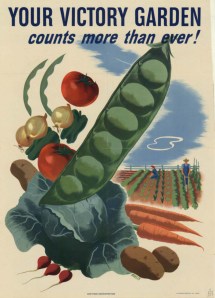
Victory Gardens revisited – the Obama Foodscape

US World War II era poster promoting Victory Gardens (source: http://www.art.unt.edu/ntieva/pages/about/newsletters/vol_15/no_1/WarPosterImages.htm)

US World War II era poster promoting Victory Gardens

Victory Gardens, also known as ‘war gardens’ or ‘food gardens for defense’ were fruit, vegetable and herb gardens planted in backyards and on rooftops in the USA, the UK, Canada and Australia during World War II. They were considered to be an important means to reduce the costs for vegetables needed by the US War Department to feed the troops and to safeguard food security. One of the advocates of the Victory Garden was Eleanor Roosevelt, US first lady from 1933 to 1945, who also planted a Victory Garden at the White House. The Victory Gardens were a great success: the 20 million Victory Gardens in the US produced up to 40% of all vegetables that were consumed in the US.

After World War II the number of Victory Gardens rapidly decreased as most citizens believed that food shortages would be over soon. However, in recent years there is a campaign to re-establish Victory Gardens. Not to reduce the price of vegetables needed to feed US troops, but primarily from the perspective of food sovereignty; as a means to escape the growing dependence of consumers on the food stuffs provided by the food processing industries and retailers. At the same time gardening is also considered to be an important instrument in greening cities, in growing sustainable communities and in educating children about food and healthy eating (see e.g. our recent blogs about urban agriculture and nourishing the city).

For such a movement to become a success it is always helpful to have a leading figure as an icon. It seems that the USA’s new first family, in particular first lady Michelle Obama, is taking on this role. For the first time since the Roosevelt days, the White House once again as a garden. This beautiful short movie gives a good impression of the White House kitchen garden and the rationale behind it. 

However, there is more to food and the Obama’s than the White House kitchen garden only. Recently President Obama  announced that he wants to set up a White House farmers market to support local farmers and as an example of creating new connections between cities and its surrounding countryside. Interested to be informed about  the Obama Foodscape, have a look at the  Obama Foodorama weblog.

Multifunctional Agriculture miniconference

On Thursday 8 October 2009 we are organizing a miniconference about multifunctional agriculture (recently also announced in Dutch). This event is part of a two year research project entitled ‘Dynamics and Robustness of Multifunctional Agriculture’ and is funded by the Ministry of Agriculture, Nature & Food Quality. Aim of this conference is to examine what we can learn from experiences in other countries to enhance the development of multifunctional agriculture in the Netherlands. Four speakers will talk about (aspects of) multifunctional agriculture in different countries: Italy, United Kingdom, Norway, Brazil and China.

Mariënwaerdt (source: http://www.marienwaerdt.nl/)

Mariënwaerdt (source: http://www.marienwaerdt.nl/)

The miniconference will be held at Rural Estate Mariënwaerdt and participation is free of charge. All presentations as well as the discussion will be in English. If you are interested to participate, please apply by sending an e-mail to corine.diepeveen@wur.nl. You can also use this e-mail address for any queries about the miniconference.


Dynamics and Robustness of Multifunctional Agriculture – Lessons from Abroad

 Thursday 8 October 2009

 Rural Estate Mariënwaerdt, De Hooge Schuur, ‘t Klooster 5 in Beesd

12.30 – 13.00

Welcome and coffee/tea

13.00 – 13.05 Conference opening by the chairman Krijn Poppe – Chief Science Officer Agro-chains and fisheries, Ministry of Agriculture, Nature & Food Quality
13.05 – 13.15 The multifunctional conference setting – a short introduction to Rural Estate Mariënwaerdt     Frans van Verschuer – Owner of Rural Estate Mariënwaerdt
13.15 – 13.30 Dynamics and robustness of multifunctional agriculture – introducing the project and presentation of the first results Han Wiskerke – project coordinator and Professor of Rural Sociology, Wageningen University
13.30 – 14.00 Multifunctional agriculture in Italy – the rural district approach in Tuscany Gianluca Brunori – Professor of Agricultural Economics, Pisa University, Italy
14.00 – 14.30 Multifunctional agriculture in the UK – the role of the state and the public sector Roberta Sonnino – Lecturer in Environmental Policy & Planning, Cardiff University, United Kingdom
14.30 – 15.00 Multifunctional agriculture in Norway – the relation between multifunctional agriculture and sustainable rural community development Katrina Rønningen – Senior Researcher at the Centre for Rural Research, Trondheim, Norway
15.00 – 15.30

Coffee/tea break

15.30 – 16.00 Agrarian and rural development dynamics across the globe – comparing Europe, China and Brazil Jan Douwe van der Ploeg – Professor of Transition Studies, Wageningen University
16.00 – 16.55 Debate: inspiring lessons for multifunctional agriculture in the Netherlands
16.55 – 17.00 Conference closing by the chairman
17.00

Drinks

Sustainable food planning conference

AESOP logoOn 9 and 10 October 2009 the first Sustainable Food Planning Conference will be held. This conference is an initiative of the AESOP (Association of European Schools of Planning), the ISOMUL (International Studygroup On Multiple Use of Land) and the Rural Sociology Group of Wageningen University.

The sustainable food planning conference is organized to examine the role of food in urban and regional planning. Although political, societal and academic interests in food and the city are rapidly increasing, food largely remains a stranger to the field of urban and regional planning, spatial planning policies and planning studies. Recently the American Planning Association launched its Policy Guide on Community and Regional Food Planning. Inspired by this policy guide, this conference seeks to explore ways in which food can and should be incorporated in planning practices, policies and research and develop strategies for enhancing sustainable food planning in Europe. The character of the conference is primarily agenda-setting by establishing a network of planning practitioners, policymakers and agrifood and planning scholars in Europe and beyond.

.

Restaurant and meeting centre De Kemphaan (source: http://www.restaurantdekemphaan.nl/content/ons_bedrijf)

Restaurant and meeting centre De Kemphaan (source: http://www.restaurantdekemphaan.nl/content/ons_bedrijf)

The conference will take place at De Kemphaan in the city of Almere in the Netherlands. If you are interested to participate in this conference, please apply by e-mail to corine.diepeveen@wur.nl. Costs for participation are € 100,- (incl. drinks, lunches and diner). The number of participants is limited to 50 persons. For more information have a look at the conference programme below:


Day 1 – Generating ideas, exchanging experiences and comparing perspectives

09.00 – 09.30

Welcome and coffee/tea

09.30 – 09.45 Food and planning: an introduction to the conference Prof. Kevin Morgan (Professor of Governance & Development, Cardiff University, UK)
09.45 – 10.00 Including food and agriculture in urban planning: the Almere approach Mr. Henk Mulder (Almere municipality – director urban development and planning) 
10.00 – 10.30 An integrated and territorial perspective on food studies, policy and planning Prof. Han Wiskerke (Chair of Rural Sociology – Wageningen University, NL)
10.30 – 11.00

Coffee/tea break

11.00 – 12.00

Session 1: Agri-food policy issues

11.00 – 11.30 Food and agriculture in Europe’s peri-urban regions Mrs. Dwarshuis (President of Peri-Urban Regions Platform Europe – PURPLE)
11.30 – 12.00 Feeding the city: practices, challenges and lessons from developing countries Mr. Henk de Zeeuw (director RUAF foundation)
12.00 – 13.00

Session 2: Urban food planning practices

12.00 – 12.20 The practice of food planning in New York City Dr. Nevin Cohen (Associate Professor in Urban Studies at the New School for Liberal Arts, New York
12.20 – 12.40 The practice of food planning in New York State Mr. Bob Lewis (Senior Planner New York State)
12.40 – 13.00 Amsterdam’s food strategy (“Proeftuin Amsterdam) Mr. Bart Pijnenburg(Programme manager Proeftuin Amsterdam)
13.00 – 14.00

Lunch break

14.00 – 15.30

Session 3: Theoretical perspectives and academic issues

14.00 – 14.30 Reconnecting consumers and producers:  dynamics, diversity and potentials of alternative food networks Prof. Gianluca Brunori (Professor of Agriculture Economics – Pisa University, Italy)
14.30 – 15.00 Urban Food and Public Spaces: Planning for Security and Sustainability Dr. Roberta Sonnino (Lecturer in Environmental Planning – Cardiff University, UK)
15.00 – 15.30 Food and the city: the links between food, public health and sustainable urban development Dr. Martin Caraher (Reader in Food & Health Policies, City University London, UK)
15.30 – 16.00

Coffee/tea break

16.00 – 18.00 Excursion to City Farm Almere Tineke van den Berg (urban farmer)
19.30 – 22.30

Drinks & Diner

Day 2 – Towards an agenda for sustainable food planning

09.00 – 09.30

Welcome and coffee/tea

09.30 – 10.00 Including food in planning studies and planning practices: experiences from the USA Prof. Jerry Kaufman (Professor Emeritus of Urban and Regional Planning – University of Wisconsin-Madison, USA)
10.00 – 10.45 Issues, topics, themes for a sustainable food planning agenda (plenary inventory) Moderated by Prof. Arnold van der Valk (Professor of Land Use Planning – Wageningen University, The Netherlands)
10.45 – 11.15

Coffee/tea break

11.15 – 12.45 Developing the building blocks for a sustainable food planning agenda (parallel working sessions)
12.45 – 14.00

Lunch break

14.00 – 14.45 Plenary presentation of and discussion about results of parallel working sessions Moderated by Prof. Terry Marsden (Professor of Environmental Policy – Cardiff University, UK)
14.45 – 15.00 Sustainable food planning in Europe: concluding reflection and look ahead Prof. Kevin Morgan (Professor of Governance & Development, Cardiff University, UK)
15.00

Coffee & tea / end of conference