Unknown's avatar

About Han Wiskerke

Chair and Professor of Rural Sociology at Wageningen University (The Netherlands) Research domains: rural development, multifunctional agriculture, city-region food systems

Good food nation: reversing obesity via local food systems

Recently the Massachusetts Institute of Technology (MIT) and Columbia University published the results of a study on reversing America’s obesity epidemic by reorganising the system of food production, processing and distribution. According to the researchers obesity is widespread due to the national-scale system of food production and distribution, which surrounds children — especially lower-income children — with high-calorie products. Up to 90% of American food is processed, which contains ingredients, often acting as preservatives, that can make food fattening. The MIT and Columbia researchers propose a solution:

 America should increase its regional food consumption. Each metropolitan area, the researchers say, should obtain most of its nutrition from its own “foodshed,” a term akin to “watershed” meaning the area that naturally supplies its kitchens. Moreover, in a novel suggestion, the MIT and Columbia team says these local efforts should form a larger “Integrated Regional Foodshed” system, intended to lower the price and caloric content of food by lowering distances food must travel, from the farm to the dinner table.

For more information, you can read the complete press release by MIT or go the online project results.

1 Billion Hungry

One billion people live in chronic hunger. In the time it takes to watch this video, two children will die of hunger. If this situation is unacceptable to you, sign on http://www.1billionhungry.org

The Food and Farming Transition: Toward a Post Carbon Food System

More and more scientists are pointing to the fact that the end of the cheap oil era will require us to fundamentally change the prevailing current food and agricultural system; a system that has become addicted to and dependent on fossil fuels. This week I came across a report entitled “The Food and Farming Transition: Toward a Post Carbon Food System” published by the Post Carbon Institute earlier this year.  Although the report focuses on the United States, its contents applies to many other parts of the world as well. In this well accessible and readable report the authors not only point to the key vulnerabilities of a food system resting on an unstable foundation of massive fossil fuel inputs but also to the seeds of transition toward a post carbon food system:

The seeds of the new food system have already been planted. America’s farmers have been reducing their energy use for decades. They are using less fertilizer and pesticide. The number of organic farms, farmers’ markets, and CSA operations is growing rapidly. More people are thinking about where their food comes from.

These are important building blocks, but much remains to be done. Our new food system will require more farmers, smaller and more diversified farms, less processed and packaged food, and less long-distance hauling of food. Governments, communities, businesses, and families each have important parts to play in reinventing a food system that functions with limited renewable energy resources to feed our population for the long term.

Food, agriculture and cities

Recently the Food and Agricultural Organisation (FAO) has published a brochure and briefing note about food and agriculture in and around cities. Like many international public bodies, national governments and NGOs the FAO is concerned about the social, economic, ecological and health consequences of the concentration of the world’s population in and around large cities. In the brochure the FAO states that there is an urgent need to invest in urban food programmes: 

The 4th World Urban Forum cited the need for policies and interventions to ensure that the increasing number of urban poor do not get left behind. The food dimension of poverty in urban areas still has not been translated into sufficient policy action in many countries. Rural-urban linkages will become increasingly important. Urban policies also need to acknowledge the role of urban and peri-urban agriculture in urban development, ensure urban food supply and strengthen livelihoods of poor urban producers. This includes removing barriers and providing incentives for urban and peri-urban agriculture (UPA) as well as improving natural resource management in urban and peri-urban areas. … A paradigm shift in both urban and agriculture development, planning and policy formulation is required in order to ensure access to urban food security, improved environmental management and enhanced rural-urban linkages.

In order to broaden the approaches and to gather new insights for cities both of developing, intermediate or developed countries,  the FAO’s Global Forum on Food Security and Nutrition (FSN Forum) has opened a debate which is, in terms of contributing to the debate, only open for FSN forum members. However, everyone can read contributions to the debate. Furthermore, for those interested in this topic, I can highly recommend the website of the FAO’s Food for the Cities Initiative. It contains a lot of interesting fact sheets and publications about the multiple aspects related to food, agriculture and cities.

Stadslandbouw in perspectief – Tilburg als voorbeeld

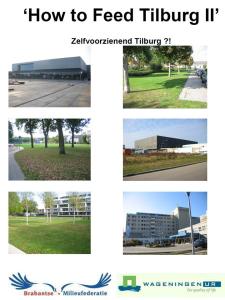
Cover Zelfvoorzienend TilburgEen groep studenten van Wageningen Universiteit heeft in opdracht van de Brabantse Milieufederatie een kort onderzoek uitgevoerd naar de mogelijkheden om het aantal voedselkilometers in de gemeente Tilburg te reduceren. Dit onderzoek is een vervolg op een eerdere verkenning van een andere groep Wageningse studenten naar voedselconsumptie in Tilburg, waarover ik op 24 april een blog schreef. De effecten van het toepassen van volkstuinen in de gemeente en de huidige voedselconsumptie van inwoners zijn hierin onderzocht. De afgelopen weken heb ik deze groep begeleid. Het rapport dat zij hebben gemaakt n.a.v. hun onderzoek is via deze link te downloaden. De belangrijkste uitkomsten van hun onderzoek zijn samengevat in de vorm van een persbericht:

Duizenden inwoners van de gemeente Tilburg kunnen worden voorzien in de jaarlijkse behoefte aan groenten en fruit door het aanleggen van volkstuinen in verschillende woonwijken. Door grasvelden rondom flatgebouwen en andere gebouwen te gebruiken als volkstuin zijn de bewoners in staat, dichtbij huis hun eigen (biologische) voedsel te verbouwen.

Voedselkilometers, het aantal kilometers afgelegd door voedsel, zijn in de gemeente Tilburg onnodig hoog. Aardappelen, appels, tomaten en melk worden buiten de grenzen van de gemeente gehaald. De CO2 uitstoot van het geconsumeerde voedsel is derhalve zeer groot. Door een tekort aan land- en tuinbouwgrond in de gemeente Tilburg is het echter niet mogelijk om in de toekomst in de gehele consumptie van de bewoners van de gemeente Tilburg te voorzien. Het vergroten van de mate van zelfvoorziening door een aanpassing van de benutting van de land- en tuinbouwgrond en het uitgeven van extra grond voor de verbouwing van aardappelen, groente en fruit, verkleint de CO2 uitstoot aanzienlijk.

 “Urban agriculture”, het verbouwen van aardappelen, groente en fruit binnen de grenzen van de stedelijke omgeving kan toegepast worden voor het verminderen van het tekort aan land- en tuinbouwgrond. De gemeente Tilburg beschikt binnen de stad over een groot aantal hectare grond geschikt voor de verbouwing van aardappelen, groente en fruit op volkstuinen.

Grasvelden en platte daken in woonwijken kunnen worden toegepast voor de verbouwing van aardappelen, groente en fruit. Buurtbewoners zijn hierdoor in staat om lokaal verbouwde producten te consumeren en de CO2 uitstoot aanzienlijk te verminderen. In totaal kunnen ruim 5100 bewoners jaarlijks worden voorzien in de voedselconsumptie van aardappelen, groente en fruit door het toepassen volkstuinen in woonwijken. Dit is meer dan zes keer de stadsschouwburg Tilburg vol.