Het is al weer 50 jaar geleden dat de Boerengroep[1] werd opgericht in een roerige tijd van grootschalige boerenprotesten. Een Europese demonstratie van boeren in Brussel op 23 maart 1971 liep uit op een confrontatie met de politie. Er gingen tientallen auto’s in vlammen opgingen en één boer vond de dood (klik op deze link voor een nieuwsverslag over deze betoging uit 1971)[2]. De demonstratie maakte duidelijk dat er onder boeren en boerinnen grote ontevredenheid was over het gevoerde Europese landbouwbeleid. Continue reading
Category Archives: Agriculture
Boerengroep 50 years: kick off. Farmers’ Protests with emeritus prof. Jan Douwe van der Ploeg
It has been 50 years since De Boerengroep (The Peasant Foundation) was founded in a turbulent time of large-scale farmer protests. A European farmers’ demonstration on March 23, 1971 rocked Brussels. Against this background of protests, the Boerengroep was established. Celebrating 50 years, De Boerengroep will organize a series of events. Monday, February 15 they will kick off with a seminar about farmer protests then and now.
You can still register through this link: https://forms.gle/DhYqsbTMR3RQr2Ta7
February 15, 19.30-21.00: Speakers
Jan Douwe van der Ploeg, one of the founders of the Boerengroep, and emeritus professor in Rural Sociology, he devoted a large part of his career to research on the “New Peasantries”. Currently, he is Adjunct Professor at COHD at CAU in Beijing, a member of the Board of Agroecology Europe and of the Advisory Board of the Northern Frisian Woodlands Territorial Cooperative.
Tim van der Mark, board member NAJK Pigs, poultry and calf husbandry.
Roel During, researcher at the Biodiversity and Policy team within Environmental research in WUR, expert on cultural history and resistance.
Comparing pathways towards sustainability: Lessons on transformative agency from three pioneering farms in Europe – MSc-thesis by Samuel van Rozelaar

Samuel van Rozelaar is a Master student Organic Agriculture has recently completed an excellent and beautifully illustrated MSc-thesis on the transformative agency of three pioneering farmers, all members of the lighthouse farms network, and meticulously reconstructed their transition pathways towards sustainable farming systems. ‘Comparing pathways towards sustainability: Lessons on transformative agency from three pioneering farms in Europe‘ can be downloaded (click on hyperlink). Below the abstract.
Abstract
This thesis offers lessons on the transformative agency of the farmers behind three pioneering farms. This is done by comparing the transformative strategies they applied in relation to the three-fold embedding of their farms, throughout their pathways towards more sustainable farming systems. To reconstruct these pathways semi-structured interviews and pathway mapping exercises were conducted with the main actors on each farm. This data was then coded, categorized and grouped in dimensions that allowed for a comparison of the interplay between strategies and embedding. The resulting 8 lessons show that these farmers persevered in developing, adapting, and moving towards their dreams and visions, despite many critical moments, by applying a range of transformative strategies. Through these strategies they managed to transform their farms in terms of its practices and relations. Throughout this process of transformation, the farmers continuously moved through a learning process, and as such also personally transformed in terms of thinking and doing, which in turn further enhanced their transformative capacities and strategies. Finally, the lessons show that these farmers have managed to create and navigate complex sustainable farming systems by tapping into the knowledge, skills, and resources of others. This shows the significance of the co-creation of contextual knowledge and the capacities to apply it in the transformation towards sustainable food systems. For future research, it is recommended to test to what extent these lessons resonate with other pioneering farms, but also with conventional farms. In addition, it is worth comparing family farms with non-family farms in their transformations towards sustainable farming systems, with a focus on intergenerational differences. In doing so, the frameworks of resilience of social-ecological systems and the adaptive cycle of transformations could be highly useful. Lastly, future research into transformations should also include the role of the relations to non-humans.
75th Anniversary: 17) Multifunctional farming in development: education at the care farm
Multifunctional farming (an umbrella term to indicate a combination of agriculture and services to society, wur.nl) has been a research subject for the Rural Sociology Group for decades, as multifunctionality is one of the diversification strategies employed by farming to sustain their farms and connect with various groups in society such as consumers or tourists. The first multifunctional activities were nature conservation, agritourism/recreation, care farming, farm shops/short chains, farm education and agricultural day care. These activities, however, are subject to constant change. This leads to new research topics and new collaborations for the Rural Sociology Group. Continue reading
75th Anniversary: 16) Meaningful Diversity: Origins of the Farming Style Concept

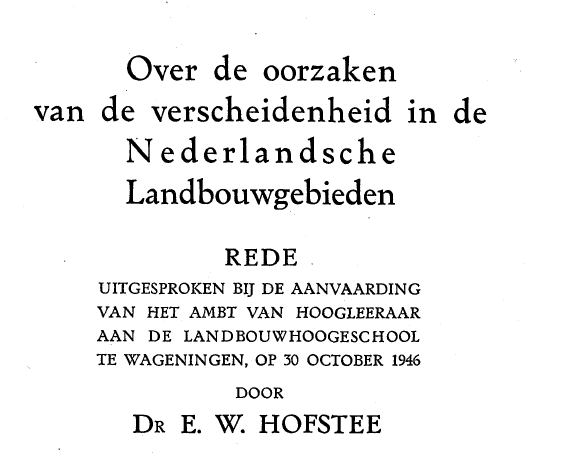
Part of the front cover of Hofstee’s inaugural lecture “On the causes of diversity in agricultural areas in the Netherlands” (1946)
E.W. Hofstee’s interest in the concrete, the lived, and the particular marked his inclination towards an “inductive” research methodology. He combined in-depth descriptions of social groups with a comparative approach (Hofstee 1938: 7-8). This grounded theoretical approach yielded the concept of farming styles in agricultural production. A farming style can be defined as shared normative and strategic ideas about how farming should be done (see also Blog 10). Hofstee’s concept of farming style implied an important analytical inversion: one should not try to understand the practice of farming from the structural conditions to which the farmers responds but rather move to the center of our analysis the agency of farmers as creative actors. Hofstee thought that rural sociology should emancipate itself from structuralist and functionalist “adjustment sociology,” as the understanding of rural life in terms of an adaptation to “order” was not only narrow and incomplete but also wrong: it erased the agency of people in the creation of the world they inhabit (see also Blog 14). Continue reading