
This is a 16-min video about the developments in farming in Long Island. Having great soils and an agriculture history, the setting lends itself for farming activities. However, land prices are a clear barrier for newcomers. The video also talks about new farmers trying to make it in the agricultural world from making a living, facing their romanticized preconceptions of life as a farmer, to breaking stereotypes of who can be a farmer.
Category Archives: Agriculture
Meat: the good, the bad and the complicated
By Birgit Boogard, former RSO-staff member, now Post-doctoral fellow at the International Livestock Research Institute (ILRI) currently working on the imGoats project that has the objective to: ‘increase incomes and food security in a sustainable manner by enhancing pro-poor small ruminant value chains in India and Mozambique’. (b.boogaard@cgiar.org).
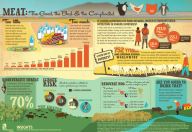
Meat: the good, the bad and the complcicated (IFPRI Infographic)
The International Food Policy Institute recently published an interesting info-graphic on meat production and consumption in the world entitled ‘Meat: the good, the bad and the complicated’ . The debate about meat production and consumption is a very interesting one in many ways. I don’t need to remind us of the recent discussion at Wageningen UR on ‘the good’ of intensified animal production ‘to feed the world’. In response to such arguments, ‘the bad’ are brought into the debate (see for example earlier blog by Petra), which are subsequently answered by the animal production sector with defensive responses. Continue reading
Set-up vegetable farm: Internship at PeerGroup
Set up of small-scale vegetable farm in Donderen – Province of Drenthe
Location: the headquarters of the PeerGroup, Depot Donderen. The vacated ammunition Depot Donderen was built in the time of the Cold War and is working space of the PeerGroup since January 2011. The bunker complex sits in a small forest and has several ammunition buildings of varying sizes with open space in between. The PeerGroup shares the grounds with care farm Peest. The site, with the neighbouring farms is popularly called ‘Donderboerkamp’.
Commissioner: PeerGroup, a theatrical group that specializes in site-specific theatre in the northern provinces of the Netherlands working with themes of, in and for rural communities.
 The PeerGroup is looking for a student who relates to the creative energy of the artist community of PeerGroup while bringing along collaborative skills, agro-ecology knowledge and an open mind for co-creation and learning. The student will be selected on the basis of an intake on the site. The student develops a plan and makes it happen with the support of the PeerGroup. The student can live on-site during the internship.
Applications with a motivation letter: Petra.derkzen@wur.nl
Food myhts Busted – do we need industrial agriculture to feed the world?
In the light of the debate on how to feed the world’s growing population and what type of agriculture is needed, a video by the Food Myth Busters takes a firm position: we do not need corporate agriculture, actually we are even better of without it. In the video they demystify claims upholded by corporate businesses with some facts. I’m however sure that these are not the facts the CEO of Wageningen UR has in mind when proclaiming that further intensification of agriculture is needed (in fact he is arguing for a further industrialization of agriculture according the famous Dutch model and promoting a joint venture of corporate business and science, ergo: corporate science) to secure food provision for 9 billion people. Have a look yourself and make up your mind:
Rhetorical devices in feeding the world
Recently there were two food events here, a university run Food4you series of events and a series organised by critical student organisations Boerengroep and Otherwise called Food for All. The very different approaches to food are captured in their titles. The latter series finished yesterday on World Food Day with the Dutch premiere of the film Crops for the Future. An instructive film about agroecology practices and food sovereignty from all over the world. Examples from the field were backed up with interviews with the Special Rapporteur on the Right to Food , with an author of the Agriculture at a Crossroads report and others. The message; we urgently need to move to another paradigm, the coming century is one of biology/diversity instead of chemistry. Still, it seems that the protagonists of a gone-by era are capable of organising a stage for themselves, the PR machine of Louise Fresco seems overheated. What are their rhetorical devices? Continue reading

