International Master Sciences of Rural Development (IMRD) – Application open till March 15 2015

IMRD Programme

IMRD Programme

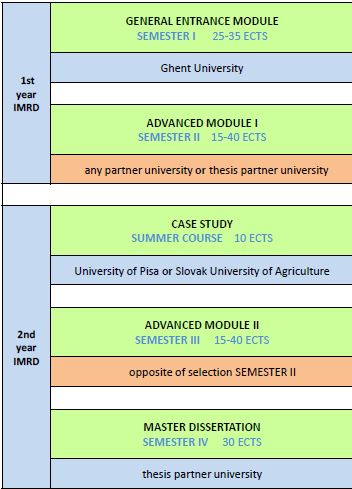
Wageningen University is partner is the International Master of Science in Rural Development (IMRD) and providing an advanced module in Sociology of Rural Development in the 3rd semester.  Students can subsequently do their MSc-thesis in Wageningen. Till March 15 2015 students can apply for a scholarship. See the IMRD website for more information.

Origin Food: a market for identity – course starts March 16 2015

Monday March 16 2015 we will again start with the course RSO-21806 Origin Food: a market for identity.

Montbeliarde cheese made by the Meester Affineurs nearby Wageningen

Montbeliarde cheese made by the Meester Affineurs nearby Wageningen

The main aim of the course is to provide for a broad and scientific understanding of the growing importance of food products with an indication of origin within the globalising agro-food system. The course is obligatory in the specialisation Gastronomy of the Master Food Technology. No specific prerequisite knowledge is asked. The course is open to students from other Masters. Different educational backgrounds is stimulating for an interdisciplinary study of Origin Food Products in groups.

Food products with a geographical indication are becoming more important worldwide, both in economic and cultural terms. In the course a distinction is made between Origing Food Products with a protected Geographical Indication (PDO, PGI or TSG) based on EU-regulations such as Parma ham, Boerenleidse kaas, Café de Colombia and not officially acknowledged Origin Food Products locally sourced by e.g. restaurants, shops or online box schemes.

The course deals with a range of questions on OFPs organised in five themes: 1) Linking people, place and product: the construction of distinctiveness; 2) Regulation and legislation; 3) Marketing and branding; 4) Sustainability impact; 5) Consumers’ appreciation, regional gastronomy and food tourism.

The course consists of a combination of lectures, group assignments to study some Origin Food Products more in detail and a gastronomic excursion, often seen the higlight of the course.

For more information you can contact Dirk Roep (dirk.roep@wur.nl).

Agro-ecology in practice: Farm Experience Internship 2015 – get enrolled!

By Elske Hageraats, Msc. Biology and Msc. Development and Rural Innovation, WUR.

There is a battle for ‘truth’ (Foucault, 1976) and this fight for independent research and education is still going strong: be inspired by the story of the FEI

FEI 2014 LuizaFor my internship I have organised the Farm Experience Internship (FEI) 2014. The FEI is a international summer course at the Wageningen University for students and non-students, intended to bring theoretical knowledge from the University with practical skills and knowledge from farmers. Wageningen University students can get 3 ects credits for their participation in the FEI. Above you can see one of the FEI 2014 participants, Luiza from Brazil, harvesting ‘rainbow carrots’ in the Netherlands. Are you also interested in growing your own food, discovering local knowledge and practices on organic farms in the Netherlands? Do you want to learn about permaculture, agro-ecology and sustainable food systems? Would you like to interact and discuss with farmers to find creative, innovative ways of farming? Then this course is what you’re looking for! Join as participant, as farmer or organise the course at your own university as your internship. Check our website, or send us a mail: farmexperienceinternship@gmail.com.

Continue reading

Wasted Lives by Sacha Buisman (MSc student doing an internship in Chiapas)

The last week I spent my time mostly in the dark, at the International Filmfestival in San Cristóbal de Las Casas in Chiapas, Mexico, where I am for my internship. The movies and documentaries seem to have a common underlying theme: the disappearance of Mexicans (and many others) and the involvement of the State in this process. ???????????????????????????????La hora de la siesta (2009) tells the story of the ABC Daycare in Hermosillo, that burned down on the 5th of June 2009. 49 Children died during the fire while they were taking a nap. The State Finance Department was directly responsible for the safety of the building. Retratos de una búsqueda (2014) tells the story of mothers looking for their sons and daughters that got lost in the Mexican narco war. A war that the government started in 2006 under the presidency of Calderón to control the drug trafficking. The Human Right Watch[1] estimates the number of disappearances around 26.000. Mention that this is the number of people missing, the number of killed Mexicans in this ‘war’ is three times higher. Llévate mis amores (2014) is a beautiful documentary that shows the people that try to cross Mexico by hitching on the roof of a cargo train, nicknamed ‘La Bestia’ or ‘the train of the unknowns and dead’. Their wish is to reach The United States where they hope to find a better future for themselves and their families that stayed behind in poverty. Official records of Amnesty International state that thousands of migrantes are ‘lost’ every year during this journey[2] .The federal police and the drug gangs, who have close ties with the government, can be held responsible for the majority of these losses. The 43 students from the State of Guerrero that were kidnapped on the 26th of September 2014, can be added to this endless list. Quite a big chance that there will be a documentary on this disappearance during the next edition of this filmfestival in San Cristóbal de Las Casas. I guess this is what Zygmunt Bauman calls ‘wasted lives’ (2004). People are hidden away, they suddenly disappear and are dumped in sewages. The people in charge decides which lives are to be wasted and which lives are not. What makes these documentaries so beautiful is that they all give meaning to these lives by making them visible. In doing so, they break away from the image of wasted and anonymous lives that the authorities prefer to establish. Las madres de la Plaza de Mayo (1985) shows the movement of the mothers of the children that disappeared during the military dictatorship of Videla between 1976 en 1981 in Argentina. These women come together every Thursday to walk on the most famous square in Buenos Aires, wearing white scarfs around their head and carrying a picture of their loved one in front of their chest. Every single Thursday since 1977. In Llévate mis amores the focus is not on the ‘wasted lives’ that try to cross the border but on the people caring for them. The documentary tells the story of a group of women from La Patrona, a village in the State of Veracruz,  who prepare around 200 meals every day to give to the women and men that try to reach The United States. Traveling on ‘La tren de muerte’, they try to get a better future for their families back home in Honduras, Guatamala, El Salvador, Mexico and other parts of Latin America. When the train passes through their village, Las Patronas stand next to the tracks, reaching their hands out with bags of food and bottles of water. The migrantes, hanging on the sides of the speeding train, grab the bags out of the womens hands while screaming words of appreciation and admiration for their work, care and love. One mother in Retratos de una búsqueda explains to an police official that they are not looking for  lost dogs, the mothers are on a hunger strike to ask attention for her lost children. Wasted lives are seen as lost dogs. The (bodily) protest seems to be the only weapon that the weak have. By camping and protesting in front of the Federal Police Office they claim the public space in order to make themselves visible and heard. Yesterday there was a group of men delivering a speech on the the central square in San Critóbal, asking the audience what they had to do to be heard. They suggested to go after the sons of the police chiefs, the political leaders and the people in power and personally kill them. Wasting the lives of the people that are not accepted to be wasted in order to get attention for their cases. Only later I heard that they were the fathers of the 43 killed students from Guerrero. My housemate works at a day center for street children in the city. The biggest dream for the children is to jump on the train heading to Estados Unidos. The train that will take them out of poverty, crime and violation. A dream in the minds and hearts of the children that you pass by on the street after seeing these documentaries from a comfortable theater seat. Still in shock by the number of ‘lost’ lives on the railroad-tracks heading to the North. All these documentaries tell the stories of the present situation in Mexico. Protests expressed in graffiti on the walls everywhere in San Cristóbal will be covered up with yet another layer of paint, done by municipality workers in the darkness of the night. The next week there will be writings again on the white painted walls: ‘Vivos los llevaron, vivos los queremos!’ and ‘Nos valtan 43’(‘Alive they took them, alive we want them back’ and ‘we are missing 43’). How long can voices not be heard or listened to? According to my housemate, Mexico will explode sooner or later. It will be the only way to make voices heard and invisible lives visible. I would like to hold the belief that as long as the people who care for lives outnumber the people that think some lives are to be wasted, there is a way to change this current situation in Mexico, and the rest of the world. At least it is a thought that could help me out of the darkness that I have been sitting in this week.

Sacha Buisman, a MSc student at RSO, is doing her internship at the Institute for Indigenous Studies at the Autonomous University of Chiapas in Mexico. She participates in the development of the courses ‘Culture, Society and Education’, ‘Urban Studies, Population Movements and Cultural Change’, and ‘Household Farming’.

[1]Mexico drug war fast facts http://www.cnn.com/2013/09/02/world/americas/mexico-drug-war-fast-facts/ 20/01/2015

[2]Invisible victims: migrants on the move in Mexico: http://www.amnesty.org/en/library/asset/AMR41/014/2010/en/8459f0ac-03ce-4302-8bd2-3305bdae9cde/amr410142010eng.pdf 20/01/2015

Hungry for Food Waste?

hungry for food wasteThis course is organised by Boerengroep, RUW, WEP, Green Office, ILEIA, Rural Sociology Group.

The “Hungry for food waste” course is half way in terms of lectures. Time to check the balance. Each evening we have been moving to a different room to accommodate the growing number of students, yesterday evening we counted 100 students. That shows food waste is hot and students are hungry to discuss it. The course approaches the topic from a multidisciplinary way, which suits the audience very well: nearly all Bachelor and Master programmes of Wageningen University are represented in the audience of students. A short overview of the evenings so far and what to expect.

Last week on Tuesday 28th of October, the new course ‘Hungry for Food waste” was kicked off with a dinner made with ingredients that would otherwise have gone to waste. The dinner was attended by 30 students and 2 speakers, who were very thankful to Humble Harvest for investing their time and energy in collecting the ingredients from the farmers, cooking the meal and delivering it to the Leeuwenborch.

This first evening was devoted to distribution. For this course we discuss food waste generated at different levels in the food chain. Logically, you start with production: how farmers (are forced by powers higher up in the chain to) produce food waste at the farm level. However, due to practical reasons, we started with distribution. We invited Han Soethoudt (FBR) and Drees Peter van den Bosch (Willem&Drees). Their presentations were very inspiring in resulted in good discussions about what is actually considered food waste and how is to blame? The course divides the evenings into nodes in the chain, but in reality these parts are interconnected and interdependent. What a farmer does is directly related to how it is distributed, to how the supermarket is organised to what the consumer demands.

Back to production on the second evening. Jan-Douwe van der Ploeg (Rural Sociology) introduced the students into the debate on peasant farming and how certain farmers are locked into a system where they are volatile to generating more waste. André Jurrius, an organic farmer close to Wageningen, then took over and presented the dilemmas he is faced with daily on his farm. Like every evening, the rest of the evening was easily filled with all the questions raised by the students.

The third evening was devoted to retailing with presentations by René Haijema (ORL), Onno Franse (Ahold) and Chantal Engelen (Kromkommer). We invited Stefano Pascucci to be our keynote listener but the students were so full of energy to comment on the presentations and criticise the speakers, that there was too little time to go in-depth. We had to stop the discussion with about 25 arms raised in the air. Hopefully, the questions will be kept for this Thursday when we continue.

Students aiming to collect 3 ECTS with this course, will start shooting a documentary on food waste next week, when we have the first workshop on ‘How to shoot a short documentary? ‘ by What to Film Wageningen (Emil Kuijs). Furthermore, these students will keep a personal food waste diary, based on pictures taken during the first 6 weeks of the course. What impact do the lectures have on your own food waste behaviour, how critical are you? On the 17th of December the documentaries will be shown.

Are you inspired and want to join? There are still 2 evenings to come that are open to the public. Thursday 6 November we will talk about consumers and the efforts made to reduce waste at consumer level. It is often said that the big gains are to made at that level. Hilke-Bos Brouwer (FBR) will introduce us to the project ‘Food Battle’ and Wageningen Municipality shows are food waste is combatted at city level. Tuesday 11 November is the last evening and we will bring things together by closing the cycle. How do nutrients come back into the chain? How does waste create input for food? What is the role of policies to stimulate unwasteful practices? Jeroen Candel will touch upon the political & policy dilemmas, while Theo de Vries of Capuchinha Catering will talk about how a restaurant chef deals with food waste and how he closes the cycle. Finally, we will have a presentation by Stephen Sherwood who started an inspring initiative in Ecuador called ”250 thousand families! Ecuador’s agroecology collective’s campaign for closing the loop between production-consumption”.

For more information, go to the Facebook group on ‘Hungry for food waste’. Hope to see you one of these evenings!