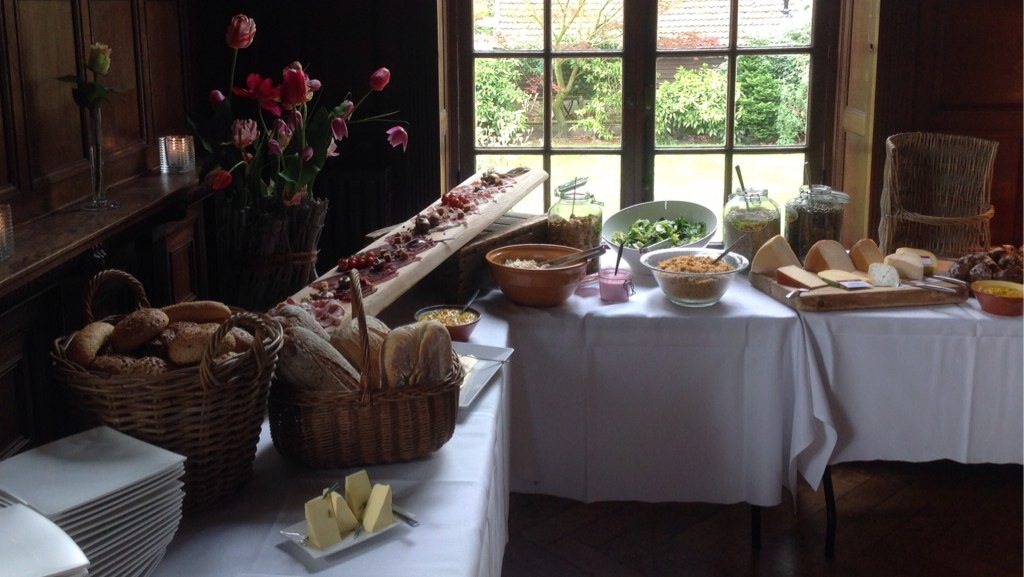
RSO en SDC organiseren een kennismakingsborrel voor aanstaande BSc Thesis studenten (BIN)

Dinsdag 24 Maart a.s. organiseren de leerstoelgroepen Rural Sociology en Sociology of Development and Change een kenningsmakingsborrel voor studenten van de Bachelor ‘Internationale Ontwikkelingsstudies’ die de intentie hebben dit jaar met hun BSc Thesis te starten.

Deze informele borrel is bedoeld om je kennis te laten maken met onze staff leden en hun expertise, en je hier ook een mogelijkheid te bieden om die personen te ontmoeten die je in je BSc Programma (tot op heden) nog niet bent tegen gekomen. Daarnaast biedt deze borrel de mogelijkheid om een eerste brainstorm op gang te brengen over de mogelijke focus van je onderzoek, om je (uiteindelijk) te helpen met het vinden van een begeleider voor je BSc Thesis.

Daarom zijn jullie van harte uitgenodigd op dinsdag 24 Maart 2015 vanaf 17.00 in onze Lounge (te vinden op de derde verdieping van de Leeuwenborch).

Voor vragen neem contact op met Miriam Vreman (Miriam.Vreman@wur.nl), Onderwijs Coördinator Rural Sociology en Sociology of Development and Change.


MSc Thesis: Een onderzoek naar samenhang tussen bedrijfsstijlen, houding en sociale normen (in Nederland)

Melkveebedrijven in Nederland kunnen ingedeeld worden naar manieren van boeren, oftewel bedrijfsstijlen; deze manieren worden gedeeld door groepen boeren. Zo is er een groep boeren die zich richt op schaalvergroting, terwijl een andere groep zich richt op kostenbesparing.

Bedrijfsstijlenonderzoek kan worden gebruikt om te verklaren hoe boeren vorm geven aan hun bedrijf en welke keuzes ze maken, bijvoorbeeld om hun vee al dan niet te vaccineren tegen een besmettelijke dierziekte. Eerder onderzoek heeft uitgewezen dat economische motieven een rol spelen maar ook de houding van boeren ten aanzien van dierenwelzijn. Boeren houden rekening met sociale normen en wat zij denken hoe anderen hun keuzes en gedrag zullen beoordelen. Zo is bij de keuze om wel of niet te vaccineren de mening van de dierenarts belangrijk, maar ook die van familie en andere boeren.
Er is nog weinig onderzoek gedaan naar samenhang tussen de keuze voor of tegen vaccineren, bedrijfsstijlen, individuele houding en sociale normen Terwijl dit wel belangrijke inzichten zou kunnen opleveren voor beleid. Zo zou men op die manier te weten kunnen komen hoe boeren te motiveren zijn om over te gaan tot vaccineren. Ter illustratie: is het voor de vaccinatiebeslissing zo dat een boer met een bedrijfsstijl gericht op kostenbesparing voornamelijk wordt gedreven door economische motieven? Maar het is ook wetenschappelijk interessant om beter te begrijpen hoe sociale normen individuele attitudes en keuzes rondom bedrijfsvoering beïnvloeden.

We zijn op zoek naar een MSc-student die zich in deze vragen wil verdiepen. De student kan aansluiten bij het onderzoek van Jaap Sok naar de keuzes rondom vaccinatie tegen Blauwtong, en gebruik maken van de door hem verzamelde (kwantitatieve) data. De opdracht van de MSc-student zou zich met name richten op het verzamelen van kwalitatieve data door middel van diepte-interviews om zo inzicht te krijgen in het bestaan van verschillende bedrijfsstijlen en de samenhang tussen bedrijfsstijlen, keuzes voor of tegen vaccinatie en sociale normen rondom dit vraagstuk.

De student zal begeleid worden door een begeleider van de leerstoelgroepen Bedrijfseconomie en Rurale Sociologie.

Geïnteresseerd? Neem contact op met Miriam Vreman (Miriam.Vreman@wur.nl), Onderwijs Coördinator van de leerstoelgroep Rurale Sociologie.

MSc course Sociology of Food Provisioning and Place-based Development

On the 16th of March 2015 the MSc course ‘Sociology of Food Provisioning and Place-based Development’ (RSO-31806) starts. Students that want to participate in this course can contact the course coordinator Han Wiskerke (han.wiskerke@wur.nl) as the deadline for online registration has passed.

IMG_0315

The course aims to provide a theoretical, empirical and methodological understanding of place-based development processes, with an emphasis on food provisioning and rural and territorial dynamics in urbanizing societies. The course is based upon recently completed and ongoing research activities within two of the main research domains of the Rural Sociology Group:

  1. The sociology of food provisioning;
  2. The sociology of place-based development.

Being based on recently completed and ongoing research projects implies that this course provides an up-to-date  insight into current theoretical debates and research findings. These are mainly derived from international collaborative research programmes (see ‘our projects’), carried out by multi-disciplinary research teams in different countries inside and outside Europe. Within and linked to these programmes the Rural Sociology Group has approximately 30 ongoing PhD projects. Some of these projects will also feature during this course.

The course is divided into four main themes: Continue reading

Global dynamics and empowerment of the local street food network: a case study on the Ghana Traditional Caterers Association

By Hilde-Marije Dorresteijn, MSc International Development Studies at Wageningen University

For my MSc thesis within the RSO chair group I did research on street food in Ghana. During the master programme I became more and more interested in food issues and its possibilities for local development. These possibilities are beautifully illustrated by the following quotation with which I started my thesis:

“Food provides an answer. Our landscapes and cities were shaped by food. Our daily routine revolves around it, our politics and economies are driven by it, our identities are inseparable from it, and our survival depends on it. What better tool, then, with which to shape the world.” (Steel, 2012 in Viljoen & Wiskerke, 2012:36).

HM Dorresteijn blog picture 1

Despite its importance I found little scientific research on street food, a phenomenon that is particularly relevant in developing countries. Street food can be defined as: ‘ready to eat food or beverages prepared and/or sold in the street and other public places for immediate consumption or at a later time without further processing or preparation’ (FAO, 2012). I decided to look into this topic within the context of Ghana’s capital Accra. An estimated 85% of the urban population in Ghana patronize it, cutting across socio-economic boundaries and thus also designating the important cultural role of street food In Accra, from early morning till late at night all sorts of food are being sold on the streets. Also, there is a great variety in the professionalism of microenterprises. There are many hawkers walking around trying to sell their products, well established enterprises that have fixed stands and seating facilities, and the informal eating houses called ‘chop bars’. Street food make an essential contribution to nutrition of the urban population by providing easily accessible and affordable food, as well as they provide a good livelihood strategy by creating employment and increasing incomes for a large number of urban dwellers. Hereby street food thus makes a great contribution to the local economy. This informal sector requires low start-up capital and low levels of education are needed, making it a good business opportunity for especially women.

The cheapest way to make money, is to cook food. You are a secretary, or you have a shop, and the shop collapses. You can buy a pot, buy silver, cooking utensils, buy water, the pepper, yam and you cook and you’ll get people to buy. Very, very cheap. So day in day out people have been coming into the system. That is why they are plenty. And automatically when you cook, you will get people to buy.” (Mr. Ansong, PRO GTCA, 13 Jan. 2014) Continue reading

Internship: diversification strategies of farmers in peri-urban Amstelland

Aside

Amstelland is a traditional meadow landscape, dominated by dairy farming, and framed on three sides by the cities of Amsterdam and Amstelveen. The vicinity of the city offers threats and opportunities for farmers in Amstelland. The area is intensively used for recreation.

Citizen organisation Stichting Beschermers Amstelland (SBA) is concerned with the future of the area. SBA presumes that preservation of the landscape is connected to economic sustainability of the farms. For that reason SBA is interested in the strategies of farmers towards diversification and pluri-activity. A number of farmers already have added multifunctional activities to their conventional farm. Most farmers are member in the environmental cooperative De Amstel and take agri-environmental measures. Some farmers have started a B&B or sell products on farm. The peri-urban situation leads to high land prices, slowing down opportunities for farm enlargement. As a result, more farmers are likely to consider diversification and pluri-activity as an alternative strategy.

Continue reading