New to the Rural Sociology Group: Introducing myself

I have been here in Wageningen and at the Rural Sociology Group for two weeks now so it only seems appropriate that I introduce myself.  I’m Jessica Duncan and I have been hired to teach courses in food cultures and food policy.
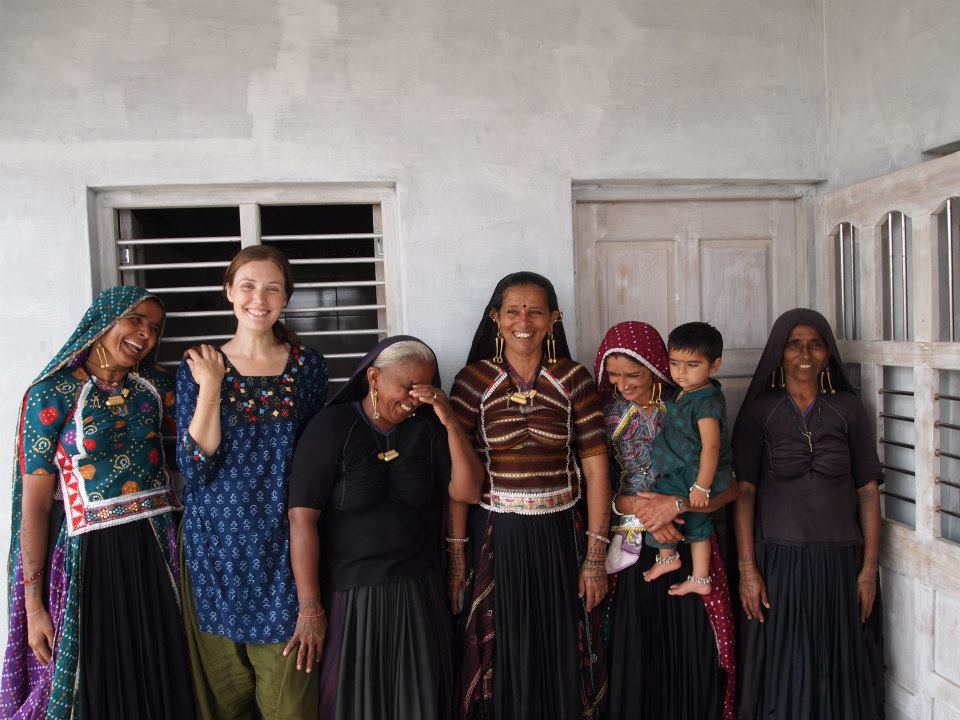
Conducting field work with women pastoralists in Gujarat, India (Summer 2012)

Conducting field work with women pastoralists in Gujarat, India (Summer 2012)

My teaching philosophy is based on the awareness of the central role food plays in socio-cultural and economic issues and across political discourse at all levels. Using food – with its physical, emotional and symbolic resonance – as a lens, allows us to approach complex problems and search for solutions that can impact our lives and the lives of others. I work hard to create a space where students feel encouraged to test ideas and tackle difficult questions with new concepts. Above all, I teach because I love to learn.

From 2008 to 2013 I worked in the Department of Food Systems, Culture and Society at the Universitat Oberta de Catalunya (UOC) in Barcelona. Here I developed and taught courses on research methods, food governance, and contemporary issues in food studies. I also supervised a broad range of post-graduate research students on topics related to food cultures and food security. The international nature of the programme gave me the chance to interact with students from around the world on key issues related to the study of food.

Continue reading

Food4all festival and more … – presented to you by Grassroots science and partners

food4allWhat are the current challenges facing our food systems. And what can be done? Get a taste of the problems and solutions at the 2nd edition of the Food4all festival. Part of the festival are: a regional farmers’ market, a documentary on Monsanto, a book presentation, and a dinner with music and gastronomic film. Later this year, a 2 day training on the right to food, agroecology and food sovereignty. For more information see the programme below or visit www.grassrootsscience.nl.

Grassroots science & partners are: OtherWise, ILEIA, Boerengroep, Lazuur, Fian, Transition Towns and Project EAT. Contact: leonardo.vandenberg@wur.nl

Also opportunities offered for MSc-thesis research, internship and Academic Consultancy Training (ACT) in 2nd educational period.

Continue reading

The Course RSO55306: ‘A global sense of place’ starts 28-10-2013, sign in now!

For whom?

We invite all master students interested in sustainable development, spatial development, community building, place-based policy, rural socio-logy and anthropology for this course.

What?

This course gives an overview of place-based approaches in development. A relational place-based approach is key to the understanding of interrelated rural and urban transformation processes and sustainable development. People are networked to both local and extra-local places.; hence they have a global sense of place and one that is locally specific (Massey 1994; Escobar, 2001). Places are considered as contingent but in time and space differentiated outcomes of three interrelated, unbounded, transformative processes: political-economic, ecological and social-cultural. We will have discussions about:

  • Sense of place
  • Places as sites of negotiation and power struggles
  • The constitution of identities, subjectivities and difference.
  • Politics of place.

poster capita selecta 2013-2 final

Continue reading

Boerengroep Bike excursion Binnenveld September 17 visiting farmers

Bike excursion BoerengroepSeptember 17 the Boerengroep organises a bike tour in ‘t Binnenveld visiting a goat farmer, sheep/chicken farmer and organic veggie farmer. Students can register at the website.

Migration – sixth post RUW-RSO studytrip to Poland

RUW Foundation and the Rural Sociology Group organized a studytrip to Poland. In a 10 day intensive program different cities and rural areas in Poland were visited, interesting people and organizations met and farm work is done. The theme of the trip is “Glocalise”. Students are asked to prepare themselves well on different themes in groups before leaving and to write a concluding reflexive paper on their impressions and findings, and to write a blog. This sixth blog is about migration by:

Diand Laarman

wooffing groupIn the morning and afternoon, we were WWOOFing at Ekozagroda farm again. Today, we were divided into 4 groups for 4 tasks including weeding in the field, making spiral garden, repairing the fence and rebuilding the old house at the farm. Everybody had their hands dirty. At 1 pm., it was a lunch time. In Poland, lunch was the most important meal and polish people liked to have a warm meal. We were served with a typical Polish dish including potato dumpling, meat and salad. Then, at 4 pm., it was the time to say good bye to WWOOFing with a cheerful group picture.

The discussion evening started with a presentation of Dr. Malchar-Michalska lecturer at the University of Opole. Dr. Malchar-Michalska explained how the region of Opole suffers from Continue reading