
We have received a high number of inquiries with regard to our 12 PUREFOOD vacancies. It is good to see there is so much interest in these topics!
Most reactions were inquiries about similar issues. Therefore, we have prepared a list of FAQs for the PUREFOOD vacancies. Please have a look at this list of FAQs before sending us an e-mail!
Category Archives: Food
PUREFOOD – 12 vacancies for ESRs are open
As mentioned in an earlier post on this weblog, the Rural Sociology Group has been granted the the coordination of a Marie Curie Initial Training Network entitled ‘Urban, peri-urban and regional food dynamics: toward an integrated and territorial approach to food (PUREFOOD)’ funded by the European Commission’s Seventh Framework PEOPLE program. The objective of PUREFOOD is to train a pool of 12 early-stage researchers (ESRs) in the socio-economic and socio-spatial dynamics of the (peri-)urban and regional foodscape. The PUREFOOD network is centred around food as an integrated and territorial mode of governance and studies the emergence of the (peri-)urban foodscape as an alternative (as opposed to a globalised) geography of food, including the ways in which, and the extent to which, sustainability aspects generally considered to be intrinsic to the alternative food geography are incorporated by the more conventional food companies.
As of now all 12 PUREFOOD research vacancies have been published (or soon will be) by the host universities. For information about the ESR vacancies and application guidelines, you can download the PUREFOOD vacancies leaflet. For more information about the objectives, training and research approach and training program of PUREFOOD you can download the PUREFOOD information pack for prospective ESRs. The deadline for application is 3 January 2011.
Eligibility criteria
The enhancement of transnational mobility to improve career perspectives of early stage researchers is the main goal of the Marie Curie Initial Training funding. To achieve this objective the following eligibility criteria for prospective ESRs have been formulated:
- You are eligible as an ESR if you are, at the time of recruitment (i) in possession of a university degree, and (ii) have a maximum of four years of full-time research experience, including any period of research training. This is measured from the date when you obtained the degree which formally entitles you to embark on a doctorate, either in the country in which the degree was obtained or in the country in which the research training is provided. Please not that ESRs cannot be PhD holders.
- You are eligible to the position if, at the time of the selection by the host university, you did not reside or carry out your main activity (work, studies, etc) in the country of the host university for more than 12 months in the 3 years immediately prior to your recruitment.
If you have any questions about a vacancy please contact the contact person mentioned in the vacancy announcement. For general question about PUREFOOD please contact me (han.wiskerke@wur.nl).
AESOP; the government in the garden
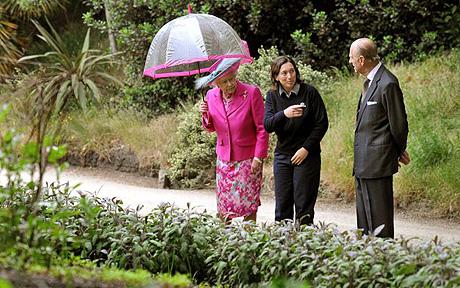
Queen Elisabeth's Vegetable Garden. Photo:John Stillwell/PA Wire
Why is the government in the garden? This was the title of the last presentation in our Working Group Urban Food Governance at the AESOP conference this weekend in Brighton. Some governments are getting into the garden, case studies presented by conference participants showed how and why. Food is ‘becoming public’ a process of taking responsibility for what has been seen until very recently as a pure free-market issue. Public planning and action occurs for various reasons; because of urban health and obesity, the Urban Heat Island effect, food security in poor neighborhoods or in response to civic actions and food movements.
Notwithstanding the promising examples, there is reason for worry too. The political climate has shifted markedly in countries such as the UK and the Netherlands and budget cuts are threatening the sustainable food agenda because this ‘additional’ issue came in last and is the first to be thrown out. A second reason is what seems to me a continuing planner’s identity crisis. The philosopher Hans Achterhuis admits in his recent book that neoliberalism became so much the norm that the process of how it slipped into virtually every policy by small pragmatic adjustments happened unseen even for many of the critics.
Planning seems the opposite of neoliberalism. At the conference, we were stimulated to start planning again, the word master plan fell and was heavily debated. Planning –by default – seems to restrict choice. And free choice is the symbol and myth of neoliberalism with which few people dare to interfere. It is an unproductive and misleading contrast. As if no planning takes place now. Urban planners who decide upon the location for a supermarket are planning, the question is, which criteria are used and which of those do conflict with other public interests? The neoliberal idea of planners restricting choices has encroached the belief that planners can counteract private business interests. They can and should I think. The case studies often showed that current successful examples developed from a particular local ‘culture’ among those working with urban food planning incorporating public values such as equity, fairness, access and community.
The presentations and keynotes will be made available over the course of the coming week at the conference website
PhD position: Knowledge brokerage to promote sustainable food consumption and production
In January 2011 the project ‘FOODLINKS’ (Knowledge brokerage to promote sustainable food consumption and production: linking scientists, policymakers and civil society organizations) will start. This project is funded by the European Commission and will be carried out by a consortium of 14 partners (universities, regional and local governments and civil society organizations) from 9 European countries. The overall project aims at developing and experimenting with new ways of linking research to policy-making in the field of sustainable food consumption and production. FOODLINKS will be coordinated by Prof. Han Wiskerke and Dr. Bettina Bock of the Rural Sociology Group of Wageningen University.
Job description
Within the FOODLINKS project we are looking for a a PhD candidate who is interested in issues of science-society dialogue, science-policy collaboration and social learning in the field of sustainable production and consumption. The PhD candidate will combine the writing of a PhD thesis with hands-on participation in a EC-funded project and contribution to project deliverables.
Within the overall FOODLINKS project, the PhD project monitors and evaluates the processes of social learning taking place in three Communities of Practice that are established as part of the project. In these Communities of Practice researchers, policymakers and civil society organization exchange knowledge and experiences and commonly define new research questions in the field of short food supply chains, sustainable public food procurement and urban food strategies. The PhD project will evaluate the knowledge brokerage activities and processes of social learning that are taking place in the Communities of Practice as well as in the project as a whole.
Requirements
- A Master degree in sociology, communication science or innovation studies.
- Knowledge of relevant theoretical concepts in science and technology studies, science-society dialogue and science-policy collaboration, such as boundary work, knowledge brokerage, multi-stakeholder participation and social learning.
- Knowledge of and experience with monitoring and evaluating processes of (social) learning.
- Some knowledge of or interest in agro-food research and issues of sustainable food production and consumption.
- Good analytical and writing skills.
- Fluent in English
- Willing to travel as the project will include frequent meetings within Europe.
Appointment conditions
A PhD position for a period of 18 months, extended with another 30 months upon favourable evaluation. Gross salary will increase from € 2042 per month in the first year up to € 2612 per month in the last year based on a full-time appointment (38 hours per week). In addition, we offer a holiday bonus of 8% and an end-of-the-year bonus of 8.3% of your annual salary.
Additional information
Additional information about the vacancy can be obtained from:
- Prof. dr. ir J.S.C. Wiskerke, Chair of Rural Sociology, Telephone number: +31 317 482679/4507 and
- Dr. Ir B.B. Bock, Associate Professor Rural Sociology, Telephone number: +31 317 483275/4507
Additional information about the FOODLINKS project can obtained through this link. The PhD position is mainly related to Work Packages (WPs) 2, 6 and 7 of FOODLINKS.
Additional information about the organisation can be obtained through one of the following:
- Wageningen University
- Rural Sociology Group
- Rural Sociology Group’s research program (on this weblog)
Interested? Apply now via www.jobsat.wur.nl before November 8th 2010 (Vacancy number: SSG-RSO-0005).
Inclusion and exclusion of the rural… – Jan Schakel in Rennes – Part 4
As I wrote before, there are many relations between the urban and the rural. I just mentioned some of them: the markets, the food, the regional identity, the life histories of families and …. biking trails… Although many people (in Rennes) don’t recognize this aspect, they do agree when I explain it to them. Maybe it’s too familiar to them –it might be in their backbone. But maybe also, because many Rennes’ peoples are getting very global: they just travel by car, TGV, Thalys or plane. Not any more by bike. Anyway, every day –after work- I’ll take my Batavus, and start roaming around. But when sunsets starts, I go to the écluse de St Martin’ (“shiplock”), just nearby the Agrocampus. It is exactly on the edge of the city and the countryside. I go there, just to experience a beautiful phenomenon. I am not the only one that goes to that place. When it’s getting dawn, I see ten, hundred, thousand and ten thousands, maybe even millions of birds (starlings) coming back from the countryside. I don’t know where they have been all day, but every night the gather together on the electricity pylons and its wires; they come from everywhere, with thousands and thousands. Like me, but I’m there just to watch them. It almost takes an hour when they’re “all there”..(although I do not count them). And then, suddenly (who said to leave; which bird took the initiative; and why?) they disappear, and they all go into the city. I’ve been told that they always go to the same places, and that hundreds of trees are fully loaded with birds, really: fully loaded, and you can listen all night to their talks and stories…you can’t even sleep. But the next morning: they all have left. Where have they gone? Fascinating. But even more astonishing is the fact that this daily rural-urban migration became part of an urban ‘exclusion’ policy. The birds are not welcome anymore in the city, at least: not everywhere. For example, in the luxurious Avenue de Jean Janvier (just opposite the central railway station)all trees are covered with nets(see picture), so the birds can’t have their sleep there anymore. I noticed these nets one morning on my daily trip to the station to buy my “de Volkskrant”. Rennes is changing … Anyway; the peoples who I asked about these nets, they just shook their head; they didn’t understand it either. Why exclude the birds…?

Some years ago, Rudolf van Broekhuizen and I did some research on “breeding and culture” as part of the EU funded project called “Sustainable Farm Animal Breeding and Reproduction” (SEFABAR). We studied the cultural context of breeding (for four species: poultry, pigs, ruminants and aquaculture)in 6 different countries. France was one of them, together with the USA, Thailand, Norway, Italy and the Netherlands (by the way: why do I have to say in French that ‘je suis Hollandais, je parle Neerlandais, et je habit a Pays Bas’? Three words for one nationality; rather complicated!). Anyway, breeding can be embedded in or intertwined with culture in many ways and with different meanings. Although we noticed –especially in breeding – an ongoing process of globalization, we also noticed processes of (re-)localization. Our main conclusion was: culture and context still do matter! In Italy for example, breeding is strongly related to food, and in France breeding still is deeply rooted in the region: ‘origine’, ‘identity’ and ‘terroir’ are the keywords to understand the cultural context of French breeding.
 Rural Sociology Wageningen University