Thesis Opportunities: Social Economies of food, agriculture, and nature in Gelderland.

Social economy is an umbrella term used to describe a variety of third sector, cooperative, voluntary, non-profit, and social enterprise initiatives that put social and environmental well-being before profit.  They operate in different sectors of the economy, and provide a number of important goods and services – that range from food to social services and care. The social economy is also an important part of the solidarity economy, a term used to describe diverse economic practices that seek to strengthen local economies and communities and create alternatives as a form of resistance to the social, economic, and environmental injustices associated with capitalism, colonialism, racism, and neoliberalism. The cities of Ede, Arnhem, and Nijmegen are home to a growing number of social economy initiatives, especially in the areas of agriculture, food, and nature (e.g. ecosystems services, green infrastructure). Here they play a vital, yet often unrecognized role. With these three thesis topics –  on (WP1) mapping, (WP2) diverse economies analysis, and (WP3) assessment –  we hope to change that.

Start date: January or February 2019

Qualifications:           

  • You are able to conduct qualitative research in Dutch.
  • You are able to engage diverse stakeholders in participatory and collaborative research
  • You can use basic excel and mapping tools (WP1)
  • You have an interest in diverse economies and social innovation (WP2).
  • You have some experience in assessment and evaluation (WP3)
  • You are registered for one of the following MSc programmes: MID, MCS, MLP, MFT, or MOA
  • You have completed at least 2 RSO courses (or relevant social science courses)

Questions? Please get in touch!

Supervisors: Oona Morrow (RSO) oona.morrow@wur.nl and Jan Hassink (PRI) jan.hassink@wur.nl

  1. Mapping social economy in food-health valley

What/ Where is the social economy in food-health valley?

This MSc thesis will seek to inventory and categorize social enterprises in the greater Ede, Arnhem, and Nijmegen region. Through online research and field research you will construct a database and map of social economy initiatives in the agriculture, food and nature domains providing social services. You will work closely with a MSc student specializing in diverse economies to develop a typology for categorizing these initiatives in terms of their organizational model, funding, sector and services,  etc. The data you collect is important for measuring the size and scope of the social economy. And ultimately for making the social economy visible to itself, the general public and policymakers. You will organize several stakeholder events in each city to reflect on the reflect on your data, and also what is missing. You will use your research practice to strengthen existing social economy networks in the region by bringing stakeholders together. Your MSc thesis will thus also reflect on the role of mapping as a method for making networks visible.

  1. Diverse economies of social economy in food-health valley

What are the diverse economies of the social economy?

This MSc thesis will work closely with the Mapping the social economy thesis to adapt the diverse economies framework (Gibson-Graham 2008) to create a typology of social economy initiatives and practices. You will draw upon  the database and map created by MsC 1 to select case studies from several different sectors (e.g. food, agriculture, nature care, etc.) and analyse them for their diverse economic practices and business and funding models. You will examine the social and institutional relationships and policies that shape these practices – e.g. health policy, access to land from the city. And identify emerging social innovations and best practices to share within this network social economy initiatives.

  1. Co-designing Impact and Assessment tools for social economy initiatives in food-health valley

What are the impacts of the social economy, and how can we measure them?

Social economy initiatives have important goals. But how do they know they are achieving them? What metrics and indicators are meaningful? And what types of evaluation tools are actually useful and usable ? And how can they best communicate their impact (to funders, policy makers, and participants)? You will answer these questions, in collaboration with social economy initiatives working in different sectors of the region. Together you will co-design impact and assessment tools that are tailored to the unique needs of social economy initiatives yet also replicable and can be implemented by the initiatives. You will organize communities of practice around evaluation that are rooted in the concrete needs and practices of different sectors.

Further Reading:

Amin, A. (Ed.). (2013). The social economy: International perspectives on economic solidarity. Zed Books.

Gibson-Graham, J. K. (2008). Diverse economies: performative practices for other worlds’. Progress in Human Geography32(5), 613-632.

Gibson-Graham, J. K., Cameron, J., & Healy, S. (2013). Take back the economy: An ethical guide for transforming our communities. University of Minnesota Press.

Loh, P., & Agyeman, J. (2018). Urban food sharing and the emerging Boston food solidarity economy. Geoforum.

Miller, E. (2010). Solidarity Economy. In Eds. E. Kawano, T. Masterson, and J. Teller-Ellsberg. Solidarity Economy I: Building Alternatives for People and Planet. Amherst, MA: Center for Popular Economics. 2010


Foodscapes of the sharing economy

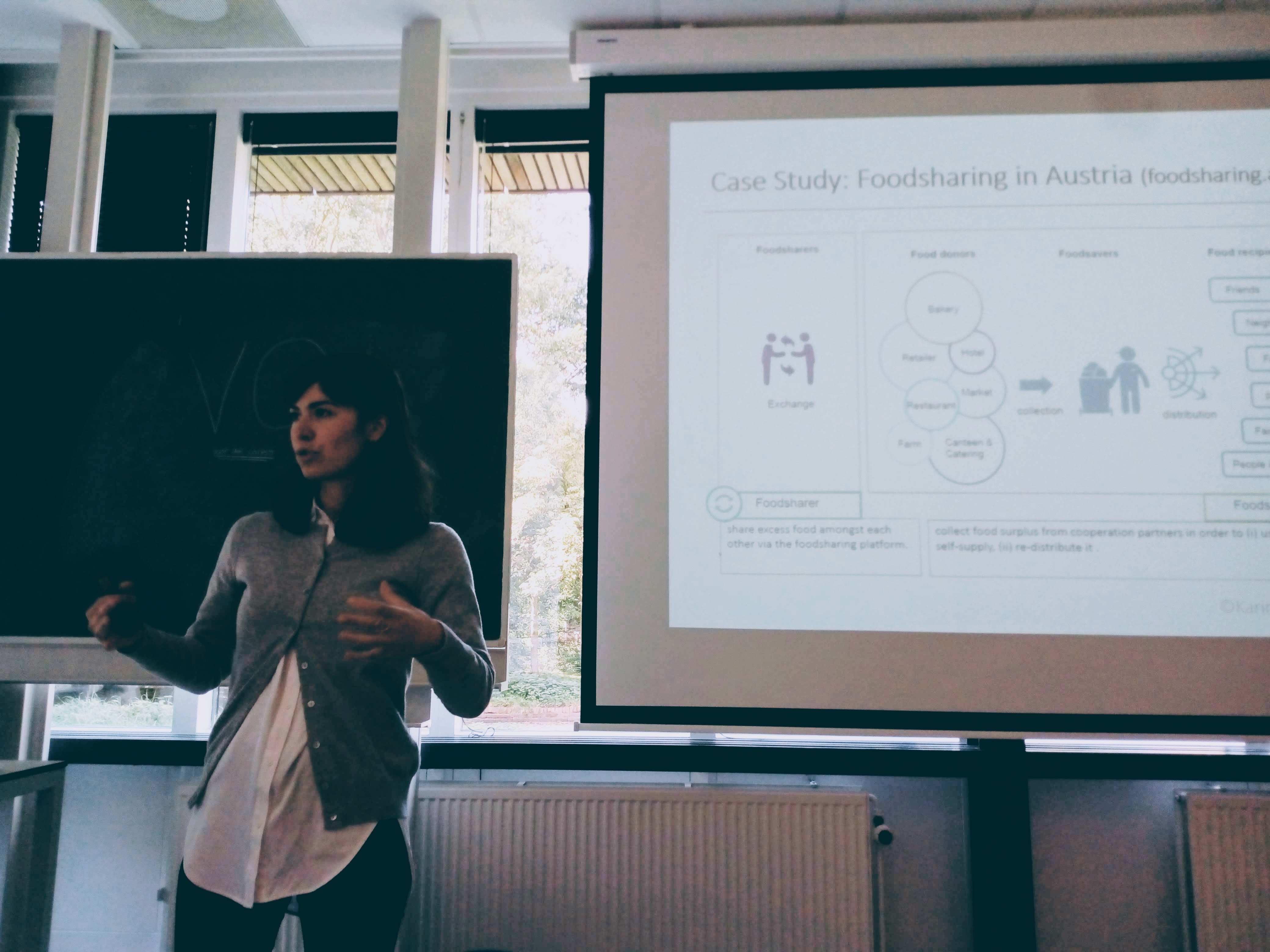
On the 25th of September, the Foodscapes cluster of the Centre for Space, Place and Society (CSPS) organised a critical food studies work shop on the food sharing economy. We invited Karin Dobernig from Vienna to talk about the research that she conducted with her colleague Karin Schanes.

Karin gave a very interesting and inspiring talk on “Collective Action Around Food Waste: Investigating the determinants and characteristics of participation in food sharing initiatives”.

After the talk there was plenty of time to discuss food sharing in more detail. We tried to link the concept of foodscape to that of food sharing, and raised and discussed various questions. For instance, to what extent is food sharing an urban phenomenon? When sharing food, who is liable and should food savers and food sharers accept responsibility? How is this organised in different countries? Also, to what extent does food sharing cross the binary opposition between consumers and producers? Who are the recipients of food sharing, and should they always be in need? There were no clear answers to these questions that can easily be reproduced here, but the discussion was insightful.

This was the first activity organised by the Foodscapes cluster. We much enjoyed the presentation and the discussions. Hoping for more inspiring meetings in the future!

Critical food studies workshop and seminar series

The Foodscapes cluster of the Centre for Space, Place and Society (CSPS) is pleased to announce the following workshop:

Foodscapes of the sharing economy

25 September 2018 – 13.45-17.00

Room C 62 in de Leeuwenborch (Hollandseweg 1, Wageningen)

During the recent decade, new modes of food provisioning have emerged under the guise of the sharing economy. A dominant picture of initiatives in the sharing economy is associated with platform capitalism and the gig economy. Yet, a variety of initiatives are using the tools of the sharing economy to promote sustainable consumption, thereby reducing our dependence on commercial activity and reducing the use and reliance on material possessions. This seminar will scrutinize the interconnections of the sharing economy and food, people and places. We are interested in food in the sharing economy, how exchanges are performed, by whom, and to what end. We want to provide an embodied understanding of food and place in the sharing economy. We are interested in issues of social, spatial and environmental justice, health and well-being in the sharing economy.

Program

13.45 – 14.00   Walking in

14.00 – 14.15   Introduction

14.15 – 15.00   Karin Dobernig and Karin Schanes: Collective Action Around Food Waste: Investigating the determinants and characteristics of participation in food sharing initiatives

15.00 – 15.15   Discussion

15.15 – 15.30   Coffee break

15.30-16.30     Roundtable discussion

With Karin Dobernig, Karin Schanes, Esther Veen, Oona Morrow, Stefan Wahlen

16.30-17.00     Drinks

About the foodscapes cluster:

The Foodscapes cluster brings together a variety of academic researchers and PhD candidates at Wageningen University, who are engaged in the multi-disciplinary domain of critical food studies.


Sign up for #SUSPLACE2019 Final Event, May 7-10 in Tampere

The EU funded MSCA ITN project www.susplace.net is coming to an end in 2019 and for that matter a Final Event is organised to celebrate the results of the 15 research projects so far and the effort the project makes to further sustainability transformations as a science and as practice. One can now sign up and submit an abstract for a contribution. For more information see: www.lyyti.fi/p/susplace2019