Emmelien Venselaar reflects on attending the Committee on World Food Security

As part of a voluntary course offered by Rural Sociology, 16 students visited Italy to look at two different examples of global food security in action. Emmelien Venselaar, who studies International Development, has written a short blog wherein she reflects on her experiences. Happy reading.
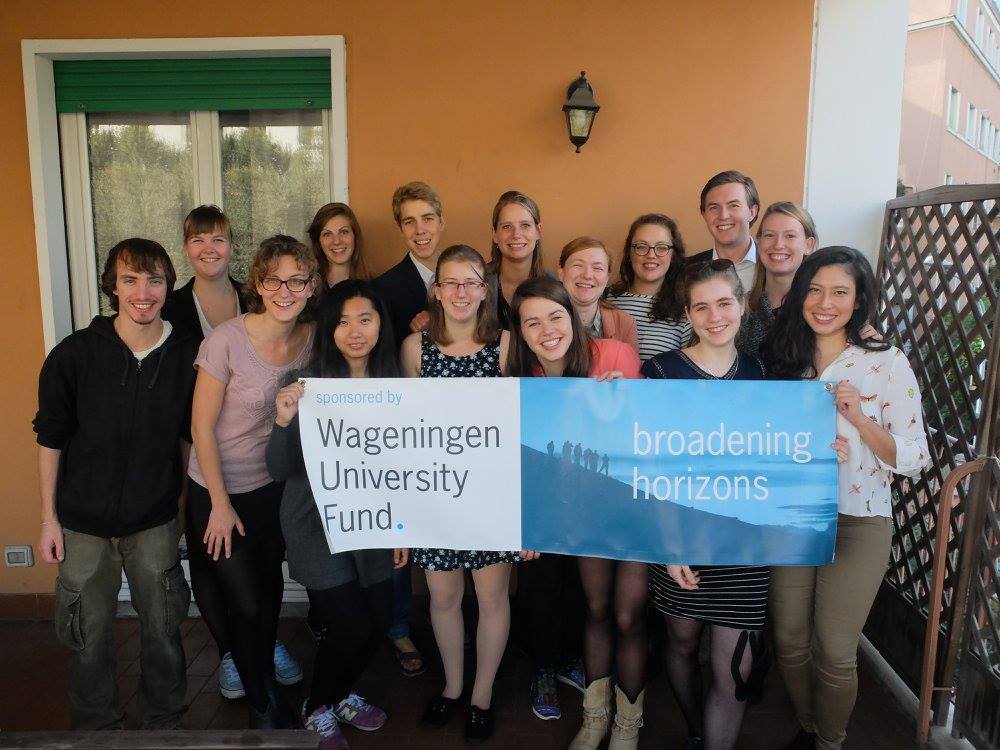
Students get ready to observe politics in action at the UN's Committee on World Food Security (photo by X. Jiang)

Students get ready to observe politics in action at the UN’s Committee on World Food Security (photo by X. Jiang)

As part of the Capita Selecta “Global Food Security Governance” from chair group RSO, 16 students got the chance to visit the Committee on World Food Security (CFS) in Rome. This Committee is an intergovernmental body addressing global food security governance. It aims to be inclusive and thus takes the interests of states, civil society, NGO’s and the private sector into account. In practice this means that a discussion can be conducted by Coca Cola, Finland, peasants and a representative of the FAO. This conference is an annual event hosted by the Food and Agricultural Organization, a UN agency, in Rome. During three days we experienced what is it like to formulate international guidelines at nighttime, watch African students pitch their business ideas, discuss matters over lunch on the roof terrace of the FAO office, take one minute espresso breaks to get us through the day and network our way through the side events. As students, we are quite used to short nights, networking events and important discussions. Only this time it was much more official than at our student associations or student board events back in Wageningen. This time we were talking politics.

Continue reading →

Building a Common Food and Nutrition Policy: asking the new structures question

Transmango Member's avatarTRANSMANGO

Terry Marsden revisits the opinion paper he wrote earlier this month on a common food policy and reflects on the ‘new structures question’. If you would like to comment on this please join us in our discussion on #commonfoodpolicy on Twitter or Facebook.

Since my first intervention calling for a radical reorganisation of the CAP, both in terms of individual responses and further reading, I am increasingly struck by the significant weight of evidence calling for more policy integration around food. This includes various EU Foresight reports. In debating these proposed changes and policy needs it is perhaps important not to rush into concerns about changes in actual policy instruments and structures, but first to more fundamentally consider and debate some of the principles which lie behind a ‘new deal for food’ in Europe. One key area is to re-position rural development concerns right at the heart of the debate…

View original post 577 more words

“We need policy rupture not incremental conservatism”: Toward a #commonfoodpolicy

Quote

Transmango

The EU-project TRANSMANGO is focussed at sustainable pathways to changing the food system. This project aims to combine and integrate different theoretical approaches to gain insight into Food and Nutrition Security (FNS).
In light of that, TRANSMANGO’s Terry Marsden has written an opinion paper about transitioning from the CAP to a Common Food and Nutrition Policy to start the debate.

Join the debate: 

A Common Food and Nutrition Policy for Europe?
Having been fortunate enough to have attended and participated in several international conferences and working groups over the spring and summer of this year, and had a change to explore and discuss the current ‘state of play’ in what seems to be the increasingly dysfunctional global food system, I have recently begun to seriously reflect on European policy, and the questions of radically changing the current EU CAP into a Common Food and Nutrition Policy. This was mentioned by Damien Canare, from Montpellier at a meeting of the FLEDGE research programme in Waterloo in September this year, and in my preparation and discussions for a presentation on the TRANSMANGO EU project at the Agriculture and Urbanising Society Conference in Rome thereafter.

“Some have perceived this as being something of a naive question, given the overall complexity and political inertia in the glacial process of CAP reform experienced over the past 25 years”

Continue reading →