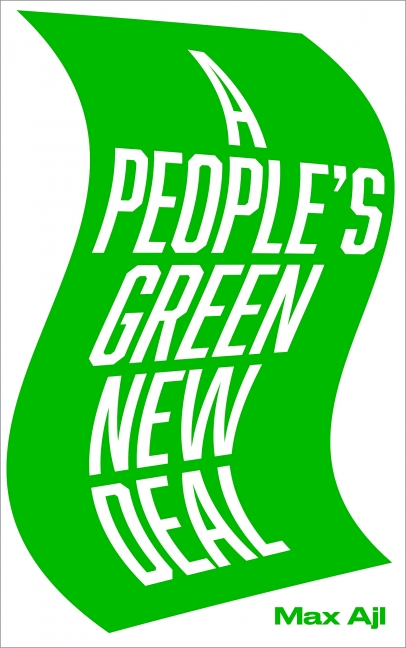
The idea of a Green New Deal, a set of proposal to address climate change and its effects, was launched into popular consciousness by US Congressperson Alexandria Ocasio-Cortez in 2018. Evocative of the far-reaching ambitions of its namesake, it has become a watchword in the current era of global climate crisis. But what – and for whom – is the Green New Deal?
In this concise and urgent book, A People’s Green New Deal, RSO postdoc Max Ajl provides an overview of the various mainstream Green New Deals. Critically engaging with their proponents, ideological underpinnings and limitations, he goes on to sketch out a radical alternative: a ‘People’s Green New Deal’ committed to the decommodification of social reproduction, anti-capitalism, anti-imperialism and agro-ecology.
Ajl diagnoses the roots of the current socio-ecological crisis as emerging from a world-system dominated by the logics of capitalism and imperialism. Resolving this crisis, he argues, requires nothing less than an infrastructural and agricultural transformation in the Global North, and the industrial convergence between North and South. As the climate crisis deepens and the literature on the subject grows, A People’s Green New Deal contributes a distinctive perspective to the debate.
We kicked-off our seminar series ‘Looking back, Looking Forward: Setting a future agenda for rural sociology’ as part of the 75th anniversary celebration of Rural Sociology. The seminars lead-up to our grand anniversary celebration on May 13, 2022. For this anniversary seminar series we have invited a range of highly interesting scholars active in diverse fields closely linked to rural sociology and engaging with research themes, questions, approaches, and concepts relevant for the research agenda of rural sociology. The seminars engage with current work of the speaker as well as the context of past debates and future issues for rural sociology. You can watch the past two seminars on our YouTube channel. See here the announcement for our next seminar (May 19) on migrant labour in agriculture. Webinar: Migrant labour in agriculture | Rural Sociology Wageningen University
Lecture 1:‘Farming Inside Invisible Worlds: Political ontologies of modernist agriculture’:
Hugh Campbell, University of Otago, New Zealand
Date: 3d February 2021
This talk examines the way in which an explicit focus on colonisation can open up new ways to understand the power of modernist farms. Using the example of colonisation in Aotearoa New Zealand, farms are revealed as agents of ontological politics: both being created by the colonisation of indigenous worlds in many parts of the globe, but then also becoming agents that enacted a new, ‘scientific’, pacified, and highly ontologically-bounded modernist world. The outcome is a very specific kind of highly-empowered modernist/capitalist farming, locked into ‘farming inside invisible worlds’. The story of farming in Aotearoa New Zealand from colonisation to the present day reveals both the enormous colonising powers of modernist/capitalist farming, but also the inevitable fractures, overflows and contests that signal its inevitable demise.
Lecture 2: ‘Towards a Gaian agriculture’
Anna Krzywoszynska, University of Sheffield, UK
Date: 28th April 2021
This talk is concerned with the role for agri environmental social sciences in understanding the new human condition called by some “the Anthropocene”, and what I increasingly think of as the challenge of living with Gaia How have we become so lost that our most fundamental relationship with the environment, food getting, has come to undermine both our futures and those of our environments? And what is needed to build a new pact between humans and living ecosystems? I have been exploring these questions specifically in relation to soil as an existentially and conceptually crucial matter In this paper, I examine modern farming as built on multiple alienations, and propose the conditions under which re connection and a building agricultures which work with Gaia may become possible.
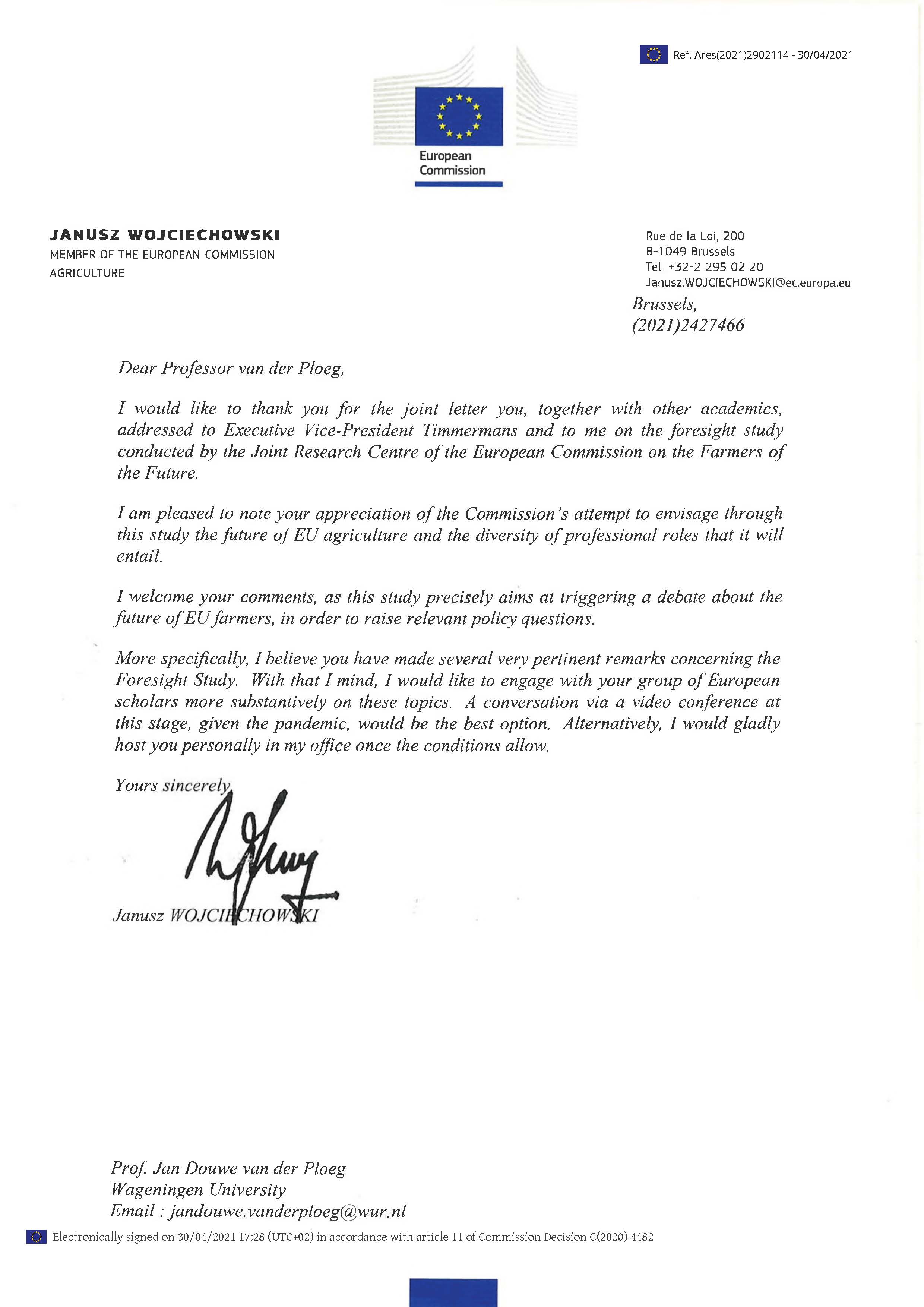
On March 11, we published an open letter to Frans Timmermans, Executive Vice-President of the European Commission, Janusz Wojciechowski, European Commissioner for Agriculture, and Norbert Lins, President of COMAGRI of the European Parliament about the ‘Farmers for the Future’ (EUR 30464 EN) policy report. Signed by many academics from different countries in Europe, the letter wrote: “[W]e observe that ‘Farmers for the Future’ critically fails to make use of, or build upon, Europe’s rich academic tradition of exploring and extrapolating the wide and richly-chequered heterogeneity of its agriculture. We also observe that the report does not offer evidence-based, scientific, support that can contribute to the process of European policy making. Instead, ‘Farmers for the Future’ contains and introduces dangerous biases into the discussions and debates.” See the post: Open letter on the EU’s ‘Farmers for the Future’ Report and the Farm to Fork Strategy | Rural Sociology Wageningen University
In his response to the letter, European Commissioner for Agriculture Janusz Wojciechowski writes “I welcome your comments, as this study precisely aims at triggering a debate about the future of EU farmers, in order to raise relevant policy questions”.
In de jubileum publicatie rondom ons 25 jarig bestaan leverde Lijfering een bijdrage onder de titel ‘het rural-urban continuüm in het licht van sociale veranderingen’. In die bijdrage gaat Leifferink in op de zin en onzin van dichotomisch denken en de noodzaak om de begrippen stad-en platteland als ideaaltypen te beschouwen. Vertrekkende vanuit het centrale begrip menselijke nederzetting, verwijst Lijfering naar de volgende drie dominante onderscheidende kenmerken: het fysieke milieu, de sociale interactie en het cultuurpatroon. Naast deze in zijn ogen verhelderende invalshoeken om stad en platteland als anachronismen nader te duiden, komt Leifering met het voorstel om meer expliciet aandacht te besteden aan wat hij benoemt als ‘functionele stad-platteland patronen’. Continue reading →
Open letter of European scholars to (in English, French and Spanish):
Frans Timmermans, Executive Vice-President of the European Commission
Janusz Wojciechowski, European Commissioner for Agriculture,
Norbert Lins, President of COMAGRI of the European Parliament.
Re: ‘Farmers for the Future’
Wageningen, 10th of March 2021
Dear Sirs,
In 2020 the European Commission released ‘Farmers for the Future’ (EUR 30464 EN), a Science for Policy Report, prepared by the Joint Research Centre (JRC) of the European Commission. This policy report is intended to contribute to the further elucidation of the EU’s Farm to Fork Strategy which is a key element of the European Green Deal. It has, at its core, a description of 12 profiles that are attempt to categorize the likely diversity and range of professional farming styles in European agriculture in 2040. The report asks, and tries to respond to, the following question: “ Who will be the key players of the EU next generation agriculture, the farmers of the future?” Continue reading →

 Rural Sociology Wageningen University