Rebel governance without territorial control: The experiences of the PKK in 1970s Turkey

In this article published in Geoforum Francis O’Connor and Joost Jongerden discuss the politics of citizenship in Turkey – and how voices that represent “otherness” – Kurds, peasants, women – are supressed.

Insurgent movements rely on popular support using varying strategies to build supportive constituencies, including forms of rebel governance. The rebel governance literature explicitly limits its scope to insurgent cases with territorial control, excluding all groups that did not obtain territorial control, areas of weaker insurgent presence and early phases of mobilisation. This article focuses on Kurdistan Workers Party’s (PKK) use of rebel governance (1977–1980) through municipal politics prior to the launch of its insurgency. The article makes two important contributions: firstly, it demonstrates the need to broaden the scope of the rebel governance literature to include phases where insurgent movements do not control territory. Secondly, it critiques the linearity of retrospective readings of insurgent trajectories that downplay the role of interactions and contingency in early mobilizational phases. It is based on original data including primary source documents and qualitative interviews with people involved in the PKK’s municipal politics between 1977 and 1980 in Batman and Hilvan, towns marked by conflicts among (agricultural) workers, villagers, and landlords.

Read more: https://www.sciencedirect.com/science/article/pii/S0016718523002300

The history of Dutch potato breeding (1888-2018): from hobby to industry

On the 15th of May 2019 Jan van Loon defended his PhD thesis about the history of Dutch potato breeding. This thesis was written in Dutch (see thesis cover below). Over the past two years we (Jan and his supervisors) have been working on a paper in English, summarizing the main findings of his thesis (which is over 400 pages). This was quite a challenging endeavor, but we are pleased that the paper was accepted by Potato Research and was published online this week as an open access article.

Abstract of the paper
The Netherlands has a world-leading position in potato breeding, but little is known about the factors that led to this success. This paper analyses the factors that have influenced the development of potato breeding in the Netherlands. This study is based on research of the grey and scientific literature and interviews with various representatives from the Dutch potato breeding sector. We distinguish four periods: (i) Before 1888, no potato breeding in the Netherlands existed whereas in other countries first crosses occurred. (ii) 1888–1940, more individuals started breeding out of interest and hobby to overcome the commonly observed degeneration of potato. (iii) 1940–1967 the emergence of a corporate set up of breeding by private companies collaborating with small breeders. (iv) 1967–present, towards full-fledged breeding industry supported by the new Seeds and Planting Materials Act (ZPW) in 1967 including the breeders’ rights. Many factors including cultural practices, diseases, and market that determine the strategy of breeding have been analyzed. The development is most of all ‘crop driven’ to maintain the level of production. But it was also ‘export driven’ leading to the development of an export-oriented seed potato sector. The conclusion is that three elements were dominant in the development of a strong potato breeding sector: (1) the broad cooperation among all players in the potato chain, (2) the design of the institutional infrastructure, and (3) the remuneration of the breeding work through legislation regarding plant breeders’ rights. The study ends with an outlook on future trends, one of them leading from an open to a more closed business culture.

Boerderijovernames als mogelijkheid voor landbouwtransitie: van stoppende conventionele naar startende ecologische boer

Marcha van Wijk*

Introductie
Deze blog is een samenvatting van mijn masterscriptie over de overname van conventionele boerderijen naar ecologische boerderijen. Het scriptieonderzoek heeft deze overname verkend als potentieel onderdeel van een landbouwtransitie naar meer ecologische vormen van landbouw. Terwijl boerderijovernames vaak worden bekeken vanuit een financiële lens, belicht mijn onderzoek de emotionele en relationele aspecten, die vaak over het hoofd worden gezien, terwijl ze een grote invloed hebben op de overname.

Meer dan de helft van de Nederlandse boeren van boven de vijfenvijftig jaar heeft nog geen opvolger. Dit is een van de oorzaken dat gemiddeld drie boerenbedrijven per dag worden gestopt in Nederland. Vooral kleinschalige boeren vinden vaak geen opvolger, wat ervoor zorgt dat steeds meer kleine boerderijen verdwijnen en grote boerderijen groter worden door het opkopen van vrijgekomen land. Dit is in tegenspraak met opkomende visies over duurzame voedselsystemen, zoals de Farm to Fork Strategy (2020) en iPES FOOD (2016) die juist pleiten voor natuur-inclusieve en kleinschalige landbouw.

Mijn onderzoek verkent een alternatief op deze trend. Wat als we de overname van conventionele boerderijen door ecologische – bijvoorbeeld biologische, regeneratieve en agro-ecologische – boeren kunnen faciliteren? Dit zou zowel het gebrek aan een opvolger oplossen, als een landbouwtransitie richting ecologische landbouw op gang brengen.
 
Echter, toegang tot land is een grote barrière voor zij-instromers. Hoewel dit vaak in verband wordt gebracht met de financiële kosten van grond en een boerderij, onderstreep ik de noodzaak van een holistische aanpak en onderzoek ik affectieve processen tijdens deze overname. Wanneer een boerderij wordt overgedragen, vinden er namelijk grote veranderingen plaats en dat heeft emotionele en relationele invloed op de boeren.

Continue reading

Return to Village: Turkey’s state building in rural Kurdistan

Joost Jongerden contributed with two chapters to the book “A Hundred Years of Republican Turkey: A History in a Hundred Fragments” edited by Alp Yenen and Erik-Jan Zürcher and published by Leiden University press. One of these chapters, “The Return to the Village: Turkey’s State-Building in Kurdistan” discusses Turkey’s efforts to change the rural settlement structure in the Kurdish East and Southeast.

As part of its counter-insurgency strategy to reclaim the countryside in southeast Anatolia from the Kurdistan Workers’ Party (Partiya Karkerên Kurdistanê, PKK), the Turkish Armed Forces evacuated and destroyed rural settlements on a massive scale in the 1990s. According to official figures, 833 villages and 2,382 small rural settlements, totalling 3,215 settlements, were evacuated and destroyed in fourteen provinces in the east and southeast of Turkey. Several plans for resettlement or the controlled rural return of Kurdish villagers had already been made and discussed when the evacuations took place. It took until 2001, however, for a comprehensive plan to be released, one that, as it turned out, was more concerned about the settlement structure in Turkey than with the forced migrants, and this must be seen against the background of the Kemalist elite in Turkey, which has been preoccupied with the production of places and people as bearers of Turkish identity since the establishment of the Republic.

Continue reading

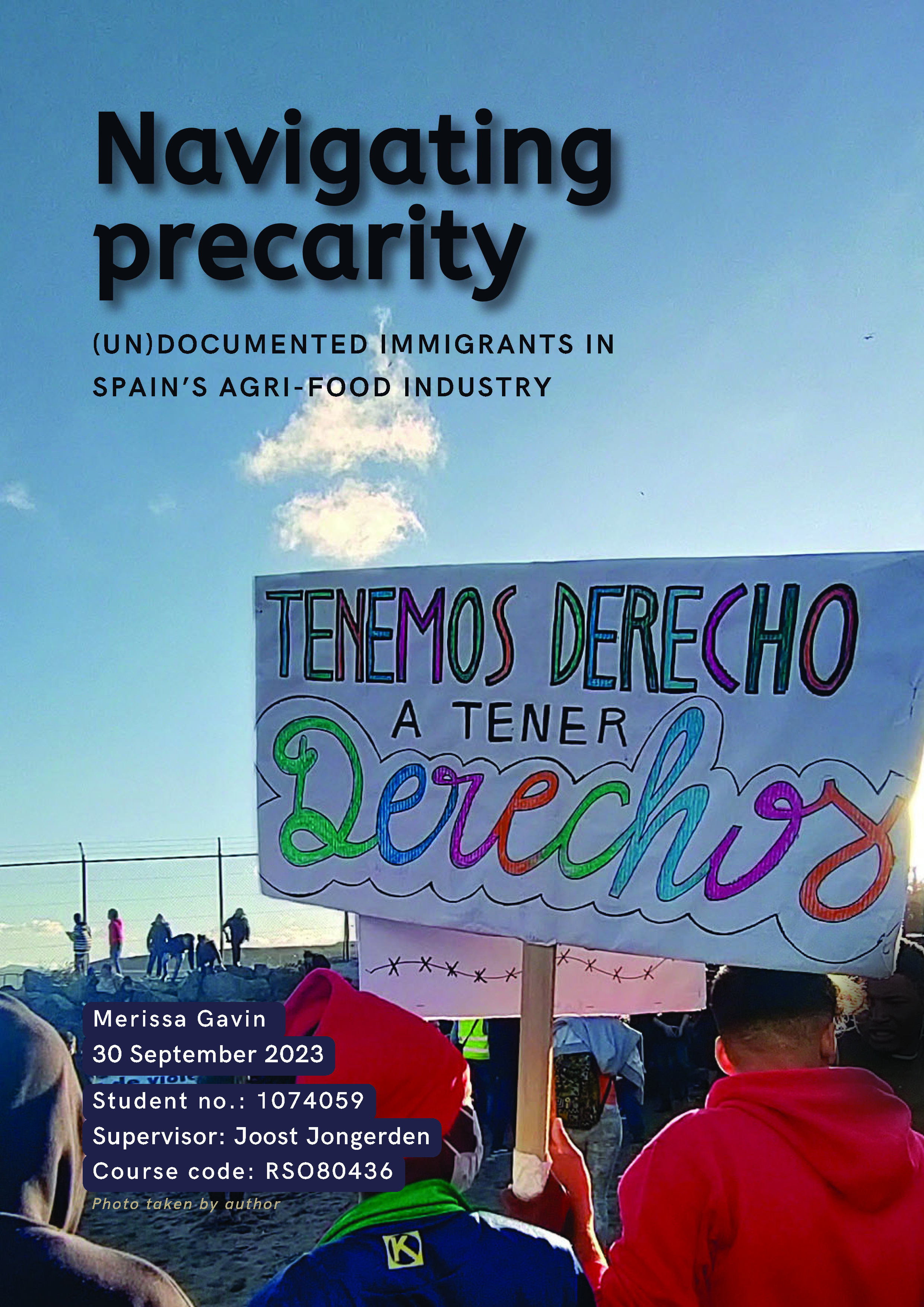
Navigating Precarity:  (Un)documented immigrants in Spain’s agri-food industry

In the master thesis “Navigating Precarity:  (Un)documented immigrants in Spain’s agri-food industry” Merissa Gavin discusses the strategies employed by immigrants in navigating precarity from the perspective of the immigrants themselves and new forms of being political are being created. The main question that guided her research was: “How do undocumented immigrant workers in Spain’s agri-food industry engage in claim-making and claim-living to navigate precarity?”

Over the last two decades, immigrant workers have become a structural element of Spain’s agri-food industry. Arriving to Spain undocumented, immigrant workers have few options other than the exploitative working conditions of the agricultural sector. The present research centres on the precarity of these workers, highlighting the multitude of ways they navigate vulnerability and uncertainty. This research is important, firstly, to raise the voice of undocumented immigrant workers and demonstrate how they exercise agency in everyday activities. Secondly, to investigate the socio-spatial conditions that facilitate, or obstruct, the emergence of a collective political being.

Continue reading