Balancing between multiple realites

By Marlies Meijer, MSc-student combining Land Use Planning and Rural Sociology

“Only when we travel, and meet strangers, do we recognise other ways of being human” (Patsy Healey in Collaborative Planning, after Latour).

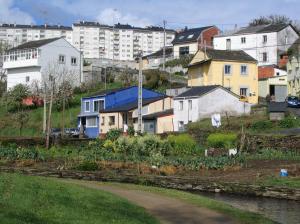
city - countryside transition in galicia

city - countryside transition in galicia

So here I am, travelling (or balancing) between land use planning and rural sociology, my Dutch planning knowledge and the Galician rural reality, between reading in Gallego, speaking in Castellano, writing in English and chatting in Dutch, between the Spanish working hours and my Dutch empty stomach.

As many students I wanted to stay abroad for a long period of time during my MSc. For students in rural sociology this is probably a logical highlight of their studies; students in land use planning leave their country less frequently. I wanted to go anyway. Since my interest in rural dynamics and policy making processes, contact with the RSO group was established quickly, together with the possibility to go to Galicia, Northern Spain.

Back in the Netherlands, I was aware of the Dutch context of my education so far. Most examples provided are Dutch, or could be placed in the planning Dutch context. I wanted to broaden my scope, go somewhere where policy making is less evident and face the effect of a different cultural context, but also to experience a real rural area. Now I find it hard to let the familiar Dutch context go and to explain what I exactly do study in the Netherlands (something like geography, people making plans and rural development) and what my research is about (even more vague). Multi-faceted policy, focussed on the spatial environment, does not exist here, as it exists in the Netherlands. So I keep on balancing, and exploring and let myself be surprised every day by the Galician way of doing.

Marlies also has a personal blog (in Dutch):  http://marliesengalicia.blogspot.com/

Excursions Understanding Rural Development

As a part off the course Understanding Rural Development (RSO 31806) we went on a field trip to de Eemlandhoeve in Bunschoten and explored the inner-city of Utrecht. By this excursion we visited a number of interesting expressions of urban-rural relationships, from a rural and an urban perspective.

De Eemlandhoeve

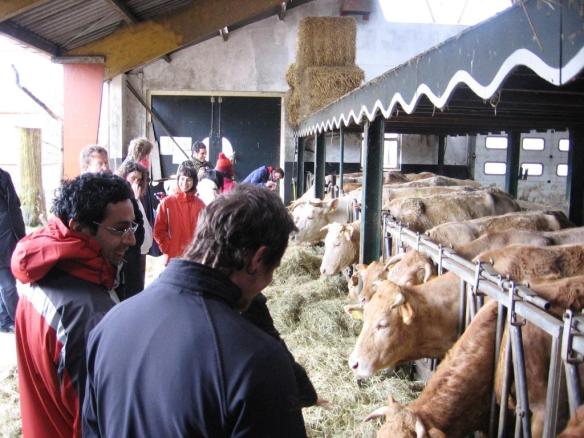
De Eemlandhoeve, owned by farmer, rural entrepreneur and philosopher Jan Huijgen, can be considered as an extreme example of a multifunctional farm enterprise. The group of Blonde d’Aquitaine’s form the centre of a rural enterprise which includes a large number of activities like a farm shop, care facilities, meeting and office facilities, an education garden and even a farmer’s cinema under construction.Blonde d'Aquitaines at the Eemlandhoeve

Next of being a multifunctional entrepreneur Jan Huijgen is a well known personality in Dutch rural development, active on a local, national, international (and maybe in the near future on a global) level. The farm residents a rural innovation centre and last October de Eemlandhoeve hosted the EEconference or Europese Eemlandconference, veelzijdig platteland.

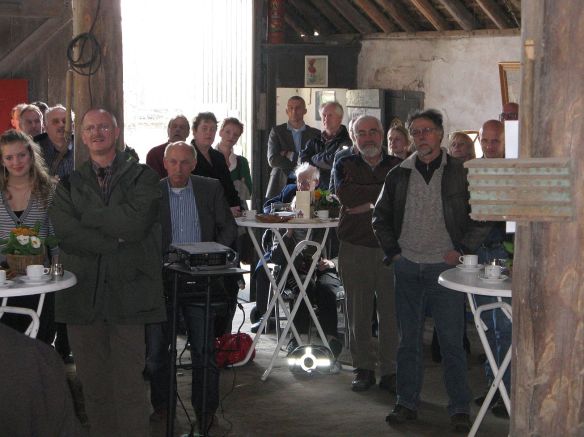
On the excursion owner Jan Huijgen told us about his inspiration, motives and future plans with his farm. After his presentation we had an interesting discussion and were showed around the place.

Local food in the city of Utrecht

The second trip brought us to a rather different surrounding; the historical inner-city of Utrecht. On de Eemlandhoeve our focus was on the rural side of urban-rural relationships, in Utrecht we looked upon it from an urban perspective.

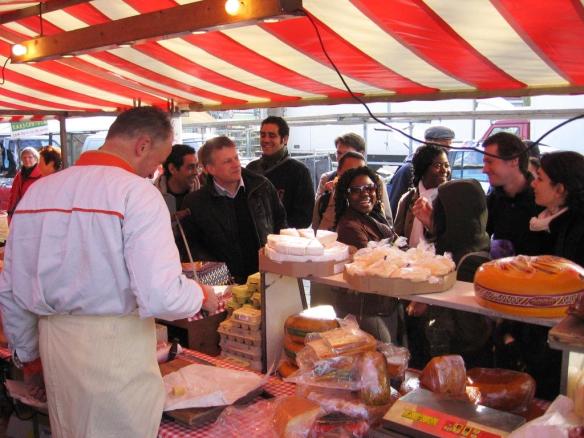
Cheese stall at the Vredenburg MarketTogether with our guide Frank Verhoeven (see his website)  we first went to the Wednesday Vredenburg Market. On this market we visited a cheese seller linked to the organization called Dutch Cheese Centre (website under construction). The stallholder told us about some typical Dutch cheeses and the trade in locally produced ones. After some tasting we set out for the traditional bakery Bakkerij Blom were owner Theo Blom showed us around and told about his bakery, traditional products and production.  
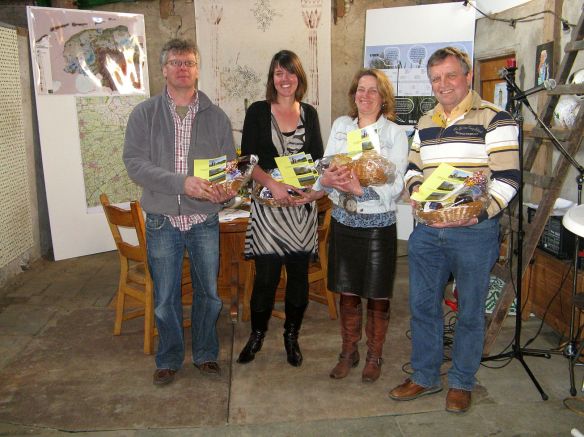
Our last stop was a visit to the five star hotel and restaurant Karel V for a number of short presentations. In the hotel our guide Frank Verhoeven started by telling us about his ‘Boerenbox’ initiative and his vision on a more locally based production and consumption. Secondly, one of the Karel V chefs explained us about the way they work with seasonal products originating solely from regional grounds and local suppliers. Lastly, Arie Bosma, one of the initiators of the campaign ‘Lekker Utregs’, told us about the initiative to reconnect the city of Utrecht with its surrounding countryside by establishing a so called Green Participation Society.

By the fieldtrips we got acquainted with several interesting expressions of urban-rural relationships, from a rural and an urban perspective. It was a nice and inspiring way of linking theory from class to reality by ‘tasting’ real life examples in ‘the field’.

Geleerd in het Westerkwartier

Afgelopen donderdag 2 april werd in Lutjegast, Westerkwartier Groningen het boek gepresenteerd over vijf jaar samenwerking tussen Van Hall Larenstein, Wageningen Universiteit en een groot aantal betrokkenen in het (zuidelijk) Westerkwartier.

simon-petra-jifke-arien3

Het boek doet verslag van de betekenis van dit onderwijsproject (2003-2008) voor het gebied, de studenten en de onderwijsinstellingen. In het gebied kwam een proces van sociaal leren en bewustwording over ontwikkelkansen op gang terwijl ruim 50 studenten leerden omgaan met interactief onderzoek doen. Voor de onderwijsinstellingen vormde het project een belangrijke brug naar de praktijk. Het kennisarrangement dat gedurende de jaren werd ontwikkeld wordt tegenwoordig wel ‘werkplaats‘ genoemd en is in het hele land volop in ontwikkeling. Ook het Westerkwartier streeft naar een vervolg op dit project, naar een werkplaats in eigen stijl.

schuur-binnen22De gezamenlijke betrokkenheid die de afgelopen jaren kenmerkend was voor de samenwerking is ook terug te zien in de publicatie van het boek, waaraan RIGO, de vakgroep Dierlijke Produktiesystemen, LEADER Westerkwartier en Staatsbosbeheer financieel hebben bijgedragen. Het project heeft een belangrijke basis gelegd voor toekomstige samenwerking in de driehoek gebied, beleid en onderwijs.

Manual for Cross Cultural Learning

Since 2005 I particpate in the ENDLT network with people from the area Westerkwartier in Groningen. Together we form a Dutch team and we have been visiting other teams in Ireland, Wales, Sweden and Finland trying to learn in-depth from other rural development practices in other cultures. Along the way we developed a manual for cross cultural learning which was discussed and tested this year January (see blogs 26-1 and 29-1). Our Swedish partners have taken up initiative to write the manual which is available now for all who want to set up cross cultural exchanges.

Our network, based on LEADER funding, differs in three ways from usual transnational LEADER visits:

  1. Teams involve different types of expertises, from local activists, to scientists, to local government officers and governors
  2. Visits are multi-team visits in which learning not only takes place in confrontation with the visiting area but also in the confrontation with other cultural perspectives from other visiting teams
  3. Multiple visits within the same network over the years

All three factors serve to make knowledge exchange and learning more effective. It pays off to invest in longer term relationships because for in-depth learning people need time, trust and enabling/safe interaction. We indicated this as one of our success factors in the factsheets that we produced for the ruract network. This network describes itself as:

1) A cooperation network gathering European Regions politically involved for promoting rural innovation at operational and regional level. 2) A resource centre providing methodological tools and an updated database with regional good practices for rural areas and analyzed in terms of transferability. 3) A field of experimentation for European Regions allowing them to exchange and find solutions face to global challenges of rural territories.

This French initiative links up good practices in rural development all over Europe. Our experience in the ENDLT network will be available on this website early summer.

Social movement and Brazil

Last week friday’s lecture in the course ‘People Policy and Resources’ discussed theory and practice of social movements. Social movements can be defined as social forms through which people:

 “coordinate and act together as collectives, respond to shifting environments and conflicts, dramatize and frame shared understandings of grievances, solidarity and visions, and challenge and influence existing political and cultural systems of authority.” (Karpantschof 2006)

One of the examples in class was the Landless People’s Movement in Brazil (MST). As a background to this example students had to read about the history and community-making of the MST (Wolford, 2003) and about the adoption of agroecology as “the science of sustainable agriculture”  within the movement (Delgado, 2008: 563).

Thanks to the cooperation of our group with the Rural Development Post Graduate Program in Brazil, of the Federal University of Rio Grande de Sul (see earlier blogs 27 January, 13 February, 6 March) the students could also see how the movement works through part of a dvd ‘Agriculacao National de Agroecologia’. Together we watched a documentary about IL ENA, the national meeting for agroecology in Brasil which took place in 2006. The documentary clearly showed how social movements work through both practice ánd language. On the one hand the struggle for the material; actions for rights and resources. And on the other hand the struggle against dominant discourse; the construction of alternative conceptions and significations which politicizes dominant understandings and creates room for change.