Financing Future Farming – MSc-thesis by Susan Drion

Susan Drion, MSc-student Organic Agriculture, Wageningen University.
Below the Executive Summary of the MSc-thesis “Financing Future Farming: an exploration of alternative financing constructions to enhance sustainability at farm level“.

The full thesis can be downloaded from the WUR-Library by clicking on the hyperlink.

De thesis bevat ook een Nederlandse samenvatting. Zie ook haar eigen website: waardenscheppers.com

The pressing ecological and economic state of Dutch agriculture begs eagerly for the acceleration of the sustainability transition in this sector. Access to sufficient capital is a major bottleneck in this transition. Established ways of financing agriculture, i.e. via a  bank loan, becomes increasingly harder. This warrants an exploration of alternative financing constructions. This research aims to study to what extent alternative financing constructions enable farmers to achieve sustainability on farm level. It aims to find out how and why these constructions work well, how they are realised and what features of possible best practice can be extracted from them. This research is limited to the context of Dutch agriculture and to financing constructions that yield monetary returns. Alternative financing constructions are defined by the underlying investment logic to create social and natural returns and by the novelty in the mechanisms used.

In this research alternative financing constructions are considered new institutional arrangements, embedded in the framework of neo-institutionalism, practice theory, new practice creation and scaling dynamics. To study the alternative financing constructions, a qualitative case based best practice approach is employed. Eight cases of alternative financing are selected, ranging from citizen participation constructions, alternative loans, business participation constructions and collaborations with institutional investors. Over the course of two months, farmers and investors directly related to the selected case sites were interviewed. The technique of crowd-sourcing was used to find cases, reach the target group and get to know the field of social financing better. Twelve blogs were written about the research process and about the interviewed farmers. Also a collaboration with communication partners was set up to make this technique more effective.

By using the grounded theory approach the data was analysed and the following findings revealed itself:

  1. The key feature that is the foundation of the mechanisms of nearly all alternative financing constructions is the separation of capital and business. Also farmers offered diverse returns on investment;
  2. The added value of the alternative financing constructions to farmers were mostly the friendly collaboration with investors, which gave them a licence to produce, and the solutions they offer to take over of farms by the next generation;
  3. The alternative financing constructions were products of a long build up, earlier failing and the right momentum. Farmers experienced little resistance in the process;
  4. Each alternative financing construction requires certain personality traits of the farmer, the latter is therefore decisive in the choice of financing. Also, the current low interest rates for saving on the bank made it easier for the alternative financing constructions to succeed.

Five features of possible best practice were extracted from the findings.

  1. Make use of certificates, acting as perpetual bonds;
  2. Make use of long term lease contracts to access land and buildings;
  3. Stack capital flows;
  4. Work with shareholders;
  5. Loans remain an option.

Finally, one can say that alternative financing construction do enable farmers to achieve sustainability on their farms. However, the scope is limited because novel alternative financing constructions are yet only used by their designers. Further research is required to find out for whom and under which conditions features of possible best practice are scalable, while at the same time harnessing the personal approach to investors.

Keywords: social financing, Dutch agriculture, alternative financing constructions, elements of best practice, sustainability, separating capital and business, new practice creation, scaling

First generation Farmers: values, practices and relations – MSc-thesis by Laura Genello

Laura Genello, MSc-student Organic Agriculture, Wageningen University.

The average age of farmers is steadily rising across the United States and Europe, while the  proportion of young and beginning farmers declines. Challenging  economic conditions, coupled with agricultural consolidation and rising costs, have led to a decrease in farm successions. Simultaneously, the popular media has reported on increasing interest in agricultural careers among those from non-farming backgrounds.

This emerging population of first generation farmers has largely been ignored by the  academic literature, with only a handful of studies that suggest the ways in which these farmers differ from others. This study aims to characterize the values, practices and  supply chain relations of first generation, beginning farmers (FBFs). By incorporating concepts from research on farming styles, agricultural paradigm shifts and identity, I investigate to what extent FBFs represent change in agricultural attitudes and practice. To do so, I position their farming styles between the archetypes of the productionist and agroecological paradigms. These paradigms hold specialized, commoditized and production-centric traditions in agriculture on one side of a spectrum, and ecologically oriented, community embedded alternatives on the other. I took a comparative, exploratory approach, recruiting farmers who were both first generation (did not take over a family farm), and beginning (approximately less than 10 years experience) from two countries, the Netherlands and the U.S. state of Maryland. Data collection occurred in two phases: an online survey distributed using snowball sampling, followed by semi-structured interviews with 33 participants (15 in the Netherlands; 18 in the U.S.), selected strategically to represent a diversity of survey respondents. The survey yielded 95 responses that met the inclusion criteria: 38 from the Netherlands and 57 from the United States. Most FBFs were practicing small-scale, diversified agriculture, marketing direct to consumer, and using some level of unmapped organic methods. Interviews revealed FBFs to be motivated by a search for meaningful work, and generally have a strong environmental and community ethic. These principles were balanced with a high valuation of the business of farming. FBFs faced a variety of challenges, predominantly financial constraints, access to land and labor, lack of knowledge and regulatory barriers. Their farm practices and structure were the result of a negotiation between their values and business ethic as filtered through practical constraints. The solutions they employed included small scale, low-investment configurations, direct marketing, judicious application of web-based and small farm technology, strong online and in-person networks, and collaborations to access land, share knowledge and market products. While their practices, relations and values are heterogeneous, overall FBFs represent a shift towards the agroecological paradigm.

Key Words: beginning farmers, first generation farmers, new entrants, agroecology,
farming styles, farmer identity, alternative food networks.

The full thesis From Food Forest to Microfarm can be downloaded from the WUR-Library

From hunger to obesity – MSc-thesis by Sonia Zaharia

By Sonia Zaharia, MSc-student Organic Agriculture.

Many low-income countries deliberately pursue agricultural specialization to increase yields and thereby lift their population out of hunger and poverty. Trade is supposed to offset the implied lower diversity of food production and deliver a food supply that supports the health of their population. This study challenges this assumption. I investigate the link between the prevalence of overweight and agricultural specialization. Using a fixed-effects panel regression on data from 65 low- and middle-income countries over the period 1975-2013, I find that countries in which agricultural production is more specialized have a larger share of overweight women. The positive relationship is higher in countries with lower per capita income. The correlation is not statistically different from zero for the male population, which confirms existing empirical evidence that malnourishment tends to be more frequent for women than for men. My results suggest that there are negative health implications of agricultural specialization in poor countries.

My full thesis From hunger to Obesity: agricultural specialization and obesity in low- and middle income countries can be downloaded from the WUR-Library.

Thesis opportunity: food banks as contested spaces for identity struggles

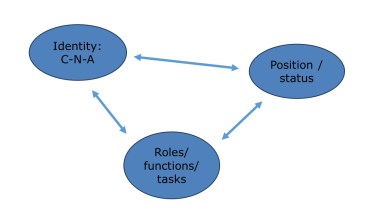
In general a person’s identity has cognitive-descriptive (C), normative-ethical (N) and affective-emotional qualities (A). Besides a person’s identity, a person can find him or herself to be in a certain position or have a certain status, and a person can have certain (un)officially assigned roles, tasks and functions. See the figure below. These three elements can ‘agree’, or be ‘in line’ with each other, but they can also diverge from each other, or be ‘in conflict’.

Plaatje fb identity

These distinctions are to a certain extent superficial: they are analytical distinctions. In that capacity they can help us discover different elements and qualities of peoples’ experiences. Moreover, a person’s identity is not once and for all a ‘given’. Identities develop and keep doing so in interaction with other people: first with primary caretakers and later with a host of significant others who also have an identity, certain roles and functions, a certain position or status, and corresponding expectations towards others.

In this MSc thesis proposal this interaction is taken to be located at the food bank where volunteers distribute food parcels among recipients. Volunteers and recipients have short or longer conversations about the food parcels and/or the reasons for being there at the food bank. In scientific literature on food banks it is an almost unquestioned assumption that the food bank is a charity organisation, very often inspired by religious ideas or values of love and kindness for fellow human beings in need, and an attitude of gratefulness and humility on the side of the recipient. A sociological understanding of charity would indeed point at these expected roles, functions and attitudes that the concept of charity implies. The general research question of this proposal is: To what extent is this general, unquestioned assumption supported by evidence?

Sub-questions are:

  • What are feelings and emotions towards, and what are normative opinions of volunteers and recipients about the existence of food banks and their activities?
  • To what extent do recipients experience discrepancies between the status in which they, (in)voluntarily, find themselves, and the way in which they see themselves or would like to see themselves? (In other words: to what extent do we see conflicts between the three elements in the figure above?)

Proposed research methods are participatory observations, interviews with volunteers and recipients, identity tests and conversation analysis. Starting literature is available.

The thesis will be supervised by Leon Pijnenburg (Philosophy) and Esther Veen (Rural Sociology). Interested? Contact Jessica de Koning: jessica.dekoning@wur.nl.

Drijfveren, waarden en praktijken van eerste generatie boeren – MSc thesis onderzoek Laura Genello

Laura Genello, student MSc Organic Agriculture van Wageningen University, doet een vergelijkend onderzoek naar eerste generatie boeren in Nederland en de staat Maryland in USA. Eerste generatieboeren zijn zij die geen familiebedrijf hebben overgenomen, maar toch op de een of andere manier zijn begonnen met boeren. Zie haar website Beginning farmers research voor meer informatie (in Engels). Daarop staat ook de online vragenlijst met een Nederlandse en Engelse versie.

Laura wil onderzoeken of deze instromers bepaalde ideeën en waarden over hoe goed te boeren met elkaar delen en in hoeverre ze die in praktijk weten te brengen. Laura heeft een online vragenlijst gemaakt die ingevuld kan worden door personen die in het profiel passen. Hier vindt u de Nederlandse versie van de online vragenlijst. Mocht u zelf een eerste generatie boer zijn dan kunt u de vragenlijst zelf invullen. Mocht u iemand kennen die hier aan voldoet, dan mag u de link doorsturen.

U kunt ook uiteraard ook contact opnemen met Laura Genello: laura.genello@wur.nl