In my MSc thesis, I studied smallholder farming in Western Bahia, a region marked by the expansion of intensive soy production in the Brazilian Northeast. As a part of the area known as MATOPIBA (standing for the parts of the states of Maranhão, Tocantins, Piauí and Bahia covered by the cerrado savannah), Western Bahia has been a crucial space for Brazilian agribusiness development since the 1980s, as it offered abundant land with unclear land titling and high agronomic potential.
Introduction A person’s food environment has a huge impact on what food is accessible to them. This influences not only the kind of food choices residents make but also how they navigate the city. In 2021, the municipality of Wageningen published its Food Agenda. The report noted that residents with a migration background had limited involvement in food-related initiatives. It also mentioned the general lack of knowledge about how residents navigate themselves in the urban food environment. My master thesis responds to this knowledge gap. My thesis was conducted using Food Asset Mapping and Photovoice methods to explore the food routines of Wageningen residents with a migration background and their perception of the local food environment. In this blog post, I will show a glimpse of the findings, answering the main research question: How do households with various migration backgrounds navigate themselves in the multi-ethnic food environment of Wageningen?
In the Master thesis “Working for the occupier: Palestinian youths navigating the colonial settlement”, Davide Fabris investigates how young Palestinians make it through the daily challenges and precarity of working in a Israeli settlement. The main research question of his research is: ”How are young Palestinians experiencing and dealing with labour incorporation within the Israeli settlements’ economy?”.
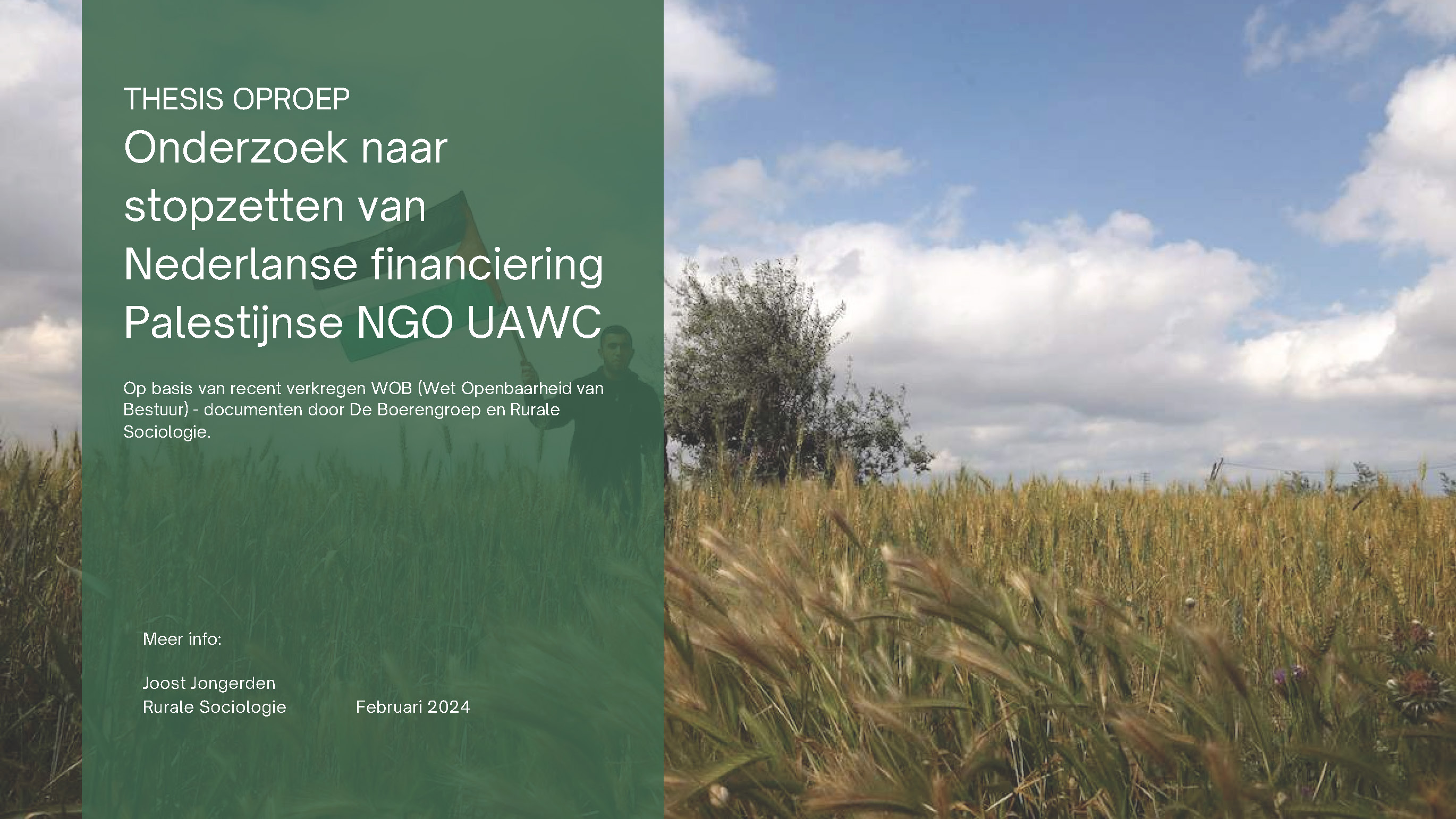
Nederland besloot in 2022 de financiering voor de Palestijnse NGO UAWC (Union of Agricultural Work Committees) stop te zetten. UAWC ondersteunt duizenden Palestijnse boeren, vooral in gebieden op de Westelijke Jordaanoever waar Israël een illegale kolonisatiepolitiek voert. Israël heeft lang druk uitgeoefend op donoren om de steun aan UAWC te stoppen, omdat het volgens Israël een mantelorganisatie is van de Palestijnse verzetsbeweging PFLP (People’s Front for the Liberation of Palestine).
Nederland heeft UAWC extern laten onderzoeken door een bureau dat gespecialiseerd is in veiligheidsvraagstukken. Uit het externe onderzoek zou blijken dat sommige (voormalige) medewerkers banden hebben met de Palestijnse verzetsbeweging PFLP. De UAWC reageerde geschokt op het besluit van de Nederlandse overheid en betoogde dat het externe onderzoek geen aanwijzingen had gevonden voor financiële stromen tussen UAWC en de PFLP, noch voor organisatorische banden tussen beide organisaties.
De Boerengroep en Rurale Sociologie hebben in mei 2022 met een beroep op de Wet openbaarheid van bestuur (WOB/WOO) verzocht om informatie met betrekking tot het besluit van Nederland om de financiering aan de Union of Agricultural Workers Committee (UAWC) stop te zetten. In januari 2024 is de gevraagde informatie toegestuurd, bestaande uit meer dan 600 documenten, variërend van (korte) e-mails tot notities. De WOB/WO-documenten bieden inzicht in hoe de Nederlandse overheid tot het besluit is gekomen om de financiering aan UAWC stop te zetten, en meer in het algemeen:
De politieke context waarin een dergelijke beslissing is genomen;
De criteria die het hanteert, en;
De afwegingen die de overheid daarbij maakt.
Voor een kwalitatieve analyse van de documenten en het doen van vervolginterviews wordt gezocht naar een masterstudent. Deze masterstudent dient te beschikken over Nederlandse taalvaardigheid en bij voorkeur bekend te zijn met kwalitatieve onderzoeksmethoden. Het onderzoek is interessant voor die studenten die geïnteresseerd zijn in onder meer i) het politieke krachtenveld waarin overheidsbeleid en besluitvorming tot stand komen, ii) veiligheidsvraagstukken in relatie tot medefinanciering en iii) de politiek van hulp in de context van langdurig conflict. Gezien de omvang van het materiaal, is er ruimte om een eigen invulling te geven aan het onderzoek.
Voor meer informatie: Joost Jongerden (RSO) en Gemma van der Haar (SDC)
On Monday 4 December 2023 at 16.00 CET Maite Hernando Arrese will publicly defend her PhD thesis entitled ‘Let it flow: Navigating hydropower conflicts in southern Chile’. The defense will take place in the Omnia Auditorium and will also be broadcasted live (a link will appear in the events box, in the upper left corner of the screen). The full thesis can be read online or downloaded (usually from the first day after the PhD defense onwards) from the repository of Wageningen University PhD theses or by clicking on the DOI link.


 Rural Sociology Wageningen University