
On 9 May, Joel and Daniel Salatin from Polyface Farms will be speaking in Wageningen on their efforts to change agricultural practices and thinking in the US.
Joel will also be a keynote speaker for the closing day of the Food Film Festival in Amsterdam on 11 May. More information is available on the evening in Wageningen at the Facebook page for this event.
(Un)accepted foods: Why are some edible substances considered food and others not?
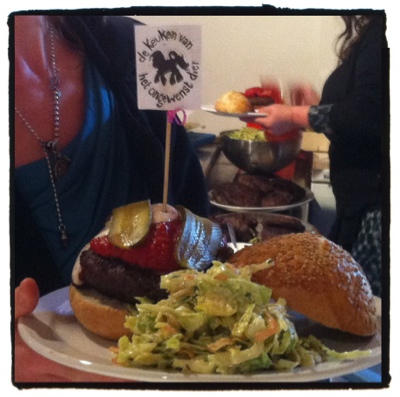
My Little Pony Burger
Last night Stichting Ruw hosted an event on “(Un)accepted Foods”.
The goal of the evening was to learn more about the potential of insects as food and about eating unconventional food products like horse and goose meat.
There were excellent presentations.
Rob Hagenouw, an artist, spoke about his project Keuken van het Ongewenst Dier(Kitchen of the Unwanted Animal) where they make and sell “My Little Pony Burgers” and croquettes from geese shot at the airport.
Arnold van Huis, author of ‘The Insect Cookbook’ and Professor of Entomology (see his TED talk here) gave a fascinating talk covering the opportunities and challenges association with the development of an insect eating culture in Europe.
Jessica Duncan, from the Rural Sociology Group, provided a socio-cultural perspective on food categorisation: why are some edible substances considered food and others not. The presentation is available here.
Burgerkracht in krimpend Limburg: master thesis student(en) gezocht
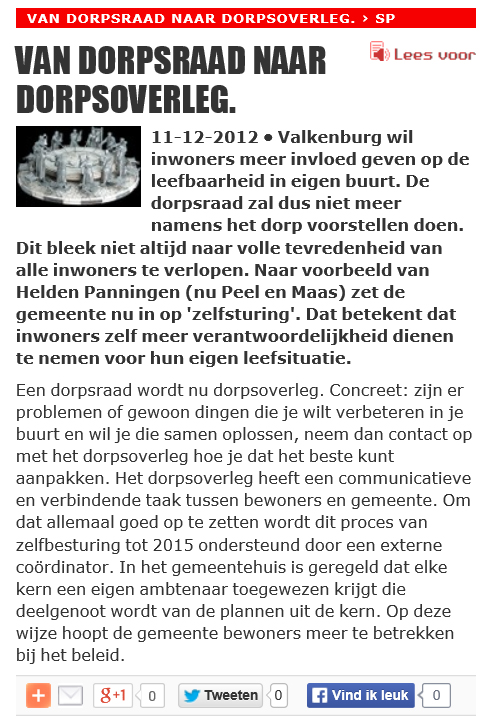 Een Masterthesis in een real life setting, dat is de mogelijkheid die je hier wordt geboden. In het wetenschapswinkelonderzoek ‘Inzicht in burgerkracht in Limburg’ wordt in opdracht van de Vereniging Kleine Kernen Limburg (VKKL) onderzoek gedaan naar de veranderende burgerwensen in Limburg in het licht van de participatieve samenleving. Door haar activiteiten in de haarvaten van de maatschappij signaleert de VKKL een trend naar een samenleving die voorzieningen zelf organiseert en soms ook zelf bekostigt. Burgers wachten niet langer af, maar nemen zelf initiatieven om hun leefomgeving te verbeteren. Binnen alle veranderingen in de Limburgse samenleving heeft vooral ook de demografische ontwikkeling (ontgroening, vergrijzing en krimp) ingrijpende gevolgen voor de leefbaarheid.
De veranderende verhouding tussen burgers en de overheid lijkt steeds meer te draaien om co-creatie. Dit vraagt om een nieuwe attitude bij de overheid én de burger. De vraag die hier centraal staat is hoe die burger hier nu op voorsorteert. Welke ontwikkelingen zien burgers op zich af komen, hoe anticiperen ze hierop en wat hebben ze nodig om die nieuwe rolontwikkeling in te vullen?
De VKKL, nu 10 jaar actief op Dorpsniveau in Limburg, ziet dat er in de praktijk heel verschillend op maatschappelijke transities wordt ingespeeld. Sommige bewoners en gemeenschappen treden daarin heel pro-actief op. Initiatieven als dorpsoverleggen kenmerken zich vaak door een sterke interne drive, samenhang en gemeenschappelijke focus. Andere, meer traditioneel georganiseerde samenwerkingsverbanden als dorpsraden zijn soms nog meer reactief en gericht op ondersteuning van buiten. Soms wordt daardoor vertraagd of onvoldoende ingespeeld op de maatschappelijke ontwikkelingen.
Als jij het leuk vindt om je te verdiepen in de aard van verschillende typen ‘burgerkracht’ in Limburg (stad en/of platteland), in de wijze waarop dergelijke lokale initiatieven in staat- en bereid zijn in te spelen op de maatschappelijke transities en uitdagingen in Limburg als het je interessant lijkt om de ondersteuningsbehoefte die daarbij bestaan vanuit deze initiatieven inzichtelijk te maken neem dan contact met ons op.
Contactpersonen: Bas Braman (bas.breman@wur.nl ) en Jeroen Kruit (jeroen.kruit@wur.nl).
Waarde van streekproducten – Groene Hart drinkyoghurt

Deze keer een berichtje in het Engels. Ik heb laatst twee buitenlandse studenten geholpen die een Capita Selecta (een ‘open vak’) volgden bij Dirk Roep, een collega van de Leerstoelgroep Rurale Sociologie. Ik heb een paar keer met ze meegedacht over hoe ze hun onderzoek zouden kunnen opzetten. Ik heb ze gevraagd een korte samenvatting van hun resultaten te geven voor dit blog. Bij deze!
“We are Miriam Romero and Camilla Ponte, Master students at Wageningen UR. We studied rural development in practice; we investigated the added value of the label Groene Hart Streekproducten. We studied the relationships of a certified local product – the drink yoghurt of farm Veldhoeve – with the food chain.
The drink yoghurt holds this label for a year now and is distributed to 64 supermarkets of the Hoogvliet chain. Veldhoeve farm is part of the Groene Hart cooperative of local farmers and craftsmen. In 2008 the cooperative adopted the
View original post 272 more words
Tijdelijk werk beschikbaar in Zwitserland in het zomerseizoen
Een klein, gezellig pension in het Zwitserse Engadin is op zoek naar medewerksters in het komende zomerseizoen (juni-september). Werk en betaling volgens C.A.O. Detailinformatie op aanvraag bij larandulina@bluewin.ch
Website: http://www.larandulina.com;
Reakties graag nog deze week.
Hotel-Pension La Randulina,
7556 Ramosch, Schweiz.
Tel.: (00)41 (0)81 860 1200
https://www.facebook.com/LaRandulina

