“I bike, so I am” (or was it…”I am, so I bike”?) – Jan Schakel in Rennes – Part 3

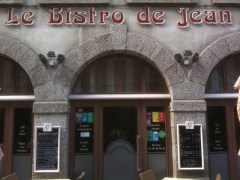
Tomorrow I will leave Rennes and go the  countryside (to Villarceaux) to assist a field practical on sustainable indicators in the rural area. But I already miss the city. As I wrote before, Rennes is an special city: it has character, class and culture. And after three weeks you’re getting to feel at home: I know my way around, do my daily shopping’s, shake hands, have a kiss here and there (‘des bisous’, more ‘cheek to cheek’…), etc. After three weeks you also get a rhythm:  I buy a Dutch newspaper at the station, have  a coffee on the terrace and a late dinner at the bistro (see picture).
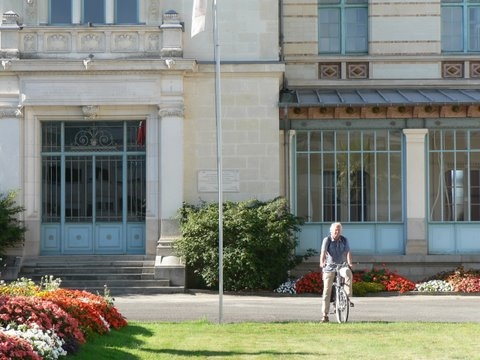
Rennes is a very beautiful city, also due the fact that they have a major that is very well respected and who is major for over 30 (!) years already. So compared to other cities, Rennes has a very sustainable and constant policy, and you can feel and see the results of that everywhere.  I will show you two –also for me – very interesting examples. First : Rennes urban strategy (and at the same time: rural). Rennes, with almost 200.000 inhabitants within the city, is a very ‘compact’  city. Also due to ecological and rural motives, the city of Rennes decided over 30 years ago to  concentrate housing within its walls, and by that, saving the qualities of the surrounding countryside. So the policy was to intensify the density of its buildings, but according to very high architectural standards. So indeed, you don’t see any suburbs, industrial zones or slumps within the city: it all has quality and a very special atmosphere.

Continue reading →

Jan Schakel in Rennes – Part 2

So, pronouncing and understanding French words in an English way and visa versa can be rather tricky. Moreover, because in France they try to keep their language ‘clean and pure’, so you can not use or pronounce words like computer, laptop or cell phone in French or in a French way (you have to know that they’re called ordinateur, portable, etc). The more surprising it is to find out that words in French sometimes do have the same meaning and structure as for example in Dutch. The English word ‘data’ for example is in Dutch ‘gegevens’, and in French ‘données’. These words have exactly the same structure, which might be caused by it’s origin: a positivistic way of thinking in both cultures. In my workshop “How to tackle reality and complexity” I could make clear to the audience that facts and data or ‘no gift from nature’, and that they or not ‘given to us’, but that it is mankind who takes information from nature in an active way and in this process it creates and constructs fact and data. So no ‘gegevens’ or ‘données’ at all!

Not only knowledge of languages is important to ‘survive’ in a different country (like knowing the difference between chamber, salle and bureau…), but also insight in their cultural and institutional history. I do work almost ten years now within an international framework on education (like IMRD, Erasmus Mundus, Intensive Programs), so I’m rather familiar with differences in educational systems between and within the European countries. But again I was too biased when I tried to understand what’s going on here in Agrocampus Ouest. For example: courses can last over 6 month, and the only way to understand the course and to get access to the content of it, is to join (‘assister’) the course. There are (hardly) any course outlines, no books, no readers, etc. Everything is taking place within the classroom and students have class during the whole day (2 x 4 hours), during the whole week, and this last week after week after week… So the professor himself is very important; not only in research but also in education. He is the authority, and the student really serves his apprenticeship with the professor. The French word for education is ‘formation’ –like word ‘vorming’ in Dutch- and indeed this educational system forms and shapes the student in a traditional way.

Continue reading →

Reality is an illusion – Jan Schakel in Rennes – Part 1

“Reality is an illusion, caused by a lack of drugs”. I found this rather philosophical text somewhere written on the wall in one of Rennes’ universities. It made me smile; not only because of it’s statement (very original), but also because I had to give a workshop the day after. The title of this event was: “How to tackle reality and complexity?”. I was wandering what to do? Should I present my 70 slides (as planned) with comments during the four hours of the workshop? Or should I ask the students to use some drugs? Maybe it was even a better way to ‘tackle reality’, according to the quotation on the wall. It was for sure a thrilling idea! I decide not to do so. So I worked with my class through all the slides, and I think I did the right thing. Drugs are forbidden anyway in France! (‘See the PDF-file Rennes handout 2010 for a brief summery of the content of this workshop).

I am in France for some weeks, being a ‘visiting teacher’ from Wageningen University, now working at the Agrocamups Ouest. One week I was supervising 40 students during a “Stage de Terrain” at  the Cote d’Armor (North Brittany), and next week I will do the same during a practical in Villarceaux, west of Paris (just very nearby Giverny). This ‘stage du terrain’ will focus on ‘Identifying sustainable indicators for Rural Development’. In between I am living and working in Rennes for three weeks. Rennes is the capital of Brittany. It is a beautiful city! With almost 200.000 inhabitants, including over 60.000 (!) students, it indeed is a cultural and intellectual city. Besides that, the city is rather wealthy and ‘good-looking’: it represents a rich history, with many important and impressive institutes, and almost no ‘heavy industry’ (except the automobile industry). Rennes is a leading centre in telecommunications and other knowledge based industries. But in spite of that, Rennes also has a different atmosphere, what sometimes makes me remember to my hometown. Rennes is ‘maxi-Wageningen’ (whereas Agrocampus Ouest really looks like a ‘mini-Wageningen’). Rennes isn’t just a very intellectual city; it also is very multi-cultural, very international and also very ‘alternative’. So a good place to be. (Have a look –for example- at www.salonbio.fr and www.legoutdici.com where you can find information on the 9th edition of the three days lasting manifestation on ‘ La Terre est Mon Metier’. I will come back later on the special relationship between Rennes and these organic initiatives in the rural area).

Continue reading →

Second European Sustainable Food Planning Conference – a last reminder

As mentioned in one of my previous blogs the  Urban Performance Group of the University of Brighton (UK) will host the second European Sustainable Food Planning Conference on 29 and 30 October 2010 under auspices of the Association of European Schools of Planning (AESOP). Although the deadlines for submission of abstracts and selection of papers and posters have passed, there are still a few places available to attend the conference. It promises to become an interesting conference due to the diversity of disciplinary and interdisciplinary contributions and the geographical range of cases and experiences that are going to be presented. And, furthermore, it also seems to be a vary timely conference; the attention for urban agriculture, food and health, food and urban design and food governance is rapidly increasing, not only in the academic realm but also in political and societal debates.

For more information about the conference you can download the conference brochure or have a look at the conference website.

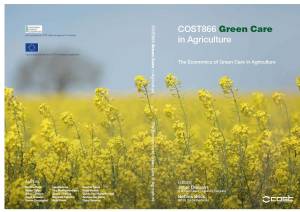
The Economics of Green care in Agriculture. Edited by Joost Dessein and Bettina Bock

Recently published and available on line The Economics of Green care in Agriculture, edited by Joost Dessein and Bettina Bock.


The publication is part of our participation in COST Action 866 ‘Green care in Agriculture’. This COST action brought scientists and practitioners together who are working in the broad domain of ‘green care in agriculture’ with the purpose of increasing the scientific knowledge on green care, its potential for improving human mental and physical health and on the best way to implement green care in agriculture throughout Europe. The COST action consisted of different working groups that looked into health effects of green care, the economics of green care and policies related to green care (http://www.umb.no/greencare/). This publication reflects on the Economics of Green Care and the possibility to measure and evaluate its costs and benefits, taking into account the wide variation in Green Care arrangements throughout Europe. A limited number of free copies is also available at the Institute for Agriculture and Fisheries Research Merelbeke, Belgium (www.ilvo.vlaanderen.be), where Joost Dessein works (email: joost.dessein@ilvo.vlaanderen.be).