In our November blog, prof.dr.ir. Bettina Bock looks back at her 44 years of research around gender and rural development. While issues of gender and agriculture have been on the research agenda since the 1970s, only recently has rural sociology started shifting its attention from the production of traditional gender roles, or the recognition of the role of the women-farmer, to an exploration of the farming cultures of queer farmers.
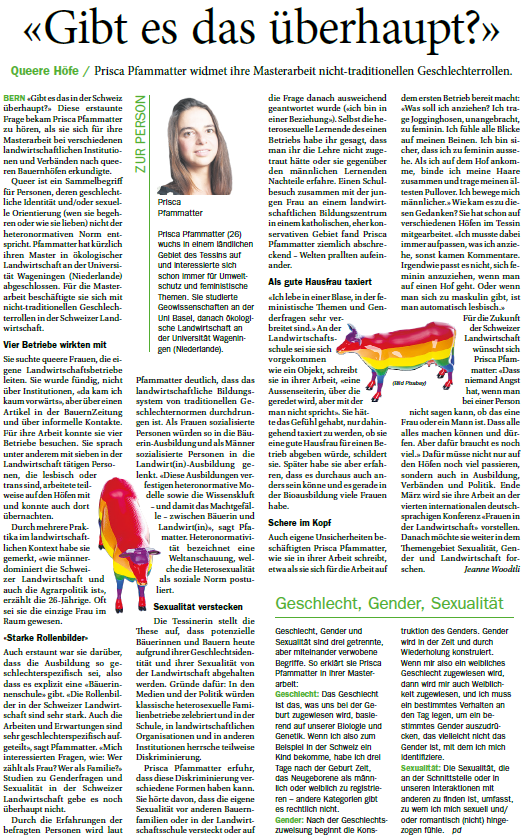
News article about Prisca Pfammatter’s master thesis, published in the Swiss BauernZeitung on December 10, 2021
Master student Prisca Pfammatter traced back how on traditional family farms in Switzerland, gender is the main axis along which labour is divided and power relationship shaped. Then, drawing from the approaches of performativity theory and weak theory, she investigated how queer farmers understand their farming performances and how these interact and intermingle to create gender and sexual identities that, in turn, inform their farming practices.
Drawing from ethnographic fieldwork and seven interviews with queer farmer, Pfammatter evidences how through their performances queer farmers not only redefine male and female and masculinity and femininity, but also challenge the gendered division of labour on the farm. As a result, their subversive gender performances have the potential to redefine agriculture as gender-neutral and contribute to a filling of the scholarly gap on how to move agriculture away from the (re)production of the traditional gender binary and its inequalities.
Pfammatter’s research makes three main contributions to the literature. First, it evidences the glaring lack of research around and the invisibility and non-recognition of queer farmers in Switzerland. This lack that is exposed extends to the mechanisms through which farmers are turned away from farming as a livelihood on the basis of their gender, sex and/or sexuality – for example, through the celebration in Switzerland of heterosexual cisgender family farms. Second, the thesis highlights subversive performances and how these challenge the production of binary gender, sex, sexual, and farming identities as well as the attribution of skills on the basis of these socially constructed categories to imply alternative possibilities, roles and futures. Third and finally, it is suggested that farming can be an accommodating space where people can become who they feel they want to be.
Prisca Pfammatter. 2021. Beyond Farming Women: Queering gender, work and family farms, Master Thesis: https://edepot.wur.nl/557032
On 23 – 25 March 2022, the study will be presented at the International German-language conference “Frauen in der Landwirtschaft”.
This thesis/research internship opportunity is a part of a broader Science Shop project which, together with local stakeholders, explores possibilities of connecting producers to local inhabitants in the municipality of Laarbeek of the Dutch province Nord Brabant.
Preliminary insights suggest a disconnect between the inhabitants of this rural area and the local farmers. We are thus looking to conduct a survey to explore local opinions. Furthermore, it would be interesting to see how media representations and national-wide debates on issues such as the nitrogen crisis or the protein transition shape local understandings and relations between citizens and farmers.
The research speaks to broader debates on rural development and the role of agriculture in society. The results should indicate possible avenues for bridging the gap between producers and citizen-consumers.
The precise delineation of the research and the methods used are open to student’s creative suggestions. Considering the research population, a working knowledge of the Dutch language is an asset. Starting dates are flexible, with results delivered by the end of May the latest. For more information contact Lucie Sovová lucie.sovova@wur.nl
Bij agrarisch adviesbureau Dirksen Management Support brengen we melkveehouders uit heel Nederland bij elkaar in agrarische studiegroepen. Het doel? Leren van elkaars ervaringen, vergelijken van bedrijfsresultaten en discussiëren over bedrijfsstijlen en keuzes. Om de meest leerzame en interessante gesprekken te creëren, maken wij onze groepsindelingen op basis van regio’s. Met als resultaat dat onze boeren kunnen sparren over problemen die voor hun van toepassing zijn. Daarnaast geeft deze indeling op een juiste manier weer hoe boeren presteren in relatie tot vergelijkbare andere bedrijven. Dit houdt je als melkveehouder scherp en geeft relevante inzichten. Zowel in onderdelen waar het bedrijf goed presteert of waar nog kansen liggen die benut kunnen worden. Ons motto luidt dan ook: “Alleen ben je sneller, samen kom je verder!”
Dirksen Management Support werkt al vanaf 1996 met gegevens vanaf het melkveebedrijf. Dit heeft geleid tot een enorme dosis ervaring en kennis op het gebied van verwerking van deze data. Naast studiegroep begeleiding werkt DMS voornamelijk veel samen in projecten voor de kringloopwijzer. De kringloopwijzer loopt als een rode draad door het melkveebedrijf heen. Op basis van kringloopwijzercijfers komt er veel informatie naar voren over oogst-, rantsoen-, en efficiëntie resultaten. Meer recentelijk zijn er ook samenwerkingen omtrent CO2, biodiversiteit, mestbeleid (BEP-pilot). Enkele hoofdonderwerpen die besproken worden zijn: Kringloopwijzer, Bodembeheer, Voermanagement en nog veel meer… Voor kringloopwijzers heeft DMS een geavanceerd systeem ontwikkeld waarmee de cijfers gecontroleerd en verwerkt worden tot analyses in compacte overzichten. Niet alleen het analyseren van data, maar ook het begeleiden van project groepen en het managen van projecten in het algemeen is een onderdeel binnen Dirksen Management Support.
Wanneer je stage loopt bij Dirksen Management Support krijg je de kans om een kijkje te nemen bij de brede taken van het bedrijf. Bij het deelnemen aan studiegroepen leer je veel van de sociale kanten en het overbrengen van kennis richting de boer. Onderzoek kan worden gedaan naar het innovatietraject richting kringlooplandbouw, het gebruik van nieuwe technologieën in de landbouw, acceptatie richting kringlooplandbouw voor zowel boer als consument, bewustwording van “the need to develop” voor de boer, communicatie strategieën voor boeren en consument, etc. Mocht je liever met het data bestand en cijfers werken voor een wat meer Bèta onderzoek kan dat natuurlijk ook! Ideeën voor onderwerpen zijn welkom!
Profiel kandidaat
We zijn op zoek naar een student met affiniteit voor de agrarische sector. Een student die gemakkelijk contact legt met zowel de boer als andere actoren in de sector. Om die rede zoeken we dan ook een student die goed Nederlands spreekt.
Nog steeds geïnteresseerd? Mail ons, inclusief je CV en interesse voor een stageonderwerp. Wat zijn jou skills die je graag zou willen toepassen bij DMS, of willen verbeteren? Wanneer zou je willen beginnen en hoe lang wil je stage lopen? We zijn benieuwd!
Contact
Kim Hahn, kimhahn@dmsadvies.nl
Hans Dirksen hansdirksen@dmsadvies.nl
Voor de aanvang van deze stage neem je contact op met Thesis.RSO@wur.nl ter goedkeuring van de stage
Vorige week bereikte ons het droevige bericht van het overlijden van Ans van der Lande-Heij. Ans was van 1983 tot 2007 werkzaam bij de Leerstoelgroep Rurale Sociologie als secretaresse. Naast het reguliere secretariaatswerk voerde Ans ook een groot deel van de werkzaamheden uit die tegenwoordig tot het domein van het adjunct-beheer horen. Voorts verzorgde ze de opmaak van de boekenreeksen “Studies van Landbouw en Platteland” en “European Perspectives on Rural Development” en de organisatie en administratieve afhandeling van de projectbijeenkomsten van de EU-projecten CAMAR en IMPACT. Het leverde haar veel internationale contacten en ook nieuwe vrienden op.
Bovenal was Ans het sociale hart van de leerstoelgroep. Ze stond altijd klaar om (gast) medewerkers en studenten te helpen met vragen en problemen – tot en met het regelen van onderdak voor tijdelijke gastmedewerkers. Ze zorgde ervoor dat we elke ochtend met z’n allen bij haar op het secretariaat koffie dronken (zo rond 10 uur galmde Ans door de gang “Koffie!!”). En jarenlang hebben we als groep, met onze partners en kinderen, een weekend gekampeerd op de camping in Arcen, waar Ans en haar man Cees een stacaravan hadden. Ook dat was, op Ans’ welbekende wijze, altijd uitstekend georganiseerd en voor ons allen een moment om naar uit te zien en nu nog steeds om met veel plezier aan terug te denken.
Ans was vrijwel altijd opgeruimd, vrolijk en beminnelijk. Handen uit de mouwen, dat was haar devies, en problemen waren er om op te lossen. Of ze deed alsof ze er niet waren (ook dat is, in een universitaire bureaucratie, een goede eigenschap). Ze was begiftigd met het vermogen steeds een gezellige sfeer te creëren en steunde de mensen die dat nodig hadden. Een bewonderenswaardige vrouw.
Ans is in 2007 met pensioen gegaan en veel van de (oud) medewerkers hebben na haar pensionering contact gehouden met Ans en Cees. Wij beiden tot op heden. Op de rouwkaart schrijven haar kinderen, hun partners en de (achter)kleinkinderen van Ans: “Denk aan Ans met een lach, een lied of een drankje”. Dat zullen wij zeker doen, maar ook met een traan omdat we haar zeer zullen missen.
Namens de (oud) medewerkers van de Leerstoelgroep Rurale Sociologie,
Jan Douwe van der Ploeg en Han Wiskerke
Last week we received the sad news of the death of Ans van der Lande-Heij. Ans worked as secretary at the Rural Sociology Group from 1983 to 2007. In addition to her regular secretarial duties, Ans performed many of the tasks that nowadays belong to the domain of assistant management. She also took care of the lay-out of the Dutch book series “Studies van Landbouw en Platteland” and the English book series ‘European Perspectives on Rural Development’ and the organization and administration of the project meetings of the EU-projects CAMAR and IMPACT. It brought her many international contacts and also new friends.
Above all, Ans was the social heart of the chair group. She was always ready to help (guest) staff and students with questions and problems – up to and including arranging accommodation for temporary visiting scientists. She made sure that every morning we all drank coffee at her office (around 10 o’clock Ans would echo “Coffee!” through the corridor). And for many years we spent a weekend as a group, with our partners and children, at the campsite in Arcen, where Ans and her husband Cees had a mobile home. That too, in Ans’ well-known way, was always excellently organised and for all of us a moment to look forward to and to remember and cherish until today.
Ans was almost always optimistic, cheerful and amiable. Get to work, that was her motto, and problems were there to be solved. Or she pretended they weren’t there (in a university bureaucracy, that too is a good quality). She was gifted with the ability to always create a friendly atmosphere and supported those who needed it. An admirable woman.
Ans retired in 2007 and many of the (former) employees have kept in touch with Ans and Cees after her retirement. Both of us to this day. On the bereavement card her children, their partners and Ans’s (great) grandchildren wrote: “Remember Ans with a smile, a song or a drink”. We certainly will, but also with a tear as we will dearly miss her.
On behalf of the (former) staff members of the Rural Sociology Group,
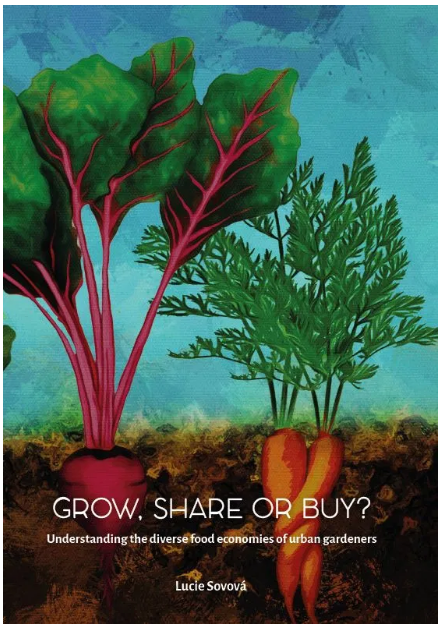
My doctoral research explored the role of urban gardens in people’s food provisioning practices, framing them as spaces of diverse food economies operating largely outside the market. In order to understand how gardens work as food sources, I observed the food provisioning practices of 27 households involved in gardening in Brno, Czechia, throughout a period of one year.
The research contributes to the broader discussion about more sustainable ways of food production and consumption, alternative food networks and urban agriculture. Research on sustainable food systems is often biased towards initiatives embedded in market relationships (Rosol 2020). Literature on urban gardening in global North mostly focuses on a specific kind of this practice (community gardens), and it discusses the multiple non-productive functions of these spaces, such as community building (Veen et al. 2016), place-making (Koopmans et al. 2017) or the improvement of urban environment (Timpe et al. 2016). Another stream of literature presents urban gardens as activist spaces questioning the status quo of neoliberal urbanism (Tornaghi 2017, McClintock 2013). This literature recognizes the potential of urban gardens to contribute to localized and sustainable food provisioning (Kosnik 2018). Nonetheless, actual data on food self-provisioning (FSP) in urban areas of the global North remains insufficient (Taylor and Lovell 2013).
Furthermore, some geographical areas seem to be excluded from the debate. FSP is wide spread in the post-socialist countries of Central and Eastern Europe (CEE): 50% inhabitants of the region grow some of their food, compared to 10% in Western European countries (Alber and Kohler 2008). Despite this potential, lessons from CEE are only recently appearing in the literature on urban gardening or alternative food networks. This discrepancy can be explained by an unequal geography of knowledge production, in which CEE rarely figures as a source of original knowledge (Jehlička 2021). In light of the failed experiment of state-socialism, CEE countries are often regarded as underdeveloped and in need of catching up with the West (Kuus 2004, Müller 2019). This transition discourse results in the framing of local informal economies (such as FSP or informal food sharing) as remnants of the past which will be eventually substituted by market economy (Alber and Kohler 2008, Acheson 2008). My research adds to more emancipatory works showing the relevance of these traditional practices for sustainable food provisioning (Jehlička et al 2020, Goszczyński et al., 2019, Mincyte 2012).
My theoretical approach is further inspired by the diverse economies framework (Gibson-Graham 2008) which points out that economic practices are not limited to capitalist markets and monetized transactions, and which calls for attention to alternative, nonmarket and informal economies. This approach is increasingly adapted in the study of more sustainable food provisioning, which recognizes the importance of economic arrangements fostering social justice and environmental wellbeing (Rosol 2020, Tornaghi 2017, Morrow 2019). It is also particularly pertinent for the post-socialist context, seemingly caught between the gloomy heritage of state socialism and the sweeping neoliberalization of the last three decades.
Recent representative surveys show that the share of Czechs involved in FSP remains steady at around 40% of the population, spread equally across income groups and educational levels (Smith and Jehlička 2013, Jehlička and Daněk 2017, Sovová et al 2021). Unpacking these statistics, my research assessed the role of FSP in terms of quantity of food produced as well as its position within broader food provisioning practices and the diverse economic arrangements they constitute. Inspired by the perspective of social metabolism (González de Molina and Toledo 2014, Burger Chakraborty et al. 2016), I used food logs to monitor the flows of fruits and vegetables entering and leaving respondent households. These flows were categorized based on the type of economic arrangements as non-market, alternative-market or market economies. Using conceptual borrowings from social practice theory (Reckwitz 2002, Shove et al. 2012), I further investigated the meanings and competences these material flows entailed.
The field work consisted of four rounds of data collection of one month, spread over the course of one year. During each round, respondents recorded fruits, and vegetables which they produced at their gardens or obtained from other sources. Next to the amount, type and source of food, they also kept track of the use of these foods, i.e. own consumption, preserving, sharing or other forms of distribution. The purpose of the multi-staged research design was to observe seasonal variations and to gradually build theory with the respondents’ participation, accompanying the quantitative accounts with a qualitative understanding of their food provisioning practices.
The results reveal complex interactions between gardens, other food sources, respondents’ eating habits and dietary preferences. FSP plays a central role in gardeners’ food provisioning practices. The gardens provide a significant amount of food, covering on average one third of fruits and vegetables consumed in gardeners’ households – results consistent with a national survey using self-reporting (Sovová et al 2021). In addition, respondents’ experience as producers shapes their food provisioning practices beyond FSP. Home-grown food is seen as the best in terms of taste, freshness and transparent origin. This creates a hierarchy of food sources, in which FSP and other nonmarket and semi-formal food provisioning practices (e.g. receiving home-grown foods from family and friends, foraging or buying directly from producers) are preferred over shopping for food in conventional venues. Alternative food networks typically associated with conscious consumerism (community supported agriculture, farmers’ markets, organic food shops) were marginal in respondents’ shopping practices. Instead, they provisioned food from a number of diverse channels spanning market and nonmarket relations, in which social relations merged with environmental considerations and subjective notions of food quality. The centrality of FSP in these practices also resulted in strong seasonal patterns in both food sources and diets.
None of the respondents aimed to be fully self-sufficient, nor did they grow their own food in order to save money. Instead, they saw gardening first and foremost as a hobby. The link of this way of food provisioning to leisure, fulfilment, and, broadly speaking, gardeners’ identities, strengthened the position of FSP in gardeners’ food provisioning practices. Similarly, other informal and semi-formal food practices were often grounded in social relations, such as visiting family and acquaintances in the countryside. Gardeners’ food practices also contributed to fostering social relations, for instance when they shared home-grown food with others, a practice which was common for most respondent households. Indeed, FSP is a generous practice in which the joy of sharing and appreciation of home-grown food prevails over expectations of reciprocity or economic considerations, as also documented by Daněk and Jehlička (2017) or Pottinger (2018).
While practiced as a hobby, FSP is mobilized as a food provisioning practice through a number of specific competences. Using the conceptualizations of social practice theory, I interpret FSP as intersection of two sets of practices, those relating to the garden (‘gardening’), and those relating to the kitchen (‘food provisioning’). Based on both quantitative and qualitative data, I identified four different types of relations between gardening and food provisioning. Put simply, some respondents were keen gardeners but did not necessarily integrate their harvest into their diets. Others strived to eat plenty of fruits and vegetables but were not always successful in their gardening efforts. Gardens are multifunctional spaces which hold different meanings for different users. Using the gardens as food sources requires not only gardening and cooking skills, but also coordination and integration of both on a daily as well as seasonal basis.
My research shows that when thinking about sustainable food provisioning, scholars and practitioners need to look beyond market venues and beyond people’s roles as consumers. The search for future-proof urban food systems cannot be restricted to environmentally-minded affluent Westerners, but it needs to consider everyday practices already existing in diverse contexts. I have shown that there is a plethora of under-researched informal food practices whose potential for sustainable provisioning, diverse economic arrangements and mutually beneficial human–nature relations merits further investigation.
Sovová, L. (2020). Grow, share or buy? Understanding the diverse economies of urban gardeners. Wageningen University. https://doi.org/10.18174/519934



 Rural Sociology Wageningen University