Ons voedselsysteem is verre van duurzaam. De huidige voedselconsumptie en -productiepatronen dragen sterk bij aan een aantal urgente duurzaamheidsopgaven op het gebied van de gezondheid en welzijn van mens, dier en planeet. Deze duurzaamheidsopgaven zijn geen losstaande problemen; het zijn gerelateerde symptomen van een niet-duurzaam voedselsysteem. In de Nederlandse agrofood sector en daarbuiten zijn vele innovatieve ondernemers, burgers, coalities en andere partijen al actief bezig met de verduurzaming van het voedselsysteem, bijvoorbeeld in het realiseren van korte ketens, het verbinden van stad en platteland, de eiwittransitie, regeneratieve, natuur-inclusieve landbouw en true cost accounting. Daarin is er een groeiende beweging naar gebiedsgericht werken met regionaal georganiseerde netwerken die aansluiten op landschappelijke kenmerken, biodiversiteit, de culturele eigenheid en sociale verbanden van een regio. In een landelijk project gefinancierd door de NWO gaan we in kaart brengen wat voor soort initiatieven in verschillende regio’s zijn ontwikkeld die kunnen bijdragen aan de gewenste transitie en hoe ze aan hun ambities werken.
De thesis/stage opdracht
Je kunt binnen dit landelijke project bijdragen aan de analyse van de verschillen en overeenkomsten tussen initiatieven in doelen, aanpak, betrokken partners en belemmeringen en kansen. Er is een vragenlijst opgesteld waarmee de kenmerken van een groot aantal regionale initiatieven in kaart worden gebracht. Als vervolgstap kun je regionale initiatieven benaderen en met hen verder in beeld brengen wat hun doelen en ambities zijn, welke kansen en belemmeringen zij ervaren, wat hun strategie is om bij te dragen aan veranderingen en wat hun impact zij willen bereiken op sociaal, ecologisch en economisch gebied.
Je kunt je ook richten op één of enkele regionale initiatieven en met hen in een vorm van co-creatie verkennen hoe succesvol hun aanpak is, wat het initiatief tot dusver heeft bereikt op sociaal, ecologisch en economisch gebied, hoe de impact van het initiatief versterkt kan worden en hoe belemmeringen kunnen worden opgelost.
In the 1950s Professor E.W. Hofstee from the former department Sociology and Sociography developed a tool to create maps with statistical data of the Netherlands. You could consider this technique as a predecessor to today’s GIS. In this video Anton Schuurman, Associate Professor of Rural and Environmental History at WUR, explains how the puzzle was used and why it was so unique.
In an earlier Blog Joost Jongerden wrote about Hofstee’s Cartophoot[i]. In this blog I will write something about the actual map that can be seen on top of the cartophoot or Hofstee’s puzzle, as it was called, in the ground floor of the Leeuwenborch-building. I will argue that the map tells a lot about rural sociology after the Second World War – its research interests and methodologies.
The use of the maps demonstrate Hofstee’s training as a human geographer, his aversion of the American sociology of the time (with its undifferentiated and ahistorical approach of society) and the use of the cartophoot to study change in time (in a period that the number of Dutch municipalities almost did not change: 1138 in the middle of the nineteenth century; 1121 in 1950. Nowadays, there are only 352 municipalities in the Netherlands. Luckily, we have GIS now.)
Hofstee was a man who was involved in debates both in general sociology and rural sociology and international as well as national. He is responsible for the fact that we have good basic demographic figures on municipal level in the Netherlands, especially for the period 1811-1850. Those statistics were not collected by the Dutch Bureau for Statistics (CBS), nor by its forerunners. Hofstee’s demographic work was important for the debate on overpopulation – as it was perceived after the Second World War in the Netherlands – as well as for his work on rural modernisation in the 1950s – which was the central topic in the rural sociology of the time. Hofstee was strongly interested in the decline of fertility. For the discussion on overpopulation it was important to determine whether the rise of fertility after the Second World War was a temporary rise or a rupture with the long-term development of declining fertility due to family planning. For the discussion on (rural) modernization, family planning could serve as an indicator of which regions had a population with a modern attitude. For Hofstee, a modern attitude meant that people had a positive attitude towards change.
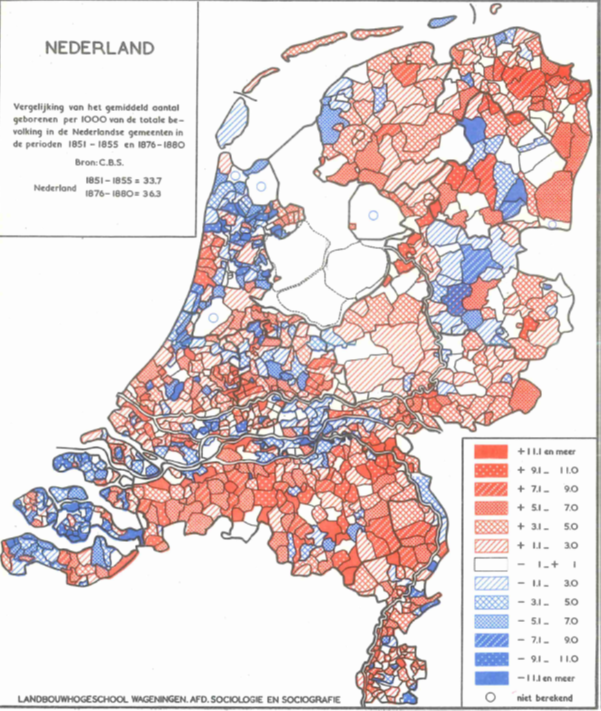
With the map that can be seen on top of the cartophoot Hofstee shows the increase/decrease of the crude birth rate between the fifties and the thirties of the twentieth century in the Netherlands. He uses a lot of shadings. To understand this map it is important that you know that red means that the birth rate has increased, and blue that the birth rate has decreased.
When you know a little bit of the Netherlands, its history and its geography you will know that the Southern provinces (Noord-Brabant and Limburg) were overwhelming Roman Catholic. The Roman Catholic population in the Netherlands (like the Orthodox Protestants) was well known for its high birth rate. But this map appears to show something different. In the same period that the crude birth rate for the country as a whole did not change: it remained 21.2, we see roughly in a line from Zeeland to Groningen a lot of red – in other words an increase – and in Noord-Brabant and Limburg a decrease. What is going on here?
First, you have to realize this is a map about changes in time, not about levels. In 1956-1959 the fertility for married women between 15-45 is 172.1 births per 1000 married women in the Netherlands. In Brabant and Limburg it is respectively 212.8 and 193.5 – which were indeed the highest provincial figures at that time (with Overijssel). The lowest were for Groningen (146.1) and Noord- and Zuid-Holland (152.3 and 153.1). In 1931-1935 these numbers were 269.1 (Noord-Brabant), 243.3 (Limburg), 141.2 (Noord-Holland) and 151.4 (Zuid-Holland) (Hofstee 1962, 23). Thus, although fertility declined, it remained high in the South of the Netherlands.
Second, and even more interesting, you should realize that the map that is on top of the cartophoot is in fact the fourth map that Hofstee published in his well-known article The growth of the Dutch population (De groei van de Nederlandse bevolking) in 1962. The combination of the four maps provides another, better frame of how to read this map.
In the first map Hofstee compared the crude birth rate in 1876-1880 with the period 1851-1855. Thus, what has happened in the third quarter of the nineteenth century in the Netherlands? The crude birth rate of the Netherlands as such increased from 33.7 tot 36.3. At the municipal level in most of the provinces (except Zeeland and West-Friesland) red is the dominant colour. The populations was growing. This is the point of departure.
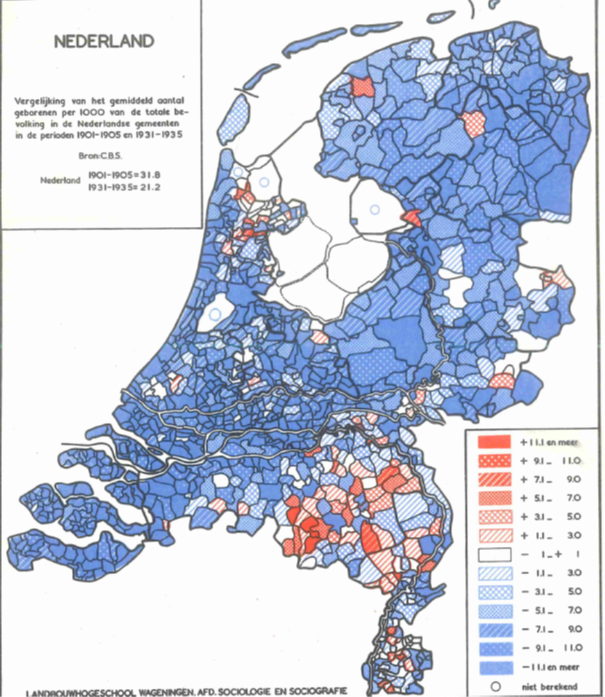
The second and third maps are the central maps. In the second map he compares the crude birth rates in the period1901-1905 with the period 1876-1880. What had happened in the last quarter of the nineteenth century? The Dutch crude birth rate declined from 36.3 per 1000 inhabitants to 31.8. But when you look at the map you see a kind of two Netherlands: the coastal provinces being blue, most of the inland provinces blue.
In the third map he looked at the first quarter of the twentieth century and compared 1931-1935 with 1901-1905. The Dutch crude birth rate declined even further from 1931-1935 to 1901-1905 from 31.8 to 21.2 birth per 1000 of the population demonstrating that the process of family planning was accelerating and spreading. The map coloured almost completely dark blue, accept (mostly) for North-Brabant.
Now we can return to the fourth map (with which we started). Here one can say that he compared the second quarter of the twentieth century. Remarkably the crude birth rate did not change between 1956-1959 and 1931-1935. However, it had changed between these periods.
Period
Mean crude birth rate
1931-1935
21.2
1936-1940
20.4
1941-1945
22.2
1946-1950
26.0
1951-1955
21.9
1956-1959
21.2
Source: Hofstee 1962, 15.
But more importantly, from the fact that the South now coloured blue we can see that after the Second World War the process of family planning/family limitation had reached the South too. Thus, the map should be read as a point in a process and not as just a comparison between two periods.
As said, Hofstee interpreted this process of fertility decline as a process of modernization. More and more families were prepared to practice modern family planning, demonstrating openness for change. Other sociologists, most well-known F. van Heek, interpreted the process as a process of secularization and differences between religions.
This discussion has been more or less settled with an article titled Demographic transition in the Netherlands. A statistical analysis of regional differences in the level and development of the birth rate and of fertility (1850-1890) by Onno Boonstra and Ad van der Woude (1984) from the Rural history group. They applied new and sophisticated statistical techniques to the data and concluded that although with regard to the level of fertility religion was the most important variable, this was not true for the development over time. Thus, one could say that they corroborated Hofstee’s interpretation, although he had not that strongly distinguished between level and development. Moreover, to explain the process of family planning/family limitation historians and other social scientists use the WAR-model by Lesthaeghe and Wilson. This is a combination of Willingness (desirability of family limitation increases when there is a decrease in family and labour intensive production with a flow of income from children to parents); Availability (availability of family limitation has never been a problem, although it has become better in time); and Readiness (are there cultural obstacles for practicing family limitation) (Lesthaeghe and Wilson 2017; Engelen 2009).
Literature
Hofstee, E.W. (1962). De groei van de Nederlandse bevolking. In A. N. J. den Hollander (Ed.), Drift en koers: een halve eeuw sociale verandering in Nederland (2e dr. ed., pp. 13-85). Assen: Van Gorcum.
Boonstra, Onno W. A., & van der Woude, Ad M. (1984). Demographic transition in the Netherlands. A statistical analysis of regional differences in the level and development of the birth rate and of fertility. AAG Bijdragen (24), 1-57.
Lesthaeghe, R., & Wilson, C. (2017). Modes of production, secularization, and the pace of the fertility decline in Western Europe, 1870-1930 The Decline of Fertility in Europe (pp. 261-292): Princeton University Press.
Engelen, Theo. (2009). Van 2 naar 16 miljoen mensen. Demografie van Nederland, 1800 – nu. Amsterdam: Boom.
The Rural Sociology Group of Wageningen University will celebrate its 75th Anniversary on the 13th of May 2022. Over the 75 years of the Group’s existence, characteristic features of the “Wageningen School” approach in rural sociology have been its comparative research, empirically grounded theoretical development, and a research output renowned for its scientific as well as for its political and practical relevance. At this celebration we will present, discuss, and reflect upon the past, present, and future challenges of rural sociology. We will do that in a lively, interactive setting with debate, workshops, and presentations.
The anniversary celebration will be organized around three thematic clusters:
Agrarian and rural development, with special attention to socio-economic dynamics and potentials at farm and regional level;
Food provisioning, the socio-spatial organization, and co-ordination of food production and consumption, with special attention to circularity, diverse food economies, and place-based food networks;
Urban-rural relations, with special attention to counter-urbanization, urban-rural fluidity, identity, and governance.
Register here if you want participate in our conference and join our celebration.
More details about the conference program will be published on this website soon!
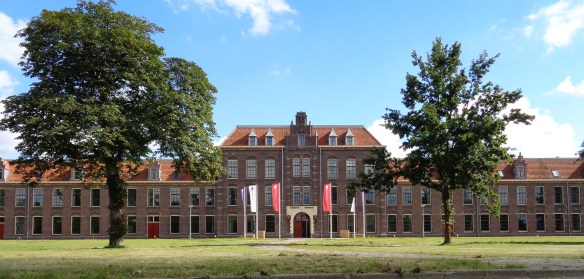
Rural Sociology: Past, Present and Future is organized at the Akoesticum conference center, Nieuwe Kazernelaan 2D42, 6711 JC Ede, the Netherlands.
No, this is not a mantra from a self-help book for success or therapeutic healing but rather the final sentence in Ece Temelkuran’s new book Together, 10 choices for a better now. The book is a collection of ideas woven into stories that help to think new ways of relating to each other. The book invites the reader to think beyond the individualizing millstones of neoliberalism, which divides by reducing us to a-social transactional entities, and beyond those of the populist right, whose parochial cultural pride separates us into belligerent communities. Spinning and weaving moments and experiences of many kinds, novelist and commentator Ece Temelkuran presents 10 threads through which we can start doing and thinking another future in the here and now. Food for thought for rural sociologists.
The opening of the book recalls the phrase attributed to Frederic James, that it is easier to imagine the end of the world than to imagine a political alternative for the economic and political system causing the world to end. This is what Temelkuran refers to as the magical ability of a status quo to make people believe that if the political and economic system we live in collapses, everything else will collapse with it. Around us we find mesmerizing experts who warn us like fearful ancient sailors that if we dare to sail into uncharted waters, we will fall off the edge of the world, notes Temelkuran. The “build back better” calls for post-pandemic times seem to confirm this atrophied imagination, that there is simply no alternative to the current economic and political system.
Fast backward. When, in 2001, George W. Bush called Americans to get over the 9/11 trauma, he found no better words than ‘go back shopping’, as Zygmunt Bauman reminded us. Consumption is the medicine. Today, no one has to tell us to go shopping, as the smart and less smart lock-downs are experienced first and foremost as a restriction of our ability to consume, now defined as the primary, sometimes only pillar of ‘freedom’. As the fullness of life has morphed into taking our fill of enjoyment and entertainment we queue to be allowed into Zara, Primark, or Footlocker, performing the entry rituals at disinfection stations. We do not even have to feel the guilt of collaboration with the dictates of consumerism since it has now become our very duty to consume with a larger mission: to save the economy through our marketplace activities and, in so doing, bail out the sinking ship of capitalism.
Ece Temelkuran’s sharp contextual sketch forms the starting point for series of key questions. Can we reshape our existence to survive a world that has transformed itself into a corporation? Can we imagine an economic policy beyond private property, one that renders the accumulation of capital both illegal and immoral? Can we learn to see the world again from an ethical perspective instead of a consumerist one? Yes, we can, she argues; we can reinvent ourselves and the world through even the smallest things, and not just to tranquilize our discomfort. All the small things we are actually already doing in which we address precarity and vulnerability can determine our future. Yet, the reader of this book should expect no recipes or prescriptions. Together offers leads, ideas from which we can start to further explore and give words to new possibilities and other futures.
One such lead is dignity, something our economic and political system not only does not value but also cannot come to terms with since, Temelkuran explains, it has no idea of the good. Another lead is enough, a term that she borrows from the novelist Kurt Vonnegut and which invalidates the contemporary ‘consumer’ identity through which we have learned to conceive ourselves. Yet another lead is faith, which Temelkuran contrasts with hope, or better, I would say, with messianic hope, which i) pacifies (as it puts the expectation of salvation onto others outside ourselves and submits to some higher power), ii) subjugates (since the hope that justice will be done keeps people obedient), and iii) procrastinates (since while hope remains unfulfilled, we are condemned to waiting). What Ece Temelkuran refers to as ‘faith’ could also be characterized as a ‘critical hope’, which is based on doing, questioning, and learning, a hope grounded in (daily) social practices and struggles.
In Together, economic and political morality emerge through the “10 choices” in addressing what Ece Temelkuran refers to as a “housing problem”: the national and international institutions through which we inhabit the world. These are worn out and offer no solutions. The question she raises is that of how to reinvent new ways to inhabit the world, together, to create new institutions based on a moral, political, and economic triangulation. The end of the book, however, also carries a warning: those who work with words have a responsibility to be careful in what they write and say. Mismanaged words have a habit of destroying lives – as the crushing weight of ‘modernization’ narratives in our own field of rural sociology has shown.
For a rural sociology celebrating its 75th anniversary, Together is a timely work. It raises questions about the world, this world, and the relentless economic and political foundations on which its rests. Importantly, this book also opens up an imaginative of possible futures in the now that develop the principles from which they are made in our daily living and social struggles. Thus, Ece Temelkuran has taken her writer’s responsibility seriously, presenting us with carefully selected words that have something important to say, also for the research agendas of our own discipline.
Ece Temelkuran, 2021. Together, 10 choices for a better now, 4th Estate: London, ISBN 978-0-00-839380-9, 199 pages.




 Rural Sociology Wageningen University