The functions and meaning attributed to the rural are manifold (Woods 2011: 1). Primarily, it operates as the intersection of “man and nature” (Ploeg 1997: 41), where for centuries most of our food, fiber, and fuel have been produced (Woods 2011: 1) but which now also provides the landscapes and scenery where visitors ‘slow-down’ or search for adventure and sensation (Buscher and Fletcher 2017) while comprising spaces of identification and belonging (Jongerden 2018). Further, the rural acquires meaning in relation to its complement: the urban. Often defined as opposites in terms of land use, population density, or social bonds, among others (Cloke 2006), these “constitute the complex unity of society viewed from a spatial angle” (Gilbert 1982: 609). This variety of functions and meanings has made the rural not only an epistemologically uncertain concept, but also a normative one.This normativity and uncertainty is part of the heritage of rural sociology. Continue reading
Research and internship opportunities in regenerative agriculture

Are you passionate about:
Food systems transformation?
Regenerative agriculture and agroecology?
Climate change and planetary health?
Farmers living amid the COVID-19 pandemic?
Qualitative and mixed method social science research?
We are looking for masters and advanced undergraduates who want an active role in data collection and data entry with a large-scale qualitative and quantitative research project led by the Midwest Healthy Ag research team.
Midwest Healthy Ag is a sociological research project launched by Regeneration Midwest in the United States, funded by the Robert Wood Johnson Foundation’s Health and Climate Solutions Program.
The study is currently entering the data collection phase, which will consist of over 200 interviews with farmers across six agrarian states in the Midwest United States. The interviews will ask farmers about their experiences dealing with multiple crises in conventional agriculture, regenerative farming practices, environmental health and climate change, as well as the impact of COVID-19 on livelihoods and community health and wellbeing. The interviews will be taking place over the next six months.
You can join our team as an intern/research assistant by collecting historical and contextual information on selected agrarian communities, doing data entry of farmer interviews into Qualtrics, and participating in our extended research network as we conduct qualitative and quantitative data analysis. We can also explore possibilities for utilizing project data and materials for academic theses and papers.
Get in touch! We will be accepting interns and assistants in early January 2021.
For more information on the project and our team, our website: https://midwesthealthyag.org
Contact at WUR: Serena Stein serena.stein@wur.nl (Postdoctoral Researcher at SDC & RSO)
75th Anniversary: 13) Reflections: From Rural Sociology to a Sociology of Place?
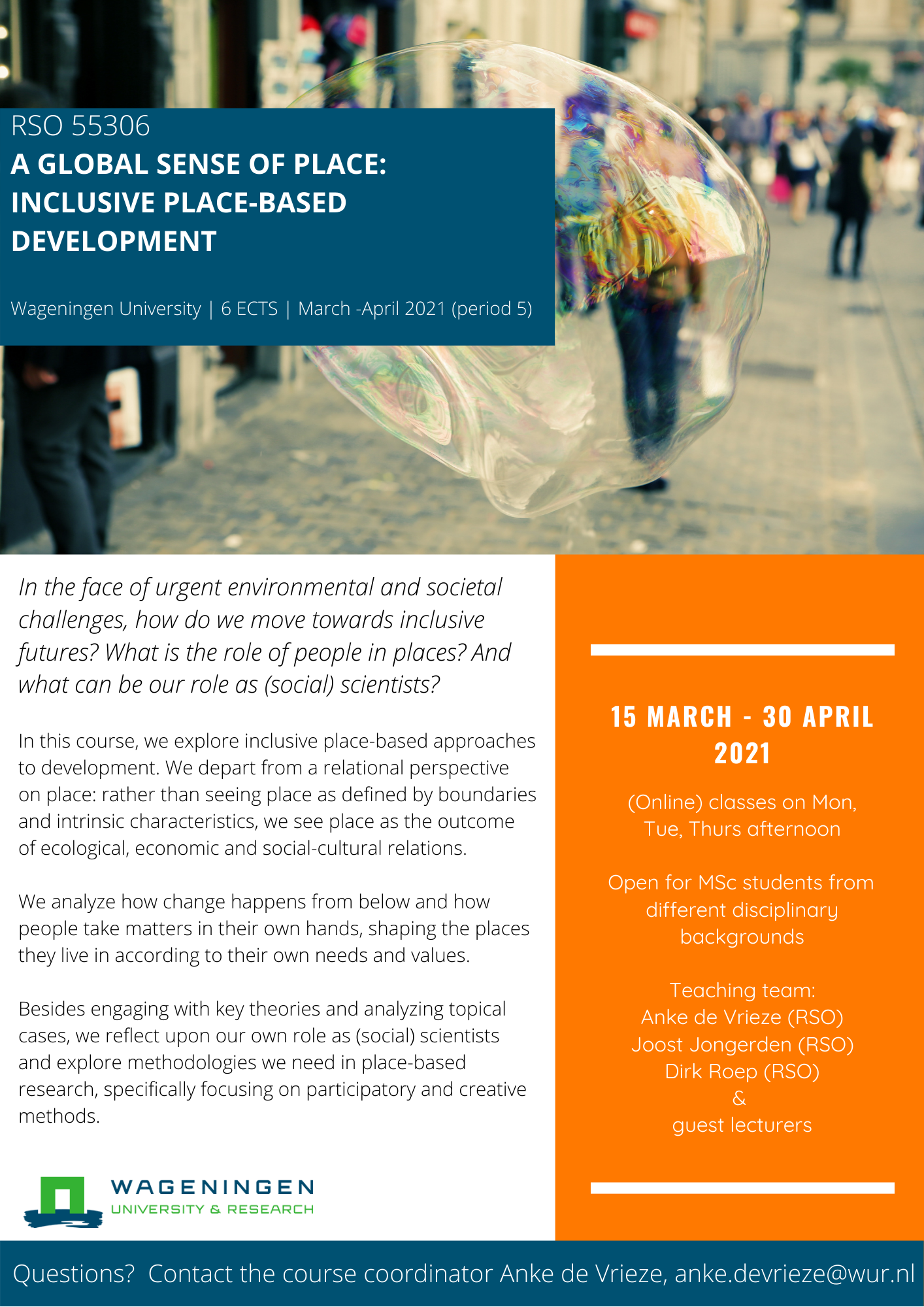
Place has figured central in the work of the Rural Sociology Group. In a way this is, of course, already implicated by the adjective “rural” which adds a spatial identity to the sociology we do. Taking this identity as a social practice and the production of meaningful differences as points of departure (Hofstee 1946, Ploeg 1993, Wiskerke 2007), my own research gradually started to crystalize around the emergence of new spatial realities beyond ‘rural’ and ‘urban’. At the background of this interest is the will to understand how people address inequality and uncertainty, and how they sustain themselves individually and collectively, socially and spatially. Continue reading
Looking back, Looking Forward: Setting a future agenda for rural sociology
We are proud to announce our upcoming seminar series ‘Looking back, Looking Forward: Setting a future agenda for rural sociology’ as part of the 75th anniversary celebration of Rural Sociology. We will kick off the series in February and continue throughout 2021, leading up to our grand anniversary celebration on the 24th of September. Continue reading
Alternative Remote Research Methods Training – February 8-12, 2021
By Lucie Sovova
How to conduct research in a world that is 80% under quarantine? How to study in a field that can not be physically accessible? How to give back to communities we have never met face to face? Continue reading