The third national Voedsel Anders (Food Otherwise) conference in Wageningen will take place in February 2020. The conference organization team calls all those interested to participate and make the third edition again successful. Some general information below. See Voedsel Anders conference 2020 for more detailed information.
Voedsel Andersis a movement of people in the Netherlands and Belgium working towards just and sustainable food systems. A lot has happened since the first conference and the drafting of our manifesto. Political as well as societal attention for the challenges and opportunities of the agri-food system have grown significantly and the urgency to ignite a transition is bigger than ever.
During the Voedsel Anders Conference 2020, we will identify and reflect on wins, barriers and solutions in our joined quest to an alternative food system. We will touch upon questions such as: What have we already achieved and what were the factors of success? How can we identify and deal with barriers? What possibilities and opportunities lie ahead? Can we strengthen the food movement whilst making it more inclusive and diverse?
If you have further question, want to organize a workshop or sponsor the conference, you can send an email toinfo@voedselanders.nl
Door Amarins Bouman, Jurrian Veldhuizen, Henry Abbink, Robin Kampert, Ester Klein Hesselink en Floor Sluijter. Studenten van Wageningen Universiteit die als onderdeel van hun Master opleiding een Academic Consultancy Training (ACT) opdracht hebben uitgevoerd.
De afgelopen twee maanden hebben wij onderzoek gedaan in het kader van het Wetenschapswinkel project ‘Boeren zonder land: hoe is dat mogelijk?’ in opdracht van Vereniging Toekomstboeren. Met 6 studenten van verschillende achtergronden (consumentenwetenschappen, bos-en natuurbeheer, international development & biologische landbouw) zijn wij aan de slag gegaan met het onderzoeken van alternatieve pachtconstructies. Binnen dit onderzoek is er gekozen voor de gemeente als landeigenaar, waarna er 3 verschillende boeren & gemeenten zijn geïnterviewd. Het onderzoek richtte zich op de sterke en zwakke punten van de pacht- en huurovereenkomsten en hoe deze de (on)zekerheid van duurzame boeren beïnvloeden. Dit is visueel weergegeven in bovenstaande figuur.
Boeren worden in de overeenkomsten met de gemeente vaak geconfronteerd met onzekerheden die verband houden met de duur van hun overeenkomsten en de duurzaamheidsaspecten. Er is vaak geen visie en/of beleid vanuit de gemeente op het gebied van het faciliteren van (duurzame) landbouw. Dit leidt tot de onzekerheidsproblematiek zoals korte contracten en beperkte mogelijkheden tot investeringen voor de lange termijn, zoals die in een goede bodem. Echter blijken de gemeenten en duurzame boeren elkaar te vinden in de waarde die de onderlinge afspraken kunnen hebben voor de lokale gemeenschap. Naast de agrarische functie kan een boerderij in de stad ook van grote maatschappelijke waarde zijn.
Op basis van onze bevindingen moedigen we boeren en gemeenten aan om meer te weten te komen over elkaars behoeften en hoe de pachtovereenkomst in ieders voordeel kan werken. Zie de Infosheet hieronder. In ons rapport kunt u hier meer over lezen.
Infosheet: ‘De weg naar een duurzame pachtovereenkomst tussen boer en gemeente’.
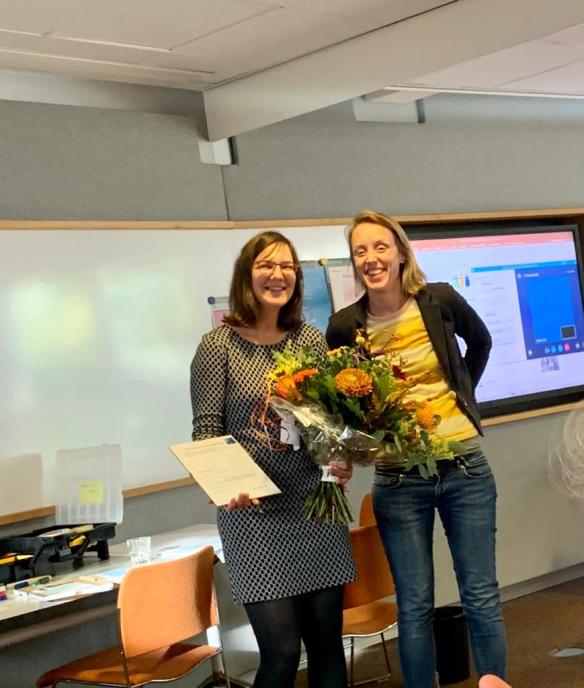
On Tuesday the 29th of October, Lucie Sovová, PhD student at the Rural Sociology Group, won an honourable distinction from the Storm-van der Chijs Fund. The objective of this fund is to encourage and support Wageningen University female PhD students to pursue their study and career in science.
The RSO chair group nominated Lucie, and soon found out that she was awarded the honourable distinction. As head of the jury Prof dr ir Arnold Bregt stated that Lucie “bridges urban gardening and alternative food networks. In her work on Central and Eastern Europe, she questions framing informal food economies as remnants of the socialist era. She shows how they are not necessarily “inferior” to, but merely coexisting and interacting with their market-based counterparts. Next to her academic work she is in many ways involved and contributing to NGOs in this field.”
The honourable distinction comes with 500 euros, which Lucie plans on spending by visiting a conference in Manchester.
Food Self Sufficiency in a Community: Dream or Reality? a documentary by László Bartha, MSc-student Organic Agriculture of Wageningen University.
During his internship at the Wageningen student organization Otherwise, László Bartha made a documentary of his MSC thesis research for the ecovillage“The Vlierhof“. It has been hard work, but it has become a very nice, and respectful documentary of a decision-making process regarding the future development of the ecovillage. “The Vlierhof” approved the creation and online publication of the documentary. Below a brief introduction to the documentary.
Intentional communities and ecovillages are present in almost every country in the world. People decide to live in these places because they want to explore and experiment with new organizational forms and alternative livelihoods. “The Vlierhof” is one of these communities with the vision “to promote awareness and peace on earth. We want to make a contribution to the social and environmental problems faced by society today, living as self-sufficiently as possible.” According to this vision, they also grow part of their food. But is the amount of food that they produce enough to sustain themselves? In this short documentary, we can learn about the community, its members and find answers to this question. The film has been created from the recorded materials of an action research project. Among the audio-visual research methods interviewing was the main data collection method. The purpose of the research was to explore social dynamics in the community and follow a decision-making process regarding the future of the community garden.
Well, the last four months has been a whirlwind of moving houses, living out of suitcases, new climates, new friends, stroopwafel, bicycles and mind-blowing public transport (for an Australian, anyway). Having finally set up some photos on my desk, and unpacked all my boxes, I thought it was time to introduce myself to all you past, present and future RSO blog readers out there.
Moving to the Netherlands to join WUR has
been a mix of the old and the new for me. It’s been a great thrill to reconnect
with friends and colleagues from around the world who have also found their way
to Wageningen, including some fellow survivors from my PhD days in the
Geography school at the University of Sydney.
A little bit about me then…Coming from an
environmental science/development studies background, it was in Sydney that I
discovered my love for the discipline of Geography (how does a geographer end
up in a sociology group you may ask? More on that later). There, I pursued a PhD
thesis project working with small farmers in Maharashtra, India who were being
enrolled in potato contract farming schemes by agribusiness firms.
It was through this work that I developed
my ongoing interest in what is known as ‘the Agrarian Question’, which connects
to old debates about agrarian change and rural development going all the way
back to Karl Marx himself, implicating Lenin, Karl
Kautsky, and Alexander
Chayanov along the way, before being renewed and applied to current
agrarian and rural development problems by my contemporary intellectual heroes
including Henry Bernstein, Harriet Friedmann, Michael Watts and Jan Douwe van
der Ploeg. My time in India also triggered a life-long love affair with the
country (not to mention the humble potato…).
That interest has since taking me to Indonesia
(working with smallholder coffee farmers engaged in global value chains), Myanmar (working on a
large-scale rural poverty, food and nutrition security, and livelihoods
project), and back to India (studying the links between land and livelihoods).
My own take on rural development in South and Southeast Asia is that we need
approaches that bridge the structural insights of agrarian political economy
with a ‘people-first’ approach that explicitly acknowledges the agency of rural
people.
My ongoing task then has been to break down
unhelpful dualisms by attempting to construct a political economy of everyday
livelihoods in South and Southeast Asia. If you’re interested, you can find a
list of my publications here. I’d love to hear from any students interested
in pursuing a thesis on any of these topics!
Back to the new about moving to WUR. Well,
while I’ve always looked to Wageningen as a place I’d love to work, I never
quite saw myself joining a sociology group! Of course, there is a lot of
overlap between geography and sociology, and you can find us geographers
infiltrating all sorts of university departments all over the world.
One challenge I’m looking forward to is
learning about the different frameworks and conceptual approaches that my
colleagues at WUR apply to these common themes of sustainability, justice, equity
and transformation in global food systems, while also getting my head around
the teaching program! This academic year, you’ll be able to find me teaching
into RSO34806 (Transforming
Food Systems), RSO21806
(Origin Food), and RSO20806
(Agricultural and Rural Development). I’m excited to meet all the students
studying these courses!
Finally, with my lovely partner, Katharine
(who is actually a sociologist, and an amazing one at that!), we have a
project investigating social, organisational and technological change in the
global hops industry. I have to say, this involves the most enjoyable fieldwork
I’ve been a part of. If you are interested in craft beer, the sociology of
agricultural, and talking with hop farmers we
are currently looking for one or two thesis students to work on this topic.
As winter approaches, I am starting to miss
the sun and surf of Sydney a little bit. However, the cosy houses, the numerous
Wageningen pubs, day trips to Den Haag, my clumsy attempts at learning Dutch,
and my wonderful new colleagues more than make up for it. Thanks to everyone
for the warm welcome so far, and I’m looking forward to all that is ahead in
RSO!

 Door Amarins Bouman, Jurrian Veldhuizen, Henry Abbink, Robin Kampert, Ester Klein Hesselink en Floor Sluijter. Studenten van Wageningen Universiteit die als onderdeel van hun Master opleiding een Academic Consultancy Training (ACT) opdracht hebben uitgevoerd.

 Rural Sociology Wageningen University