Indoor gardens for nursing homes

By Paulien van de Vlasakker

Advanced technology and alternative food-production methods, such as vertical farming and hydroponic cultivation, are part of an upward trend of initiatives for the support of the transition of conventional food-production methods to more decentralized and local production systems. The development of high-tech urban agriculture is one strategy for more sustainable and resilient urban food systems being explored by cities worldwide to feed their increasing populations.

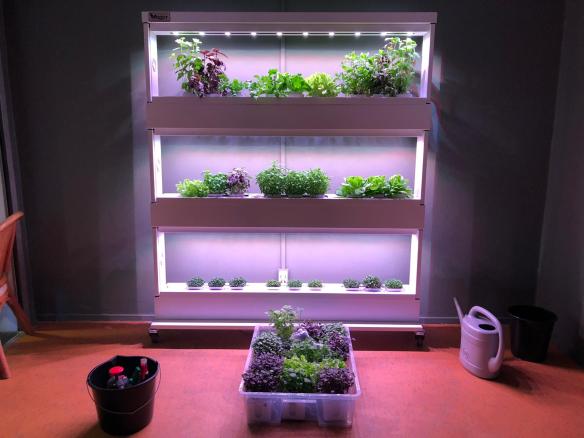
To contribute to the development of urban high-tech agriculture, I established Vegger in October 2016. Vegger is a start-up located on the Wageningen University & Research campus. During the first few years, my colleague and I designed and developed high-tech indoor gardens for the cultivation of vegetables and herbs inside people’s working and living environment. The indoor gardens that we created are cultivation systems equipped with horticultural led lightening, soilless cultivation methods and a controlled environment system. Vegger is part of StartLife, the business facilitator of Wageningen University. We rent our office/working space in StartHub, located in the Atlas Building.
Vegger

For my internship, as part of my MSc Organic Agriculture, I conducted a pilot project with high-tech indoor gardens in two nursing homes of Stichting Innoforte located in Velp, Gelderland. Growing vegetables inside nursing homes can be a response to the need for an increased intake of fresh and local vegetables by elderly people. In addition to increasing vegetable intake among the elderly, this pilot project also focused on contributing to the creation of a healing environment in the nursing homes. A healing environment is a (physical) environment that aims to promote the well-being of patients, their family and the employees, and to reduce their stress. This way people may heal faster (or the (physical) environment does not worsen their situation). The goal of my internship was to explore how high-tech indoor gardens can contribute to: 1. the consumption of fresh vegetables and herbs among the residents, and 2. the healing environment of the location.

I placed the indoor gardens in two locations. One of the locations was specialized for elderly people with far stage dementia. The other location offered housing for elderly people that do not need (intensive) care. It is important to mention that the locations make use of a different food delivery system. In the location for demented elderly, the staff cooks with fresh foods and matching recipes delivered by their food supplier. The meals for the ‘healthy’ elderly from the other location are ready-to-eat frozen meals. These meals do not contain any fresh ingredients.

During my internship I supported the indoor gardens by delivering gardening services. These services consisted of the maintenance of the indoor garden, including the cultivation of plants. The staff was responsible for harvesting the fresh vegetables and herbs. A food expert was appointed by the health care organisation to assist with the contact between me and the end users (staff and residents of both locations). As research methods I used informal conversations with staff, elderly and friends and family of the elderly, observations of the use of the gardens (including harvesting, engaging with the garden, and talking with others over the garden), and measuring the number of plants harvested by staff.

The results of the study were different between both locations. In the nursing home where the demented elderly live, the indoor garden was especially useful to enhance the healing environment. The residents of the home liked to sit next to the indoor garden; the aesthetic aspect of the indoor garden contributed to an improved living and relaxing environment. The vegetables and herbs growing in the indoor garden, however, were not used to their full potential. This was due to the fact that the home for demented elderly was already being supplied with fresh ingredients by their food supplier. In the other home, where ‘healthy’ elderly people live, on the other hand, full usage was made of the vegetables and herbs from the indoor garden. This was because previously no fresh ingredients were used in the meals. Staff used the fresh vegetables and herbs to prepare side dishes such as soup or salad.

The difference between the use of the high-tech indoor gardens did not only relate to the difference in food supplier, but also to the mental health of the elderly. Elderly with dementia experience on average higher stress levels than mentally healthy elderly. Optimizing a healing environment with indoor gardens can therefore have a greater impact on providing a quiet and relaxed environment for the residents. In addition, the elderly who live in the home for ‘healthy’ elderly people were more aware of the meals that were served. The residents of the home indicated that the fresh vegetables and herbs not only made the meal taste better, but also contributed to the experience of the meal because there were ingredients used from their own garden.
Pesticide Politics in Africa

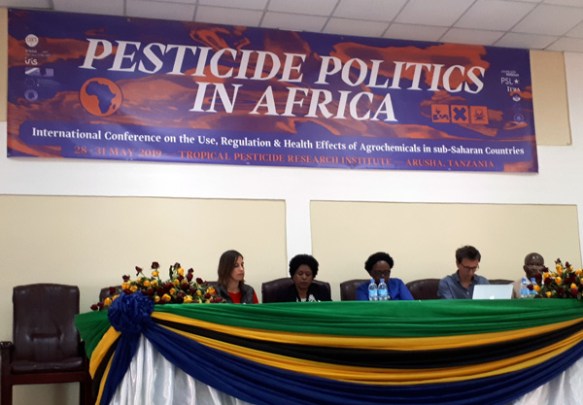
Kees Jansen presented a keynote at the conference on Pesticide Politics in Africa in Arusha, Tanzania during the last week of May. The participants came from different regions in Sub-Saharan Africa, half a dozen European countries and North America and  discussed current approaches towards pesticide problems. Conference participants formulated a call for action addressed to politicians and international organizations. The conference made clear that a very interesting body of social science research on pesticide governance and organic alternatives in Africa is currently being carried out. Scientists at INRA-France and related organizations have been the driving force behind this conference, bringing all these people together and stimulating good social science research on pesticide issues. A remarkable positive feature of this conference was the absence of wifi, leading to a much more attentive audience than usual.

Pesticide-Politics-in-Africa

Cultivating Food Sovereignty: Understanding the diverse economies of sago in Luwu Utara, Indonesia

title pg ulilMuhammad Ulil Ahsan, MSc Student Development and Rural Innovation, Wageningen University
 

Below the abstract of the MSc-thesis “Cultivating Food Sovereignty: Understanding the diverse economies of sago in Luwu Utara, Indonesia“.


The full thesis can be downloaded from the WUR-Library by clicking on the hyperlink


Indonesia has taken up food sovereignty in the constitutional document Food Act number 18/2018 that animates the food policy and program implementation in Indonesia. However, it remains largely rhetorical since the food program implementation has undermined the local food system in many places. This study explores the implementation of food sovereignty in Luwu Utara that is predicated with productionist paradigm, where self-sufficiency is the main goal and transnational corporation are involved in the process of enactment. The implementation put pressure on the local food system in Luwu Utara, particularly in relation to sago. The sago food system encompasses complex issues ranging from the relationship between people in the system to their relation with sago. The diverse economy framework is applied to unravel the diverse forms of economies that lie within the sago food system, and to legitimate the value of food sovereignty existing in Luwu Utara. Diverse economies of sago in Luwu Utara are dominated by non-capitalist practices that can challenge the dominant discourse of capitalist economy as food sovereignty against for. The different forms of food sovereignty at different scales necessitates reflection on food sovereignty implementation. Cultivating food sovereignty requires reflexivity, creating the basis of food sovereignty and building recognition are the strategies to develop a multi-scalar sovereignty. Administering multi-scalar sovereignty is a challenge that must be overcome in the development of a democratic food system in Indonesia.

Keywords: Food sovereignty, diverse economies, sago, Luwu Utara

Thesis of stage project  Versterken Vernieuwende Landbouw Beweging

Er is een forse toename in het aantal netwerken en pioniers op gebied van innovatieve agri-food systemen. Ze ontstaan vanuit de agrarische productiekant alsook vanuit de consumentenkant en bieden een alternatief voor de dominante voedsel- en landbouwpraktijk. Ze richten zich vaak op de lokale context, werken integraal met aandacht voor biodiversiteit, koolstof vastlegging, betrekken van burgers en een gezonde leefomgeving.  Voorbeelden zijn Heerenboeren, Community Supported Agriculture, Food Forests, Agro-ecological agriculture, bodemboeren en toekomstboeren. Bij veel van dit soort innovatieve agri-food systemen wordt uitgegaan van agro-ecologische principes.

De verschillende initiatieven ontwikkelen zich tot grotere netwerken die de ambitie hebben om te komen tot een gezamenlijke beweging. Wellicht met een gezamenlijk loket en/of steunpunt om zo aanspreekpunt te kunnen zijn voor beleid, onderzoek en andere partijen.

Om een goede strategie en aanpak te ontwikkelen voor het creëren van een sterke beweging met impact is het van belang de verschillende initiatieven en hun onderliggende waarden en principes goed in beeld te brengen.

Onderwerpen van een thesis of stage project kunnen zijn:

  • In beeld brengen van de initiatieven en netwerken
  • In beeld brengen van de onderliggende visie/principes van de verschillende initiatieven en initiatiefnemers
  • In beeld brengen aan welke maatschappelijke uitdagingen initiatiefnemers een bijdrage willen leveren.
  • Strategie en aanpak ontwikkelen om de impact van deze vernieuwende initiatieven meer bekend te maken en breder ingang te laten vinden en bruggen te slaan met meer reguliere vormen van landbouw productie.

Heb je interesse om mee te werken aan de ontwikkeling van de vernieuwende landbouwbeweging? Neem dan contact op met jan.hassink@wur.nl of martin.ruivenkamp@wur.nl

#VEGAN: A critical analysis of the discourses around food, identity and responsibility from vegan Instagram influencers – MSc Thesis by Adele Wilson

title pg

Adele Wilson, MSc Student Health & Society, Wageningen University 

Below the abstract of the MSc-thesis “#VEGAN: A critical analysis of the discourses around food, identity and responsibility from vegan Instagram influencers“.


The full thesis can be downloaded from the WUR-Library by clicking on the hyperlink

In the UK we need to reduce the amount of meat we produce and consume in order to prevent climate disaster and poor public health. Vegan Instagram influences have been key figures in providing society with knowledge on why and how people should live meat free. The discourses provided to us by these ‘influencers’ about, food, health, ethics and environmental concerns are extremely powerful as they shape our everyday food thoughts and practices. However, there has been relatively little academic research into the knowledge produced by these online food influencers. Therefore, this study aimed to identify some of the contemporary discourses around veganism on Instragram. Particular attention was paid to how these discourses framed the responsibility for animal welfare, human health, and environmental concerns. The research analysed the profiled of 6 vegan instagram influencers; @chakabars, @earthlinged, @deliciouslyella, @rachelama, @kingcook and @crueltyfreeclairey. The data was analysed using a Foucauldian style discourse analysis. Two main themes were identified. The first was ‘hard veganism’ that focused on the moral justifications for veganism. It was found discourse focused on the justifications for veganism was critical of the livestock industry and unevenly burdened individuals with the responsibility for preventing climate disaster, protecting animals and preserving human health through by consuming a vegan diet (e.g. Christopher, Bartkowski, Haverda, 2018). Therefore, veganism was associated with practicing one’s moral beliefs and acting in a utilitarian way to societal constraints we live in. The second theme was ‘soft veganism’ that referred to images and talk on food. ‘Soft veganism’ framed the food industry positively for providing people with many vegan food options and making veganism ‘easy’. Vegan food was also used to construct vegan subgroups that were aimed at challenging stereotypical views on veganism as an elite white practice (Harper, 2012) and breaking down barriers that prevented some people from engaging with a vegan lifestyle. Therefore, this research found that Instagram is a space where multiple vegan identities are constructed with varying levels of political involvement and philosophical engagement. This research concludes that Instagram may be a useful tool for influencing people to reduce their meat consumption, as it allows people to select knowledge on how to practice veganism that best suits their identity, beliefs and lifestyle.