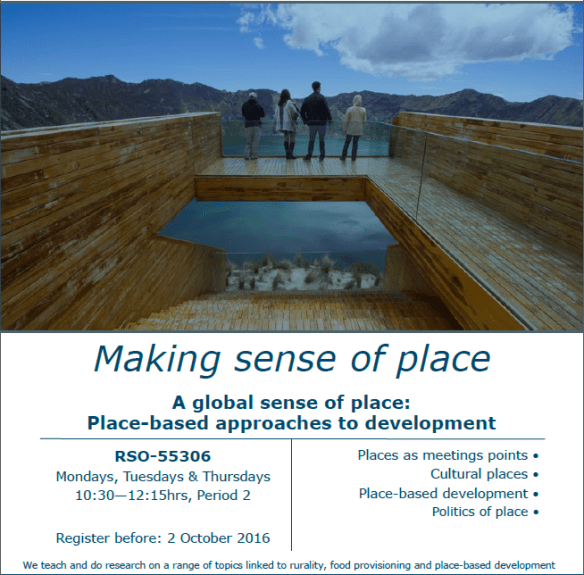
In period 2, from October 31 till December 19, we’ll be teaching again RSO-55306 A Global Sense of Place: Place-based approaches to development. Registration for the course is open until October 2, 2016.
A Global Sense of Place is an optional interdisciplinary course on sustainable place-based development for students from various master programmes (e.g. MDR, MES, MID, MLP, MUE, MOA, MFN). The course builds on the BSc course RSO-56806 Sociology and Anthropology of Place-shaping providing an introduction to place-based approaches in development. Knowledge of this introductory course is an advantage, but is not assumed. The course aims to make students acquainted with an interdisciplinary and place-based approach to development.
A relational place-based approach is seen as key to the understanding of interrelated rural and urban transformation processes and ergo sustainable development. In a relational approach places are considered as contingent,but in time and space differentiated outcomes of three interrelated interdependent and unbounded transformative processes: political-economic, ecological and social-cultural. Places are time and space specific constructs, like their boundaries and connections.
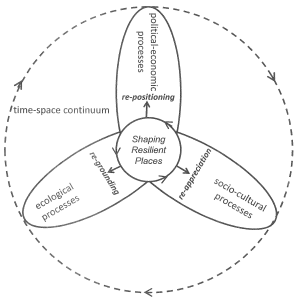
Shaping resilient places. Source: Roep, D., Wellbrock, W, Horlings, I, 2015. Raising Self-Efficacy and Resilience in the Westerkwartier: The Spin-off from Collaborative Leadership, In: J. McDonagh, B. Nienaber, M. Woods (Eds.), Globalization and Europe’s Rural regions. Ashgate, Surrey, pp.41-58
By means of this course students will achieve profound understanding in key-concepts and methods on place-based sustainable development. Work from key thinkers in sustainable place-making will be critically discussed and examined on the basis of various cases. Guest speakers are invited to reflect on place-based approaches to sustainable development and illustrate these through case studies. Ultimately students will acquire a place-based perspective on development.
Language of instruction and examination is English. Classes are taught on Mondays, Tuesdays and Thursdays from 10.30 -12.30.
Key lecturers: Dr. ir. Joost Jongerden (RSO), Dr. Ir. Dirk Roep (RSO) and dr.ir. Martijn Duineveld (GEO)
For more information, please contact Anke de Vrieze, anke.devrieze@wur.nl.

 For the next week, 6 WUR students will be participating in the UN’s Committee for World Food Security (CFS) annual meeting as part of the official Social Media Team, an initiative coordinated by the CFS and the Global Forum on Agricultural Research (GFAR).
 This week the
 Rural Sociology Wageningen University