
October 11 2016, Anne Verschoor successfully defended her MSc-thesis ‘An impact assessment of potentially radical niche developments in the Dutch dairy sector‘. She thus completed the Specialization Gastronomy of the Master Food Technology of Wageningen University. Applying a Social Science perspective in her thesis research was extra challenging but she managed very well to do so. Below an abstract of the thesis. Continue reading
Thesis opportunity: Thuisafgehaald
Note: as I am looking for a Dutch-speaking student for this thesis, the text of this post is in Dutch.
Het stedelijk voedsellandschap verandert. Bestaande kanalen bieden andere soorten voedsel aan (supermarkten verkopen steeds meer biologische en/of lokale producten) en er ontstaan nieuwe kanalen die het mogelijk maken op andere manieren aan voedsel te komen (kopen bij de boer, zelf verbouwen). Consumenten hebben hiervoor zowel ethische overwegingen (diervriendelijker, milieubewuster consumeren) als sociale overwegingen (elkaar ontmoeten rondom eten). Ondanks het bestaan van al die verschillende kanalen kopen de meeste mensen het grootste deel van hun voedsel in de supermarkt. Blijkbaar is het in de praktijk nog best lastig om de supermarkt te omzeilen. Continue reading
A light shining on Cluj – Nyeleni Europe Forum for Food Sovereignty
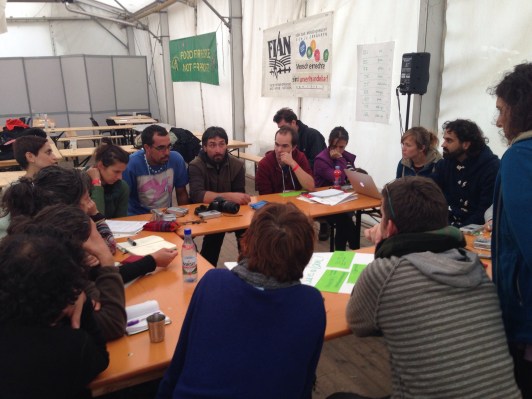
Participants discuss strategies to advance food sovereignty in Europe
Last week the second Nyeleni Europe forum for Food Sovereignty was held in Cluj-Napoca, Romania. The Forum brought together different delegations from European countries and beyond representing producers, consumers, NGOs and researchers involved in the Food Sovereignty movement. The Forum set out create new initiatives and ties among people in opposition to the dominant food paradigm. Continue reading
Fundamental but still contentious: Right to Food at the CFS
Rural Sociology’s Jessica Duncan is currently at the 43rd Session of the Committee on World Food Security (CFS). She and Nadia Lambek are live covering the meeting. Their previous contribution was an introduction to the CFS: ‘5 things you need to know about the CFS’.

This blog was originally posted here on the Event Blog of the Committee on World Food Security. It was written by Nadia Lambek and Jessica Duncan.
—
 CFS42 (photo by X. Jiang)
When the Committee on World Food Security (CFS) reformed in 2009 it identified the promotion of the right to food as one of its goals. This was an important development, as recognizing human rights is fundamental to achieving food security.
Despite this development, however, the issue of human rights is still contentious within the CFS. Participants continue to clash over whether to include human rights in the CFS’s outputs and on whether or not to adopt a rights-based perspective in making policy recommendations.
Observers attending the first plenary session of the CFS might have been surprised to see that very few governments chose to mention human rights and the right to food in their opening addresses. Indeed, these…
View original post 620 more words
Call for Papers: Association of American Geographers Annual Meeting Boston, April 5-9th 2017
Understanding challenges and opportunities for future food and nutrition Security
TRANSMANGO’s Dr. Brídín Carroll (University College Dublin, Ireland) is chairing this session at the Association of American Geographers Annual Meeting in Boston. Abstracts due the 25th of October!

Understanding challenges and opportunities for future food and nutrition security
Bridin Carroll
It is well established that the food system is globally integrated and that this system is subject to a wide range of drivers of change including climate, economic concentration and market structure, financial power, resource competition, marginalization, property rules, geo-political shifts, consumer preferences, consumption patterns and nutritional transition. These drivers of change affect how food flows through this system, at all stages from production to consumption (Yakovleva, 2007; Tansey, 1994). It is important to obtain a comprehensive picture of the effects of these drivers, as well as to systematically assess the vulnerabilities of the food system (pressures, hazards, shocks and stresses), in the context of socio-economic, behavioural, technological, institutional and agro-ecological change.
View original post 585 more words

