PUREFOOD research and training network

The Rural Sociology Group has been granted the coordination of a Marie Curie Initial Training Network  entitled ‘Urban, peri-urban and regional food dynamics: toward an integrated and territorial approach to food (PUREFOOD)’ funded by the European Commission’s Seventh Framework PEOPLE program. The PUREFOOD research and training programme aims to reduce the enormous knowledge and skills deficit that is negatively affecting the capacity to design and deliver appropriate political and developmental solutions in the crucial supra-disciplinary fields of food security, public food procurement, public health and sustainable urban and regional development. Hence, the objective of PUREFOOD is to train a pool of 12 early-stage researchers (ESRs) in the socio-economic and socio-spatial dynamics of the (peri-)urban and regional foodscape. The research and training program will therefore provide knowledge and innovation for the Commission’s aim to deal with economic, social and environmental policies in “mutually reinforcing ways” which reflects the core of the Lisbon and Gothenburg agenda’s call for integrated solutions towards economic prosperity, social cohesion and environmental sustainability. The PUREFOOD network is centred around food as an integrated and territorial mode of governance and studies the emergence of the (peri-)urban foodscape as an alternative (as opposed to a globalised) geography of food, including the ways in which, and the extent to which, sustainability aspects generally considered to be intrinsic to the alternative food geography are incorporated by the more conventional food companies.

The PUREFOOD Initial Training Network consists of 7  university partners who will each host one or more ESRs:

  1. Wageningen University Rural Sociology Group (The Netherlands)
  2. Cardiff University School of City and Regional Planning (United Kingdom)
  3. Pisa University Department of Agronomy and Agro-ecosystem Management (Italy)
  4. Latvia University Faculty of Social Sciences (Latvia)
  5. City University London Centre for Food Policy (United Kingdom)
  6. Federal University of Rio Grande do Sul Postgraduate Program in Rural Development (Brazil)
  7. Makerere University School of Public Health Department of Community Health and Behavioural Sciences (Uganda)

In addition to these universities as full consortium partners, the PUREFOOD network consists of 8 associated partners, a combination of private firms, public authorities and civil society organisations:

  1. Peri-Urban Regions Platform Europe (PURPLE)
  2. Sustainable Agriculture Initiative (SAI) Platform
  3. Sodexo UK
  4. Willem&Drees
  5. Slow Food Study Center
  6. Stroom Den Haag
  7. Sustain – the alliance for better food and farming
  8. Tukums municipality

The associated partners will contribute to the PUREFOOD training program by contributing to courses, participating in Communities of Practice and by hosting ESRs for a secondment. The active involvement of these associated partners is also of great importance for safeguarding the practical applicability of scientific research in the commercial, public as well as civic realm and for the dissemination of results.

The seven universities have opened (or soon will open) vacancies for 12 early-stage research positions. The launch of the vacancies has been announced on this weblog. As of now the PUREFOOD vacancy brochure with information about ESR projects, eligibility criteria, contact persons for additional information and addresses for submitting applications is available. For potential prospective ESRs an information pack has been compiled with information about the PUREFOOD research and training programme, the individual ESR projects, the timeline of the project and short descriptions of the full and associated consortium partners.

Superhoogbouw en Stadstuinbouw

Woensdag 29 september was ik één van de sprekers op een bijeenkomst georganiseerd in het kader van Onderzoek ERASMUSPOORT® project over stedelijke verdichting. Onderzoek ERASMUSPOORT® is tot op heden een virtuele casus, die juist daardoor de gelegenheid biedt om allerlei nieuwe ideeën en concepten te genereren over de vraag hoe op een duurzame manier om te gaan met de stedelijke verdichtingsopgave in Nederland en tegelijkertijd de kwaliteit van de stedelijke leefomgeving substantieel te verbeteren.  Daarmee wordt dan nadrukkelijk ook of vooral de kwaliteit van de publieke ruimte bedoeld.

Als onderzoek naar een virtuele casus leent Onderzoek ERASMUSPOORT® zich voor vernieuwende vragen over maar vooral voor creatieve en onconventionele oplossingen voor duurzame superhoogbouw in Nederland – uitgevoerd middels een drietal afstudeerscripties aan de TU Eindhoven, die woensdag jl. ook werden gepresenteerd. Maar het noopt ook tot nadenken over de gevolgen van verdichting voor energiehuishouding, verkeer en vervoer, sociale cohesie, et cetera. Op woensdag 29 september stond het vraagstuk van stedelijke voedselvoorziening centraal: biedt superhoogbouw nieuwe kansen om wonen en voedselproductie ruimtelijk te combineren. En zo ja, om welke vormen van voedselproductie gaat het dan, wat zijn de voor en nadelen hiervan en hoe kan die combinatie worden gerealiseerd.

In mijn verhaal ben ik ingegaan op de sociale, economische, ecologische en gezondheidsproblemen die samenhangen met het heersende geglobaliseerde en geïndustrialiseerde voedselsysteem: obesitas, ondervoeding, achteruitgang biodiversiteit, grote sociale verschillen m.b.t. toegang tot voldoende vers voedsel, waterverbruik bij voedselproductie, strijd om land, achteruitgang bodemkwaliteit, et cetera. Voedsel als thema structureel inbedden in stedelijk ontwikkelingsbeleid, zoals met veel succes in Toronto via de Toronto Food Policy Council, is mijns inziens de enige manier om allerlei grootstedelijke problemen aan te pakken, simpelweg omdat veel van deze problemen direct of indirect met het dominante voedselsysteem samenhangen. Eén van de manieren om voedsel als thema structureel in te bedden in stedelijk ontwikkelingsbeleid is het creëren van ruimte voor stadsland- en tuinbouw, waarbij ook nadrukkelijk gebruik wordt gemaakt van de mogelijkheden die de stedelijke infrastructuur biedt. Dus naast voedselproductie in de grond (in groenstroken, voor- en achtertuinen, parken, et cetera) ook voedselproductie op daken (hetgeen goed aansluit bij Rotterdam’s groene daken programma), op balkons en in gebouwen.

Dit laatste – voedselproductie in gebouwen – was de boodschap van de spreker na mij: Gertjan Meeuws van Plantlab. Plantlab staat, naar eigen zeggen, voor een revolutie in kweken omdat

“producten in meerdere lagen worden geteeld met gebruik van LED-verlichting in volledig geconditioneerde ruimten zonder daglicht. Deze meerlagen kwekerijen staan straks dicht bij de consumenten en bieden vele voordelen zoals een hoger productieniveau met een exact voorspelbaar oogstmoment en een stuurbaar product qua uiterlijk, smaak en voedingswaarde”  (http://www.plantlab.nl/4.0/index.php/revolution-in-growing/?lang=nl).

Ik vond het een fascinerende presentatie van Gertjan Meeuws; het lijkt een bijzonder innovatieve benadering die, net als mijn ideeën over stedelijk voedselbeleid, voortkomt uit de constatering dat het huidige mondiale voedselsysteem niet duurzaam is. Een technologische oplossing bedenken om honger, watertekorten en bodemdegradatie tegen te gaan vormt het voornaamste uitgangspunt voor Plantlab’s benadering. Vooral de bewering dat productieniveaus t.o.v. de huidige productieniveaus in kassen kunnen worden verveelvoudigd met slechts 10% van het huidige waterverbruik, significante vermindering van energieverbruik en zonder gebruik te maken van chemische bestrijdingsmiddelen klinkt ronduit fantastisch. En het lijkt erop dat Plantlab een systeem heeft ontwikkeld dat zich leent voor redelijk kleinschalige tot zeer grootschalige toepassing, alhoewel met name dat laatste sterk werd benadrukt. Dat deed me teveel denken aan het agro-productiepark concept dat niet alleen qua bedrijfsmodel niet goed is doordacht, maar ook niet in staat is om burgers actief bij voedselproductie te betrekken en om voedsel in de stedelijke context als een vehikel voor andere publieke doeleinden in te zetten (zoals eductie, sociale cohesie, werkgelegenheid, stedelijke vergroening, et cetera). Dat kwam ook in de discussie naar voren na onze presentaties. Maar volgens mij hoeft het één het ander niet uit te sluiten en is het juist een uitdaging om te zien hoe Plantlab’s benadering een plaats kan krijgen in een integraal voedselbeleid voor steden die worstelen met een verdichtingsopgave. En ik ga binnenkort in op Gertjan’s uitnodiging om een kijkje te nemen bij Plantlab. Het lijk me erg leuk en leerzaam om dat te doen in de vorm van een excursie met een internationale groep MSc studenten.

Food: The Link between City and Countryside

In spring 2007 the Amsterdam Food Strategy entitled Proeftuin Amsterdam , which was inspired by the London Food Strategy, commenced. Proeftuin Amsterdam combines policies, initiatives and activities which serve the following objectives in Amsterdam and the surrounding region:

  • Provide naturally-grown and preferably local food for everybody while minimizing environmental impacts;
  • Promote healthy eating habits, especially among children & young people;
  • Achieve a balance between the demands of urban consumers and the supply of food products from the surrounding countryside;
  • Preserve the surrounding agricultural landscapes of Amsterdam.

In order to achieve these objectives Proeftuin Amsterdam seeks to act as lubricant for existing and emerging initiatives, as a facilitator for new alliances between public and private parties and as an initiator of new initiatives. Some examples of the targets of Proeftuin Amsterdam are:

  • The availability of organically produced and preferably local food in:
    • all school canteens;
    • municipal canteens, hospitals and care institutions;
    • the tourist industry;
    • local day markets.
  • Preserving agriculture in the immediate surroundings of the city for the long term.
  • Kitchen amenities in new schools.
  • Every primary school to have access to a nearby school working garden.
  • Simplified regulations for retail and day markets for organic and local food.
  • Reduction of food miles, lower emissions as a result of cleaner transport.
  • School curricula to include life style and eating habits.

According to a DG Regional Policy document about Proeftuin Amsterdam[i] the

“action programme for healthy and sustainable food chains has shown impressive impact and resonance. … This is especially evident for initiatives in the field of education (schools gardens, school meals, farm-related projects) and the promotion of regional markets to connect producers and consumers. All in all the Proeftuin Amsterdam testifies to the good sense of connecting environmental and health aspects of food systems with the preservation of the peri-urban area around Amsterdam. … Such regional food strategies can be instrumental in meeting the challenges Europe will have to face with respect to changing global food markets and demographic developments.”    

Despite the fact that Proeftuin Amsterdam has achieved, albeit sometimes partially, many of its initial goals and has inspired other cities in the Netherlands to incorporate food in urban development plans, the municipality has decided to end the programme by the end of this year, although some projects will continue in the Amsterdam boroughs. To mark the end of 4 years of Proeftuin Amsterdam a special issue of Plan Amsterdam, the magazine of the spatial planning department, about food has been issued entitled ‘Voedsel – Schakel tussen Stad en Platteland’. This special issue, in Dutch but with an English summary, reflects on Amsterdam’s food strategy but also contains a very interesting article about the history of the Amsterdam food markets.


[i] See http://www.proeftuin.amsterdam.nl/aspx/download.aspx?file=/contents/pages/100532/case_study_amsterdam_food_strategy.pdf

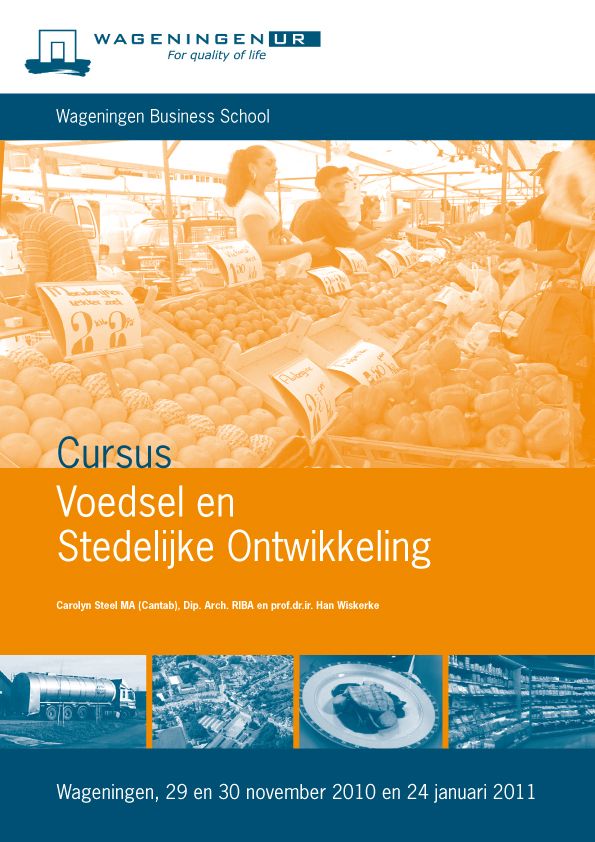
Cursus ‘Voedsel en Stedelijke Ontwikkeling’

Op 29 en 30 november 2010 en 24 januari 2011 verzorgen Carolyn Steel en ik voor Wageningen Business School een cursus over de relatie tussen voedsel en stedelijke ontwikkeling. Deze cursus is toegankelijk voor een breed publiek: beleidsmakers, architecten, landschapsarchitecten, stedelijk ontwerpers, eco-ontwerpers, docenten en mensen die in de landbouw, voedingsmiddelen- of gezondheidsindustrie werken. Daarnaast is iedereen die geïnteresseerd is in duurzame (stedelijke) ontwikkeling van harte welkom.

De aanleiding voor deze cursus is gelegen in de trend van bevolkingsgroei en voortschrijdende verstedelijking en het daarmee samenhangende spectrum aan sociale, economische en ecologische uitdagingen. Klimaatverandering, slinkende olie voorraden en het uitputten van natuurlijke hulpbronnen, gecombineerd met sociale kwesties als armoede, honger en obesitas, vormen de achtergrond voor complexe beleids- en planningsvraagstukken. De verbindende vraag in deze is hoe steden in de toekomst te voeden op een rechtvaardige en duurzame manier.

Als de toekomst inderdaad verstedelijkt is, moeten we dringend (her)definiëren wat dit inhoudt. Huidige aannames over verstedelijking, ontstaan in een tijd die voornamelijk ruraal was, zijn verouderd. We hebben een nieuwe visie nodig op steden en de relatie die zij hebben met het platteland dat hen moet voeden. Als wijzelf en onze toekomstige generaties “goed” willen kunnen leven, moeten we nieuwe inzichten ontwikkelen met betrekking tot wonen, ontwerpen en samenwerkingsverbanden. Hoe we dat moeten doen, is de kern van deze cursus.

Deze cursus is gebaseerd op en geïnspireerd door het boek Hungry City van Carolyn Steel. Hierin analyseert ze stedelijke ontwikkeling vanuit het perspectief van voedsel. Voedsel is de verbindende factor tussen tal van stedelijke uitdagingen, variërend van de ecologische footprint en klimaatverandering tot welzijn en gezondheidsvraagstukken. Door de verbinding met voedsel zichtbaar te maken, krijgen planners en beleidsmakers een middel in handen om hun aanpak te herdefiniëren en deze meer toe te spitsen op een duurzame stedelijke en rurale ontwikkeling. Cursisten leren door dit perspectief de relatie te zien tussen voedsel en verschillende publieke domeinen. Door deze relatie te begrijpen, wordt inzicht verkregen in de kwaliteit van beleid, in de samenhang van beleidsterreinen en in de verbanden tussen lokale en globale kwesties. Cursisten leren werken in multi-disciplinaire teams, waarbij voedsel als gemeenschappelijke taal en verbindende factor gebruikt.

Klik op de volgende links om je in te schrijven of om de cursusfolder te downloaden.

Worm farm

Making your own vermiculture or ‘worm farm’ is not very difficult (see the many instructions on internet). Maybe the most difficult bit here is acquiring the right type of worms. The ‘red wiggler’ which you can order by mail in Australia, US or the UK is not available through the mail man in the Netherlands. The manure heap – a left over of last year –  in the corner of our allotment garden proved the solution. The red wiggler likes manure. We dug in and ‘harvested’ around a hundred last year september and again a hundred in the spring. By now we have a healthy population which reproduces and soon we might need to expand our farm or donate worms to a new farm…. Continue reading