Regional identity and wine walks in the Alsace region (Fr)

I recently traveled to France for a short walking spring break. In the north eastern part of the country I visited the Alsace region. I stayed in the area left of the city of Colmar near the village called Munster (well known for its ‘smelly’ cheese). Although the break was a way of resetting my brain, I couldn’t stop myself from observing some interesting things.

The Alsace region
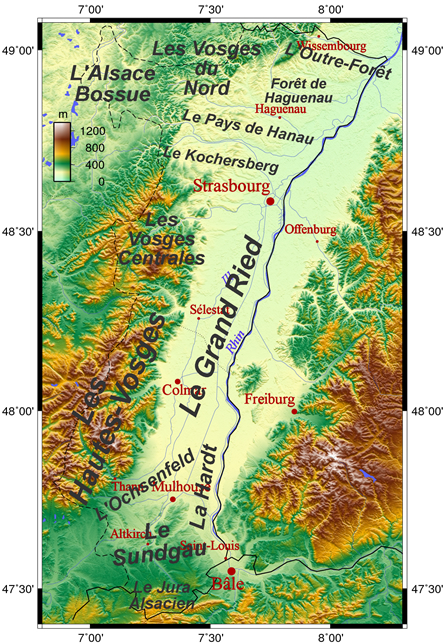
Although the Alsace is French, the area is characterized by many German influences. Not surprisingly because the area changed hands many times. The area has a strong regional identity which expresses itself physically, culturally and historically (architecture (timber framed houses), landscape, dialect, kitchen and regional products). The stork can be seen as the region’s main symbol and almost disappeared in the 1970’s. The region put a lot of effort in bringing baThe Alsace region (Wikipedia)ck the bird (by starting breeding programs) and now storks can be found on roofs of houses and public buildings everywhere. All these things are characteristic to the Alsace region.
Wine walks
An important and unnoticeable regional product is wine (Vin d’Alsace) like Riesling, Gewürztraminer and Pinot Blanc. Since Roman times the Alsace has a strong tradition in growing grapes and over time has developed as a centre of viticulture. The area has an excellent terroir: good weather, climate, fertile soils and sunny slopes. Part of the rocky hilltops every small piece of the area is cultivated for growing grapes. This viticulture can bee seen as the (historical) backbone of this region into which over time whole sets of other activities got interwoven: visiting historical villages, local products / food, touristic walks etc. Central to this all is the wine and the attractiveness of the region. On my break I explored one of these really nice walks near the village of Kaysersberg. The walk started in climbing a woody and rocky hill and lead through the village of Riquewihr and via extensive vineyards back to were we started. In the vineyards information panels were placed to give information growing techniques, pruning, different varieties and the winemaking process. During the walk we stopped at several wine farmers / cooperatives for some refreshments and wine tasting. 

These wine walks are an interesting way of using regional identity and products for regional development. The combination of activities, services and goods attracts tourists, strengthens the regional economy and contributes to the vitality and livability of this specific region. I got the impression the Alsace region is very succesful in this!
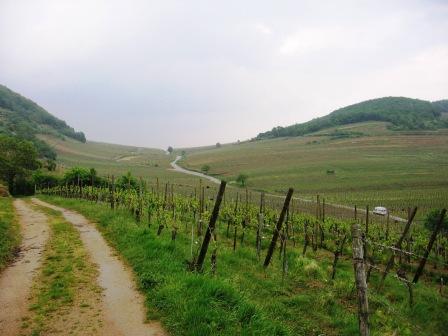
Wine walk

Food and the city

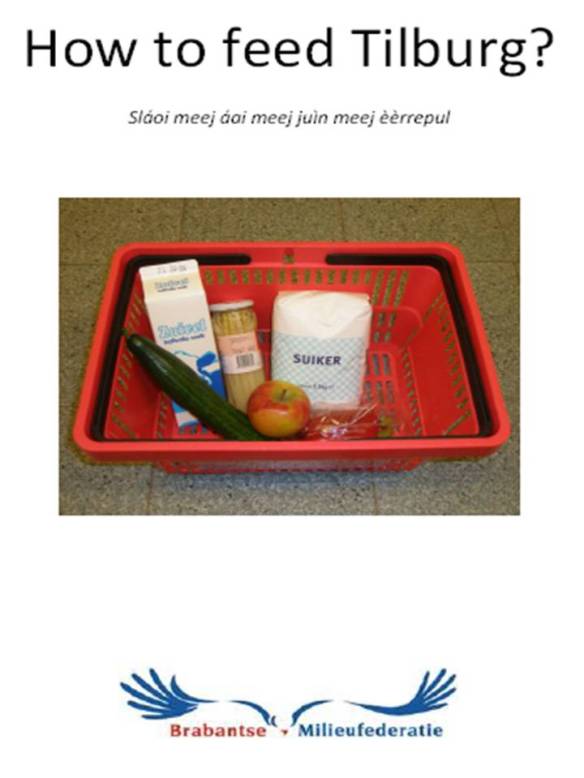
Cover "How to feed Tilburg"In the past two months a group of 5 Master students of Wageningen University carried out an exploratory study on food consumption in the city of Tilburg. This study was commissioned by the Environmental Federation of the province of Brabant (BMF). Tilburg has the ambition to become a climate neutral city in 2045, yet the issue of food is lacking in the city’s climate programme. Given the fact that approximately 40% of the urban citizen’s ecological footprint is related to food and that food production and transport make up a significant portion of a city’s CO2 emission, it will be impossible to become a climate neutral city without including a food strategy in the city’s climate programme. For this reason the BMF asked this group of students to calculate/estimate Tilburg’s total food consumption and to give a first impression of the food miles and food transport related CO2 emission of several food products (e.g. apple, sugar, sweet pepper, asparagus, milk, cucumber) for different outlets (e.g. a supermarket, a greengrocer, an organic supermarket and a farm shop). The food miles and related CO2 emissions were calculated on the basis of the products that were sold at each outlet end of March/beginning of April this year, so they only represent the situation at that moment in time. On Wednesday April 22 the group presented their findings.

Some findings I found interesting and/or intriguing: Continue reading

Excursions Understanding Rural Development

As a part off the course Understanding Rural Development (RSO 31806) we went on a field trip to de Eemlandhoeve in Bunschoten and explored the inner-city of Utrecht. By this excursion we visited a number of interesting expressions of urban-rural relationships, from a rural and an urban perspective.

De Eemlandhoeve

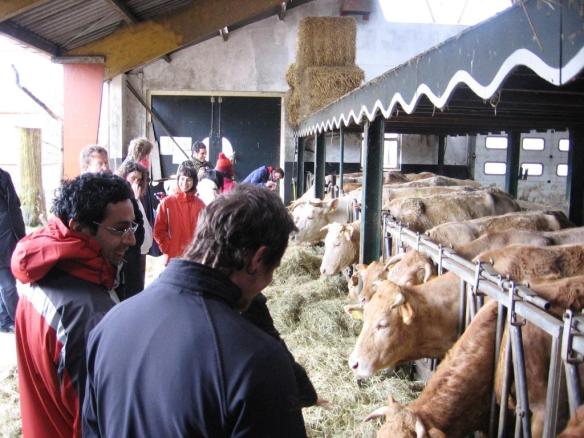
De Eemlandhoeve, owned by farmer, rural entrepreneur and philosopher Jan Huijgen, can be considered as an extreme example of a multifunctional farm enterprise. The group of Blonde d’Aquitaine’s form the centre of a rural enterprise which includes a large number of activities like a farm shop, care facilities, meeting and office facilities, an education garden and even a farmer’s cinema under construction.Blonde d'Aquitaines at the Eemlandhoeve

Next of being a multifunctional entrepreneur Jan Huijgen is a well known personality in Dutch rural development, active on a local, national, international (and maybe in the near future on a global) level. The farm residents a rural innovation centre and last October de Eemlandhoeve hosted the EEconference or Europese Eemlandconference, veelzijdig platteland.

On the excursion owner Jan Huijgen told us about his inspiration, motives and future plans with his farm. After his presentation we had an interesting discussion and were showed around the place.

Local food in the city of Utrecht

The second trip brought us to a rather different surrounding; the historical inner-city of Utrecht. On de Eemlandhoeve our focus was on the rural side of urban-rural relationships, in Utrecht we looked upon it from an urban perspective.

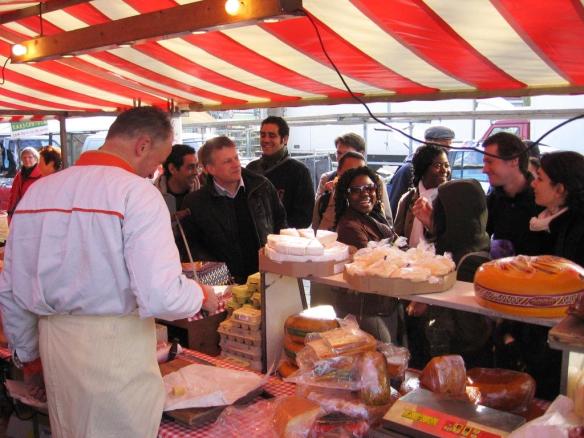
Cheese stall at the Vredenburg MarketTogether with our guide Frank Verhoeven (see his website)  we first went to the Wednesday Vredenburg Market. On this market we visited a cheese seller linked to the organization called Dutch Cheese Centre (website under construction). The stallholder told us about some typical Dutch cheeses and the trade in locally produced ones. After some tasting we set out for the traditional bakery Bakkerij Blom were owner Theo Blom showed us around and told about his bakery, traditional products and production.  

Our last stop was a visit to the five star hotel and restaurant Karel V for a number of short presentations. In the hotel our guide Frank Verhoeven started by telling us about his ‘Boerenbox’ initiative and his vision on a more locally based production and consumption. Secondly, one of the Karel V chefs explained us about the way they work with seasonal products originating solely from regional grounds and local suppliers. Lastly, Arie Bosma, one of the initiators of the campaign ‘Lekker Utregs’, told us about the initiative to reconnect the city of Utrecht with its surrounding countryside by establishing a so called Green Participation Society.

By the fieldtrips we got acquainted with several interesting expressions of urban-rural relationships, from a rural and an urban perspective. It was a nice and inspiring way of linking theory from class to reality by ‘tasting’ real life examples in ‘the field’.

SPIN farming and other forms of urban agriculture

On the last day of the second week of my course ‘Understanding Rural Development’ I discussed the topic of urban and peri-urban agriculture. As background to this topic I mentioned the following trends:

Given these trends, the question is how to feed the growing urban population and to do this in a sustainable and healthy way. In class we discussed whether or not urban and peri-urban agriculture are a means to feed the urban citizen. And, elaborating on that, what kind of (peri-)urban agriculture is desirable and/or necessary. Continue reading

Evolution of Rural Development Paradigm in Brazil

In a recent research seminar prof. Sergio Schneider (schneide@ufrgs.br), coordinator of the  Rural Development Post Graduate Program from the Federal University of Rio Grande do Sul (Brazil), presented a telling analysis of major changes in Rural Developments Policies in Brazil in the last twenty years. He explained that the recent evolution in rural development policies, as effectuated by president Lula, has to be understood within the context the evident political struggles on land. Brazil is a large country with traditionally a sharp contrast between the interests of agro-industrial conglomerates and social rural movements of landless people and peasants (e.g. MST).

This is reflected in a dualist agrarian structure between capitalist and entrepreneurial family farming and peasant familiy farming and rural poor (landless) who are struggling for survival and autonomy. In 1995 1 % of the owners with more then 1000 ha owned 45% of all land, while 90% of the owners with less then 100 ha owned only 20%. An unexpected and striking consequence of rural poverty is, that food security in rural areas is significantly lower then in urban areas. In rural areas 26% of the housholds suffers severe food insecurity versus 17% in urban areas. Because of this dualist agrarian structure Brazil is probably the only country in the world with two Ministries of Agriculture, serving different needs.

Continue reading