Resistance and Autonomy in Western Mexico – local actors creating a place of their own

 By Peter R.W. Gerritsen, Department of Ecology and Natural Resources, South Coast University Centre, University of Guadalajara, Av. Independencia Nacional 151, 48900, Autlán, Jal., Mexico. Email: petergerritsen@cucsur.udg.mx

 The local effects of global processes in the Mexican countryside are well documented; describing problems related to the quality of rural producers’ life, identity and traditional practices, as well as their resource management practices. Alike initiatives all over the world,  also in western Mexico local actors joined forces to counter these problems and created ‘a place of their own’ in a globalised world, a place for their own wellbeing.
RASA - Peter Gerritsen

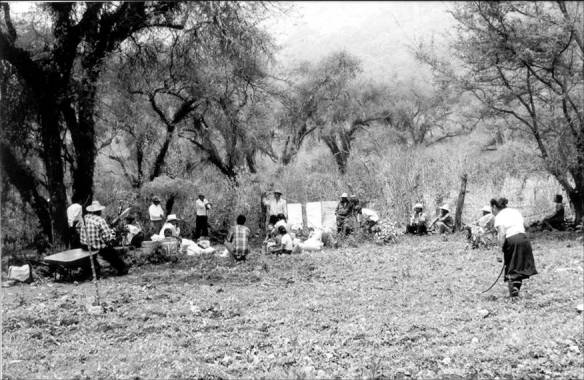
In the state of Jalisco, located in western Mexico, 20 groups of peasants and indigenous farmers, supported by professionals from non-governmental organizations and local universities, joined forces in 1999 and created the Red de Alternativas Sustentables Agropecuarias (RASA: the Network for Sustainable Agricultural Alternatives). As such, the RASA can be considered an umbrella organization for many local organized producer groups.

The RASA is also a social organization with characteristics of the so-called new social movements. New social movements have emerged since the late 1970s in the Mexican countryside, due to the problems created by global processes. The struggles that have led to their emergence originate from the demand to defend local structures and to remain control over the different domains of daily life. As such, these movements stress the need for endogenous development approaches. Closely related to the issue of specific life styles is the defense of the territory, being the place of local identity formation. It is also here, where innovative forms of resource management have emerged.
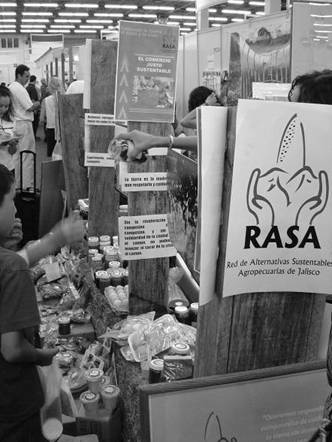
RASA 2 PGThe RASA´s main objective is strengthening a development model that aims to mitigate the local impacts of global processes and that permits the transition towards sustainable local development. In practice, the RASA organizes workshops on organic agriculture and fair trade, and organizes farmer-to-farmer meetings for sharing experiences (including political discussions on the countryside). These activities take place in the rural and peri-urban areas of Jalisco. The RASA also designs and implements new fair trade-channels, mainly in the metropolitan area of the Jalisco state capital Guadalajara. As such, the RASA´s actions are also directed at urban consumers. Finally, articulation with other social movements is actively sought for. Thus, the RASA seeks to create new room for maneuver by establishing strategic alliances with different societal actors.

The creation of local transition paths towards sustainable development, such as promoted by the RASA, is related to the issues of agency and power. These, in turn, are (often) related to resistance and autonomy. Both elements are also recognizable in the RASA experience.

To start with, the RASA has created its own socio-political space in the Jalisco countryside, which has permitted to resist to and counter the dominant rural development model in Mexico and in Jalisco that follows global tendencies. However, the RASA´s efforts must be understood as heterogeneous in nature; not all groups are involved in fair trade, but only those with a production surplus. Moreover, some groups focus more on basic grain production, while others cultivate horticultural crops. Furthermore, the RASA emerged outside the realm of governmental intervention in rural areas. In fact, it has been systematically neglected by formal institutions, as the RASA has been considered a threat to the established formal – historically-determined – political spaces in the rural arenas. Moreover, within the rural communities the RASA-members are perceived as outsiders. In this sense, the RASA conceptual approach has permitted strengthening their self-consciousness and self-organization, as well as improving their position in their communities. It has also led to the dimension of autonomy in the sustainable development model, as designed and implemented by the RASA.
Sustainable Food Planning Conference

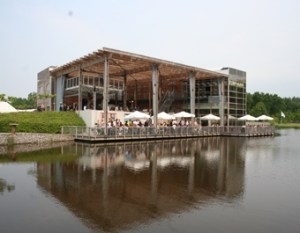
De KemphaanIn her recent blog, Petra already reflected on the Sustainable Food Planning Conference that was held in Almere (at De Kemphaan) on 9 and 10 October. My personal impression is that it was a very successful kick-off of the AESOP thematic group on sustainable food planning. In addition to lots of interesting presentations, there were interesting discussions and the strong will and desire among the participants to continue collaboration. One of the ways to continue collaboration is by means of an annual conference. Another is to create an electronic platform to facilitate exchange of experiences, examples, articles, reports, etc… Soon we will launch such a platform by means of a weblog similar to this one. For the time being, this post provides the links to the dowloads of the presentations and the discussion.

De Kemphaan, 9 and 10 October 2009, Almere, The Netherlands

The program
The participants
Presentation 1 Mr. Henk Mulder Including food and agriculture in urban planning: The Almere approach
Presentation 2 Prof. Han Wiskerke An integrated and territorial perspective on food studies, policy and planning
Presentation 3 Mr. Henk de Zeeuw Feeding the city: Practices, challenges and lessons from developing countries
Presentation 4 Prof. Gianluca Brunori Reconnecting consumers and producers: Dynamics, diversity and potentials of alternative food networks
Presentation 5 Dr Roberta Sonnino Urban food and public spaces: Planning for security and sustainability
Presentation 6 Dr Marin Caraher Food and the city: The links between food, public health and sustainable urban development
Presentation 7 Mrs. Lenie Dwarshuis Food and agriculture in Europe’s peri-urban regions
Presentation 8 Dr. Nevin Cohen The practice of food planning in New York City
Presentation 9 Mr. Bart Pijnenburg, MSc Amsterdam’s food strategy (“Proeftuin Amsterdam”)
Presentation 10 Prof. Jerry Kaufman Including food in planning studies and planning practices: Experiences from the USA
Report of the discussion

Pumpkin harvest and local food

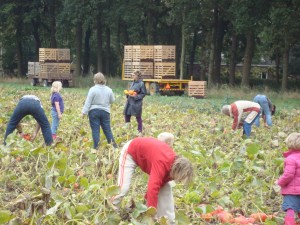
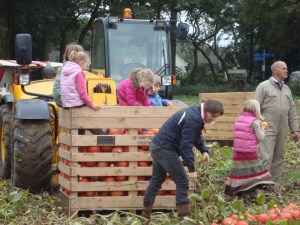
Last Saturday 30 adults and children came to help with the harvest of pumpkins of farmer André in the village of Hemmen, just four kilometers from Wageningen. We harvested around 9 thousand kilo of the approximately 15 thousand kilo on the one hectare field. The invitation to help was the first event organized by a new NGO called “Stichting Hemmens Land” of which I am a board member. This NGO aims to facilitate the cooperation between the organic farmers and organic shop in Hemmen, to engage citizens with local food and farming and to organize educative activities on and around the farms.

pompoen oogstMainly families from nearby towns and villages in the Betuwe came to help with the harvest and for the children it was great fun to stand in and fill the box in front of the tractor. The people who came were happy with the possibility to engage actively with local food and the work of the organic farmers. Some were customers of the organic box scheme, others read the announcement in the newspaper and were just drawn by the activity itself. Citizen engagement with local food is a topic of increased interest in the academic literature. Engagement with local food can strengthen regional food systems and local community and can contribute to human and environmental health. However, as has been noted, in our consumption oriented economy, ‘local’ easily becomes a new ‘brand’, a way to distinguish and create space; market space. Or ‘local’ becomes an experience, part of the cultural economy in which “harvest festivals provide an enactment of leisure activities and the urban lifestyle” (Tellstrom et al 2005: 354).

None of the Hemmen villagers came to help with the harvest or came even to look what was going on. The organic farmers and shopkeepers are newcomers, all of whom established over the last six years. Part of the reason for setting up the NGO and a real challenge is also to try to connect and integrate into the village. Local is important as a non-monetary value and at the same time it is an economic factor for entrepreneurs who are seeking multiple ways to make a sustainable living. But as Laura B. DeLind rightly argues “without an emotional, a spiritual and a physical glue to create loyalty, not to a product, but to layered sets of embodied relationships, local will have no holding power.” (2006: 126)

pompoenoogst 2

Eten van dichtbij

Werkplaats 10 - Eten van dichtbij

Werkplaats 10 - Eten van dichtbij

Vorige week verscheen een nieuwe uitgave van het blad “Werkplaats voor de Leefomgeving” van de Koninklijke Nederlandse HeideMaatschappij (KNHM). Deze 10e uitgave van dit blad heeft als thema “Eten van dichtbij” en gaat onder meer over stadsboeren, pergolabedrijven, stad-plattelandrelaties en publieke sector catering. Verder bevat het tal van korte beschrijvingen van en web-links naar initiatieven over regionale voedselvoorziening uit zowel Nederland als andere landen. De diversiteit aan activiteiten en benaderingen is zonder meer indrukwekkend. Voor een ieder die geïnteresseerd is in verschillende vormen en aspecten van regionale voedselvoorziening en/of stad-platteland relaties biedt dit themanummer een informatief en toegankelijk overzicht.

Know your farmer, know your food

Recently I joined a Dutch internet Sustainable Food group. Today the convenor of this group informed the members about a new initiative of the USDA (United States Department of Agriculture): “Know your farmer, know your food”. The aim of this USDA initiative is to help more Americans understand where their food comes from and how they can support local food economies in their communities. The initiative was announced by USDA secretary Tom Vilsack in a YouTube video:

“An American people that is more engaged with their food supply will create new income opportunities for American agriculture. Reconnecting consumers and institutions with local producers will stimulate economies in rural communities, improve access to healthy, nutritious food for our families, and decrease the amount of resources to transport our food.”

While the White House kitchen garden and Obama’s idea to have a weekly farmers’ market at the White House (see my blog posted on 4 September) could have been perceived as ‘window dressing’, this USDA initiative surely gives the impression that the Obama administration is seriously attempting to fundamentally change US agrofood and rural development policy. Will, in this case, Obama’s campaign slogan – “Yes, we can” – become true?