Sustainable food planning conference – reminder & update

As mentioned in my blog of 28 August 2009 the Association of European Schools of Planning (AESOP), the International Studygroup on Multiple Use of Land (ISOMUL) and the Rural Sociology Group are hosting the first European Sustainable Food Planning conference. The conference will take place at De Kemphaan in the city of Almere in the Netherlands on 9 and 10 October 2009. It is still possible to register for this conference. If you are interested to participate in this conference, please apply by e-mail to corine.diepeveen@wur.nl. Costs for participation are € 100,- (incl. drinks, lunches and diner).

City estate De Kemphaan

Since the first announcement a couple of weeks ago, the conference programme has changed slightly. Below you can find the most recent version of the programme:

Day 1 – Generating ideas, exchanging experiences and comparing perspectives

09.00 – 09.30

Welcome and coffee/tea

09.30 – 09.45 Food and planning: an introduction to the conference Prof. Kevin Morgan (Professor of Governance & Development, Cardiff University, UK)
09.45 – 10.00 Including food and agriculture in urban planning: the Almere approach Mr. Henk Mulder (director urban planning Almere)
10.00 – 11.00

Session 1: Setting the scene

10.00 – 10.30 An integrated and territorial perspective on food studies, policy and planning Prof. Han Wiskerke (Chair of Rural Sociology – Wageningen University, Netherlands)
10.30 – 11.00 Feeding the city: practices, challenges and lessons from developing countries Mr. Henk de Zeeuw (director of the RUAF Foundation)
11.00 – 11.30

Coffee/tea break

11.30 – 13.00

Session 2: Theoretical perspectives and academic issues

11.30 – 12.00 Reconnecting consumers and producers:  dynamics, diversity and potentials of alternative food networks Prof. Gianluca Brunori (Professor of Agriculture Economics – Pisa University, Italy)
12.00 – 12.30 Urban food and public spaces: planning for security and sustainability Dr. Roberta Sonnino (Lecturer in Environmental Planning – Cardiff University, UK)
12.30 – 13.00 Food and the city: the links between food, public health and sustainable urban development Dr. Martin Caraher (Reader in Food & Health Policies – City University London, UK)
13.00 – 14.00

Lunch break

14.00 – 15.30

Session 3: Food planning practices and policies

14.00 – 14.30 Food and agriculture in Europe’s peri-urban regions Mrs. Dwarshuis (President of Peri-Urban Regions Platform Europe – PURPLE)  
14.30 – 14.50 The practice of food planning in New York city Dr. Nevin Cohen (Associate Professor in Urban Studies – New School for Liberal Arts, New York)
14.50 – 15.10 The practice of food planning in New York state Mr. Bob Lewis (senior planner New York State)
15.10 – 15.30 Amsterdam’s food strategy (“Proeftuin Amsterdam”) Mr. Bart Pijnenburg MSc (Programme manager Proeftuin Amsterdam)
15.30 – 16.00

Coffee/tea break

16.00 – 18.00 Excursion to City Farm Almere Tineke van den Berg (urban farmer)
19.30 – 22.30

Diner (Restaurant De Kemphaan – Almere)

Day 2 – Towards an agenda for sustainable food planning

09.00 – 09.30

Welcome and coffee/tea

09.30 – 10.00 Including food in planning studies and planning practices: experiences from the USA Prof. Jerry Kaufman (Professor Emeritus of Urban and Regional Planning – University of Wisconsin-Madison, USA)
10.00 – 10.45 Issues, topics, themes for a sustainable food planning agenda (plenary inventory) Moderated by Prof. Arnold van der Valk (Chair of Land Use Planning – Wageningen University, NL)
10.45 – 11.15

Coffee/tea break

11.15 – 12.45 Developing the building blocks for a sustainable food planning agenda (parallel working sessions)
12.45 – 14.00

Lunch break

14.00 – 14.45 Plenary presentation of and discussion about results of parallel working sessions Moderated by Prof. Terry Marsden (Professor of Environmental Planning – Cardiff University, UK)
14.45 – 15.00 Sustainable food planning in Europe: concluding reflection and look ahead Prof. Kevin Morgan (Professor of Governance & Development, Cardiff University, UK)
15.00

Coffee & tea / end of conference


Local resilience to peak oil and climate change

Last night I went to the film. The film night and the discussion afterwards was organised by the Transition Town Vallei, a new ngo which started in June this year. Wageningen and its surrounding villages is not the only place with a Transition Town initiative. They are mushrooming all over the Netherlands at the moment. The movement which is now taking off, started in Totnes, the UK:

“It all starts off when a small collection of motivated individuals within a community come together with a shared concern: how can our community respond to the challenges, and opportunities of Peak Oil and Climate Change?”

The Transition Town website gives a guide for how to set up a Transition Town initiative, how to raise awareness around peak oil and climate change, how to connect with existing community groups, how to work with local government and how to come eventually to a “energy descent action plan” which increases the resilience of local community for times when energy is not such a self evident fact of life.

In Wageningen, we are at the awareness raising stage. We watched the film The Power of Community, How Cuba Survived Peak Oil. I can recommend this film to anyone remotely interested in the energy debate, the way forward with sustainability or more specific, the transition to local and organic food systems. After the initial shock and hunger, the Cubans massively started to farm on every square meter available. Tractors had become obsolete and the generation that still knew how to work with an ox trained a new generation. Without machinery, the conventional scale was untenable, which led to new systems of land distribution and a decentralisation of land ownership. Without chemical help, techniques of soil rehabilitation, worm composting, crop rotation, mixed planting and permaculture were adopted to “work with nature instead of against it”. “We call that ‘lazy agriculture’” somebody in the film explained. That should appeal to us all I would think.

Composting at Red hook farm NY

Composting at Red Hook urban farm NY

Victory Gardens revisited – the Obama Foodscape

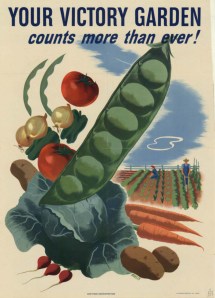
US World War II era poster promoting Victory Gardens (source: http://www.art.unt.edu/ntieva/pages/about/newsletters/vol_15/no_1/WarPosterImages.htm)

US World War II era poster promoting Victory Gardens

Victory Gardens, also known as ‘war gardens’ or ‘food gardens for defense’ were fruit, vegetable and herb gardens planted in backyards and on rooftops in the USA, the UK, Canada and Australia during World War II. They were considered to be an important means to reduce the costs for vegetables needed by the US War Department to feed the troops and to safeguard food security. One of the advocates of the Victory Garden was Eleanor Roosevelt, US first lady from 1933 to 1945, who also planted a Victory Garden at the White House. The Victory Gardens were a great success: the 20 million Victory Gardens in the US produced up to 40% of all vegetables that were consumed in the US.

After World War II the number of Victory Gardens rapidly decreased as most citizens believed that food shortages would be over soon. However, in recent years there is a campaign to re-establish Victory Gardens. Not to reduce the price of vegetables needed to feed US troops, but primarily from the perspective of food sovereignty; as a means to escape the growing dependence of consumers on the food stuffs provided by the food processing industries and retailers. At the same time gardening is also considered to be an important instrument in greening cities, in growing sustainable communities and in educating children about food and healthy eating (see e.g. our recent blogs about urban agriculture and nourishing the city).

For such a movement to become a success it is always helpful to have a leading figure as an icon. It seems that the USA’s new first family, in particular first lady Michelle Obama, is taking on this role. For the first time since the Roosevelt days, the White House once again as a garden. This beautiful short movie gives a good impression of the White House kitchen garden and the rationale behind it. 

However, there is more to food and the Obama’s than the White House kitchen garden only. Recently President Obama  announced that he wants to set up a White House farmers market to support local farmers and as an example of creating new connections between cities and its surrounding countryside. Interested to be informed about  the Obama Foodscape, have a look at the  Obama Foodorama weblog.

Urban Agriculture / Stadslandbouw

Growing food in urban gardens and allotments has a long history. In the Netherlands, allotment gardens are a marginal but natural part of the city’s infrastructure. Other European countries have their own history in urban gardening too, such as many Eastern European countries. Also in the US, urban gardening is a long standing practice.

However, in the Netherlands as well as in the US, urban gardening is moving from the fringe into the heart of a debate about health and sustainability. The manifestations look similar. For example, the Alemany Farm in San Francisco which started on a vacant lot (see story) or the Red Hook urban farm (see earlier blog). Also in Rotterdam, Proefpark de Punt started on a vacant lot and also this initiative met skeptics of urban planners and city leaders until it had proven itself.

Reading the articles and websites of initiatives related to Urban Agriculture in the US and its counterpart ‘Stadslandbouw’ in the Netherlands, there seems a striking difference too. In the US, the food production aspect of the gardening is taken far more serious as an option for providing people a significant portion of their daily food. Growing food in urban gardens is about access to fresh food. Not in the last place for those who do not have easy and affordable access.

In the Netherlands, this notion is not absent of course. But the language around the initiatives starts from a broader notion of the need for ‘green space’ for the health of the urban citizen. A green environment, education about nature and food, recreation possibilities in accessible green spaces, the improvement of mental health and social cohesion by means of gardening. These notions can also be found in the initial objective for setting up Proefpark de Punt:

‘Landleven in de Stad’, een natuurlijke speel- en recreatiemogelijkheid voor de buurt te creëren.

A trend watcher on the website of Proefpark de Punt talked about ‘squatting green space’ which is what many initiatives in the US and the Netherlands essentially do. However, the local context differs considerably which means that the connections to health and sustainability are interpreted quite differently. A call for comparative studies I guess.

Proefpark de Punt

Proefpark de Punt

A local food movement in central Finland?

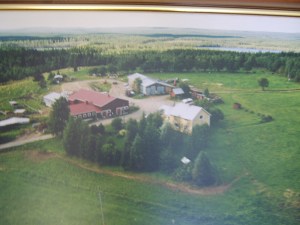
After the ESRS conference in Vaasa, I joined my friend Ella to her place in Sotkamo in the north east of Finland. In Finland Sotkamo is better know as Vuokatti, the ski and outdoor holiday area within the municipality. It makes the center of Sotkamo a rather lively exception in a region suffering from de-population and ageing rural communities. Why would a young generation of farmers take over? A real challenge for Ella’s boyfriend, a dairy farmer in the region Kainuu. Milking 16 cows on 45 hectares party under conservation agreement, he is the only dairy farmer left in his village, delivering his milk to the cooperative a hundred kilometres further. With the decreasing milk price, these are hard times to make a living from this farm.

overview of the farm

overview of the farm

Alternatives are needed, but somehow, the development of alternative food systems seems to take off very slowly in Finland. Jokinen and colleagues (Maaseudun uusi aika 2/2009) give three reasons; 1) the long distances in the sparsely populated areas; 2) the strongly consolidated food supply chain (the three largest retain chains control almost all grocery sales in the Nordic countries) and 3) the declining co-operative culture in abated rural communities. I was struck by the similarity in reasons/conditions to the American Midwest, where, especially in Iowa alternative food systems do take off – against the odds.

Farmer cooperation, consumer awareness and civic action and organisation are among the most needed ingredients for building local food systems and sustainable livelihoods in Finland. Currently, this intermediary level of organisation is lacking in many places. How to start a positive cycle of development depends on many interrelating and partly unpredictable factors. Good examples – from within Finland or from oversees – might inspire people to invest in their communities and in local food.