By Marlies Meijer, MSc-student combining Land Use Planning and Rural Sociology
“Only when we travel, and meet strangers, do we recognise other ways of being human” (Patsy Healey in Collaborative Planning, after Latour).
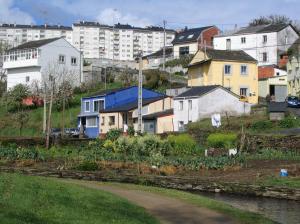
city - countryside transition in galicia
So here I am, travelling (or balancing) between land use planning and rural sociology, my Dutch planning knowledge and the Galician rural reality, between reading in Gallego, speaking in Castellano, writing in English and chatting in Dutch, between the Spanish working hours and my Dutch empty stomach.
As many students I wanted to stay abroad for a long period of time during my MSc. For students in rural sociology this is probably a logical highlight of their studies; students in land use planning leave their country less frequently. I wanted to go anyway. Since my interest in rural dynamics and policy making processes, contact with the RSO group was established quickly, together with the possibility to go to Galicia, Northern Spain.
Back in the Netherlands, I was aware of the Dutch context of my education so far. Most examples provided are Dutch, or could be placed in the planning Dutch context. I wanted to broaden my scope, go somewhere where policy making is less evident and face the effect of a different cultural context, but also to experience a real rural area. Now I find it hard to let the familiar Dutch context go and to explain what I exactly do study in the Netherlands (something like geography, people making plans and rural development) and what my research is about (even more vague). Multi-faceted policy, focussed on the spatial environment, does not exist here, as it exists in the Netherlands. So I keep on balancing, and exploring and let myself be surprised every day by the Galician way of doing.
Marlies also has a personal blog (in Dutch): http://marliesengalicia.blogspot.com/

 Greetings from Poland! At the moment we are attending the IP on rural development in Lublin. The program is very intensive indeed! Within one week, we have not only become acquainted with efforts of authorities to promote rural development but, in small groups, we have also spent three interesting days in several rural districts across the Lublinski region. During this time we visited farmers, entrepreneurs and social groups to get a better insight into their everyday lives, problems and wishes for their future.
 We also presented our work to the International Expert Group (IEG) which was established for the duration of the project. In Rome, eight experts joined us, coming from a wide range of organisations including the European Commission, the OECD, consultancies and universities. The IEG helped us to reflect upon our first results and to gain new insights. They formulated recommendations for further elaboration. The experts encouraged us to find a qualitative way to analyse the transformative effects and potential impact of the rural development policy process; the ‘forgotten middle’ in current evaluation practices.
 Rural Sociology Wageningen University