Sustainable Food Planning Conference

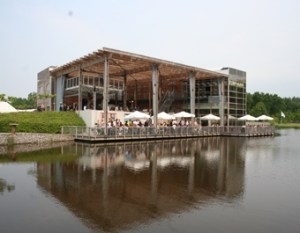
De KemphaanIn her recent blog, Petra already reflected on the Sustainable Food Planning Conference that was held in Almere (at De Kemphaan) on 9 and 10 October. My personal impression is that it was a very successful kick-off of the AESOP thematic group on sustainable food planning. In addition to lots of interesting presentations, there were interesting discussions and the strong will and desire among the participants to continue collaboration. One of the ways to continue collaboration is by means of an annual conference. Another is to create an electronic platform to facilitate exchange of experiences, examples, articles, reports, etc… Soon we will launch such a platform by means of a weblog similar to this one. For the time being, this post provides the links to the dowloads of the presentations and the discussion.

De Kemphaan, 9 and 10 October 2009, Almere, The Netherlands

The program
The participants
Presentation 1 Mr. Henk Mulder Including food and agriculture in urban planning: The Almere approach
Presentation 2 Prof. Han Wiskerke An integrated and territorial perspective on food studies, policy and planning
Presentation 3 Mr. Henk de Zeeuw Feeding the city: Practices, challenges and lessons from developing countries
Presentation 4 Prof. Gianluca Brunori Reconnecting consumers and producers: Dynamics, diversity and potentials of alternative food networks
Presentation 5 Dr Roberta Sonnino Urban food and public spaces: Planning for security and sustainability
Presentation 6 Dr Marin Caraher Food and the city: The links between food, public health and sustainable urban development
Presentation 7 Mrs. Lenie Dwarshuis Food and agriculture in Europe’s peri-urban regions
Presentation 8 Dr. Nevin Cohen The practice of food planning in New York City
Presentation 9 Mr. Bart Pijnenburg, MSc Amsterdam’s food strategy (“Proeftuin Amsterdam”)
Presentation 10 Prof. Jerry Kaufman Including food in planning studies and planning practices: Experiences from the USA
Report of the discussion

Eten van dichtbij

Werkplaats 10 - Eten van dichtbij

Werkplaats 10 - Eten van dichtbij

Vorige week verscheen een nieuwe uitgave van het blad “Werkplaats voor de Leefomgeving” van de Koninklijke Nederlandse HeideMaatschappij (KNHM). Deze 10e uitgave van dit blad heeft als thema “Eten van dichtbij” en gaat onder meer over stadsboeren, pergolabedrijven, stad-plattelandrelaties en publieke sector catering. Verder bevat het tal van korte beschrijvingen van en web-links naar initiatieven over regionale voedselvoorziening uit zowel Nederland als andere landen. De diversiteit aan activiteiten en benaderingen is zonder meer indrukwekkend. Voor een ieder die geïnteresseerd is in verschillende vormen en aspecten van regionale voedselvoorziening en/of stad-platteland relaties biedt dit themanummer een informatief en toegankelijk overzicht.

Sustainable food planning conference – reminder & update

As mentioned in my blog of 28 August 2009 the Association of European Schools of Planning (AESOP), the International Studygroup on Multiple Use of Land (ISOMUL) and the Rural Sociology Group are hosting the first European Sustainable Food Planning conference. The conference will take place at De Kemphaan in the city of Almere in the Netherlands on 9 and 10 October 2009. It is still possible to register for this conference. If you are interested to participate in this conference, please apply by e-mail to corine.diepeveen@wur.nl. Costs for participation are € 100,- (incl. drinks, lunches and diner).

City estate De Kemphaan

Since the first announcement a couple of weeks ago, the conference programme has changed slightly. Below you can find the most recent version of the programme:

Day 1 – Generating ideas, exchanging experiences and comparing perspectives

09.00 – 09.30

Welcome and coffee/tea

09.30 – 09.45 Food and planning: an introduction to the conference Prof. Kevin Morgan (Professor of Governance & Development, Cardiff University, UK)
09.45 – 10.00 Including food and agriculture in urban planning: the Almere approach Mr. Henk Mulder (director urban planning Almere)
10.00 – 11.00

Session 1: Setting the scene

10.00 – 10.30 An integrated and territorial perspective on food studies, policy and planning Prof. Han Wiskerke (Chair of Rural Sociology – Wageningen University, Netherlands)
10.30 – 11.00 Feeding the city: practices, challenges and lessons from developing countries Mr. Henk de Zeeuw (director of the RUAF Foundation)
11.00 – 11.30

Coffee/tea break

11.30 – 13.00

Session 2: Theoretical perspectives and academic issues

11.30 – 12.00 Reconnecting consumers and producers:  dynamics, diversity and potentials of alternative food networks Prof. Gianluca Brunori (Professor of Agriculture Economics – Pisa University, Italy)
12.00 – 12.30 Urban food and public spaces: planning for security and sustainability Dr. Roberta Sonnino (Lecturer in Environmental Planning – Cardiff University, UK)
12.30 – 13.00 Food and the city: the links between food, public health and sustainable urban development Dr. Martin Caraher (Reader in Food & Health Policies – City University London, UK)
13.00 – 14.00

Lunch break

14.00 – 15.30

Session 3: Food planning practices and policies

14.00 – 14.30 Food and agriculture in Europe’s peri-urban regions Mrs. Dwarshuis (President of Peri-Urban Regions Platform Europe – PURPLE)  
14.30 – 14.50 The practice of food planning in New York city Dr. Nevin Cohen (Associate Professor in Urban Studies – New School for Liberal Arts, New York)
14.50 – 15.10 The practice of food planning in New York state Mr. Bob Lewis (senior planner New York State)
15.10 – 15.30 Amsterdam’s food strategy (“Proeftuin Amsterdam”) Mr. Bart Pijnenburg MSc (Programme manager Proeftuin Amsterdam)
15.30 – 16.00

Coffee/tea break

16.00 – 18.00 Excursion to City Farm Almere Tineke van den Berg (urban farmer)
19.30 – 22.30

Diner (Restaurant De Kemphaan – Almere)

Day 2 – Towards an agenda for sustainable food planning

09.00 – 09.30

Welcome and coffee/tea

09.30 – 10.00 Including food in planning studies and planning practices: experiences from the USA Prof. Jerry Kaufman (Professor Emeritus of Urban and Regional Planning – University of Wisconsin-Madison, USA)
10.00 – 10.45 Issues, topics, themes for a sustainable food planning agenda (plenary inventory) Moderated by Prof. Arnold van der Valk (Chair of Land Use Planning – Wageningen University, NL)
10.45 – 11.15

Coffee/tea break

11.15 – 12.45 Developing the building blocks for a sustainable food planning agenda (parallel working sessions)
12.45 – 14.00

Lunch break

14.00 – 14.45 Plenary presentation of and discussion about results of parallel working sessions Moderated by Prof. Terry Marsden (Professor of Environmental Planning – Cardiff University, UK)
14.45 – 15.00 Sustainable food planning in Europe: concluding reflection and look ahead Prof. Kevin Morgan (Professor of Governance & Development, Cardiff University, UK)
15.00

Coffee & tea / end of conference


Local resilience to peak oil and climate change

Last night I went to the film. The film night and the discussion afterwards was organised by the Transition Town Vallei, a new ngo which started in June this year. Wageningen and its surrounding villages is not the only place with a Transition Town initiative. They are mushrooming all over the Netherlands at the moment. The movement which is now taking off, started in Totnes, the UK:

“It all starts off when a small collection of motivated individuals within a community come together with a shared concern: how can our community respond to the challenges, and opportunities of Peak Oil and Climate Change?”

The Transition Town website gives a guide for how to set up a Transition Town initiative, how to raise awareness around peak oil and climate change, how to connect with existing community groups, how to work with local government and how to come eventually to a “energy descent action plan” which increases the resilience of local community for times when energy is not such a self evident fact of life.

In Wageningen, we are at the awareness raising stage. We watched the film The Power of Community, How Cuba Survived Peak Oil. I can recommend this film to anyone remotely interested in the energy debate, the way forward with sustainability or more specific, the transition to local and organic food systems. After the initial shock and hunger, the Cubans massively started to farm on every square meter available. Tractors had become obsolete and the generation that still knew how to work with an ox trained a new generation. Without machinery, the conventional scale was untenable, which led to new systems of land distribution and a decentralisation of land ownership. Without chemical help, techniques of soil rehabilitation, worm composting, crop rotation, mixed planting and permaculture were adopted to “work with nature instead of against it”. “We call that ‘lazy agriculture’” somebody in the film explained. That should appeal to us all I would think.

Composting at Red hook farm NY

Composting at Red Hook urban farm NY

Education in Urban Agriculture

Urban agriculture (UA) will never substitute food production from farmland but it can contribute to make more fruits and vegetables available near our growing urban world population. This calls for interdisciplinary research, but above all for interdisciplinary education. The next generation of urban farmers and developers is currently applying to our universities. Now the potential of UA is beginning to be realized, these young people will need practical hands-on skills and interdisciplinary knowledge to design new food system solutions. How to use limited space in an intense way, using the newest technology in an ecologically sound way calls for a large number of skills (see growing power). A growing number of universities develops courses and programs on UA (Redwood in Agriculture in urban planning 2009: 236).

A good example of a course which integrates how to learn to grow food and slaughter small poultry livestock with the theoretical knowledge from various disciplines such as soil science, horticulture, (insect) ecology, sociology and biology is the Urban Agriculture course at University of California, Berkeley. According to the course description the interdisciplinarity will

“allow us to better understand the biophysical and socioeconomic opportunities for and obstacles limiting urban and peri-urban agriculture”.

With the next round of education reform towards a semester model coming up, there should be space for a course on Urban Agriculture at Wageningen University.