Unknown's avatar

About FoodGovernance

Jessica Duncan is Associate Professor in Rural Sociology at Wageningen University (the Netherlands). She holds a PhD in Food Policy from City University London (2014). Jessica’s main research focus concerns the practices and politics of participation in food policy processes, particularly the relationships (formal and non-formal) between governance organizations, systems of food provisioning, the environment, and the actors engaged in and across these spaces. More specifically, she maps the diverse ways that actors participate in policy-making processes, analysing how the resulting policies are shaped, implemented, challenged, and resisted, and she theorizes about what this means for socio-ecological transformation. Participation and engagement is at the core of her approach. In turn, she is active in a broad range of local, national and international initiatives with the aim of better understanding participation processes with a view towards transitioning to just and sustainable food systems. She is involved in several research projects including ROBUST, HortEco & SHEALTHY. Jessica is published regularly in academic journals. She recently co-edited the Handbook on Sustainable and Regenerative Food Systems (2020). Her other books include Food Security Governance: Civil society participation in the Committee on World Food Security (2015) and an edited volume called Sustainable food futures: Multidisciplinary solutions (2017). Jessica has received several awards for her teaching and in 2017 she was awarded Teacher of the Year for Wageningen University (shortlisted again in 2018 and 2019, longlisted in 2020). With the funds she has received for these awards she launched a story-telling workshop for students and faculty, with storytelling trainer, Emma Holmes. Jessica is on the Editorial Board of the journal Sociologia Ruralis and is an advisor to the Traditional Cultures Project (USA). She is a member of the Wageningen Young Academy and sits on the Sustainability Board of Experts at Wageningen University.

“Global Food Security Governance” at Kyoto University

By Joëlla van de Griend

lecture

In-class debate on trade and food security


Kyoto University’s Graduate School of Economics, as part of the Asian Platform for Global Sustainability & Transcultural Studies (AGST), aims to contribute to sustainable development in Asia and throughout the world. Wageningen University’s Rural Sociology Group is a key partner in this platform. As a part of this partnership, Dr. Jessica Duncan has come to Kyoto University to teach a course on Global Food Security Governance.

Taking a sociological approach, the course covers a variety of angles to think about global food security governance. The course is attended by graduate students, PhD candidates and faculty members, which has contributed to rich discussions. Furthermore, amongst the participants there is a large variety of backgrounds and fields of expertise such as law, economics, development studies, business management, political science, and agricultural science with attendants coming from Asia, Europe and Africa.

One of the students attending the class is Wurihan. She decided to follow the course because of a growing interest in policy regarding food security. Before attending Kyoto University as a research student, she went to an agricultural university in China where she studied geographical information systems:

“I used to think that to ensure food security we should increase efficiency in production. But after I did some fieldwork I found it was more about policy and how this can sometimes turn out differently than policy makers intend.”

That is why she wants to learn more about food governance in order to understand how we can contribute to solutions of problems like the distribution of food and obesity.

As one of the objectives of the course is to explore the complexity of the thinking about food security, many theories and approaches are discussed and explored in class while using “framing” as a method to understand the different (often competing) perspectives.
Continue reading

Muddy paddies and peace

By  Joëlla van de Griend

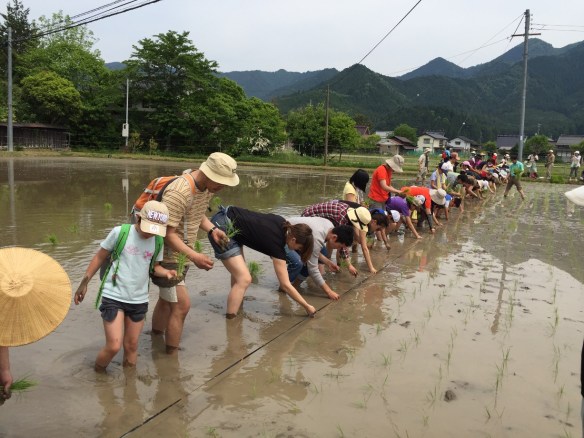
‘Mountains covered with woods’ is used to describe the green area of Keihoku, just outside of Kyoto City. As part of the AGST program, students and faculty members visited a farming event organized by the Shinfujin Kyoto (the new Japan Women’s Association) and the Nouminren Kyoto (Japan Family Farmers Movement).

Rice planting.jpg

Participants transplanting rice: Our academic hosts were not afraid to get their hands and feet dirty!

This event tries to make the connection between farmers and consumers and is visited by a lot of families. We can look at it as a celebration of what the earth has given to both farmers and consumers, illustrated by the waving flags showing the text: ‘Hug the Mother Earth’. For example, one of the farmers I met told me about how he grows his rice in the village at the foot of the mountain without making use of chemicals.

One of the organizations responsible for the event, Shinfujin, is a women’s organization that aims to promote environmental protection and emancipation but is also a movement to oppose the comeback of militarism in Japan. Many of the members of this organization are young mothers who are concerned with a variety of crises that could become a threat to their children’s future. This farming event however was more a celebration than a protest, with a vibrant temporary market with products and food stalls, activities, and the possibility to experience transplanting rice plants into the rice paddies. Continue reading

Gender & Diversity in Sustainable Development


PhD Course Gender and Diversity

Wageningen University’s School of Social Sciences  (WASS) will be offering a PhD course in May and June 2017 called Gender and Diversity in Sustainable Development.  Bettina Bock and Jessica Duncan, both from RSO, will lecture in this course.

Date Mon 22 May 2017 until Fri 16 June 2017
Time 09:30
Venue Leeuwenborch, building number 201
Hollandseweg 1
201
6706 KN
Wageningen
0317-483639

Inequality lies at the center of current debates about sustainable development, from which a number of policy issues, including Sustainable Development Goals, emanate. Yet, how social (in)equality contributes to creating sustainable development often remains invisible in research. This course enables participants to recognize linkages between gender and diversity and sustainable development in a contemporary globalising world.

The topics covered in this course are:

  • Introduction: key concepts in gender studies
  • Trends form a historical perspective
  • Economics: macro and micro perspectives
  • Work and care
  • Population and migration
  • Food security and governance
  • Environment and natural resource management
  • Global politics


This course will be a seminar. We will take a highly interactive learner-centered approach that combines short lectures with group-based learning activity and discussion. A series of instructors with gender and diversity expertise from WUR and other universities will discuss the relevance of the themes discussed in our class to their own domains.

More information is available here: http://www.wur.nl/en/Education-Programmes/PhD-Programme/Graduate-Schools/Wageningen-School-of-Social-Sciences/Courses/Show-1/Gender-Diversity-in-Sustainable-Development.htm

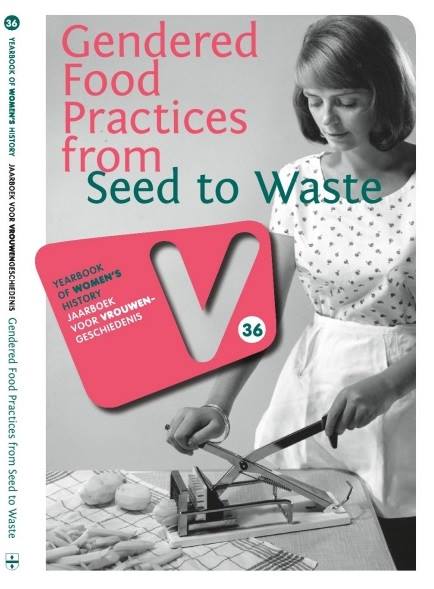
Book Launch: Yearbook of Women’s History 36 (2016)

yearbook-cover

You are all welcome to the launch of Gendered Food Practices from Food to Waste

  •  Wednesday 22 February 2017 / 15.00-17.00 
  • Impulse / Wageningen Campus, Building 115,Wageningen University
  • Address: Stippeneng 2, Wageningen

Program

There will be coffee and tea upon arrival. Guest-editors Bettina Bock and Jessica Duncan (from RSO) will give a short presentation and hand over the first copy to professor J.M. van Winter, professor emerita of medieval history, expert in food history, and main benefactor of the Yearbook of Women’s History.

Curator of the National Museum of Education Jacques Dane will give a presentation of his contribution to the volume on Domestic Science in and outside the Dutch Classroom in the period 1880-1930.

Registration:  Please RSVP before 19 February to e.c.walhout ( a ) hum.leidenuniv.nl (Evelien Walhout).

About the volume

In nearly all societies gender has been, and continues to be, central in defining roles and responsibilities related to the production, manufacturing, provisioning, eating, and disposal of food. The 2016 Yearbook of Women’s History presents a collection of new contributions that look into the diversity of these gendered food-related practices to uncover new insights into the shifting relations of gender across food systems. Authors explore changing understandings and boundaries of food-related activities at the intersection of food and gender, across time and space. Look out for intriguing contributions that range from insights into the lives of market women in late medieval food trades in the Low Countries, the practices of activist women in the garbage movement of prewar Tokyo, the way grain storage technologies affect women in Zimbabwe, through to the impact of healthy eating blogs in the digital age.

Editors: Bettina Bock and Jessica Duncan (guest-editors), Eveline Buchheim, Saskia Bultman, Marjan Groot, Evelien Walhout and Ingrid de Zwarte


Famelab: Get a training and present your popular science story


Telling your science story in just three minutes without using Powerpoint. That is FameLab, a competition for scientists, PhD-candidates or even master students who love to inspire people to see the world from a new perspective.
Young Wageningen researchers in the broad spectrum of science and technology who subscribe in Famelab competition are entitled to the dedicated Famelab Presentation Workshop preceding the Wageningen heat. Registration closes February 11th.

FAMELAB.jpg

All selected participants are entitled to the dedicated FameLab Presentation Workshop. This is a half day workshop where – in addition to general presentation skills and principles – you will be able to practice and tweak your own presentation and improve your story based on direct and personal feedback. Training  workshop is scheduled Tuesday afternoon February 14 or on Thursday morning February 16 as desired.

Apply online at the website of the organising British Council Netherlands for the Wageningen heat in the afternoon of February 24th at Impulse Wageningen Campus, get more information or contact Wageningen science information officer Jac Niessen, tel. 85003 or jac.niessen@wur.nl.