75th Anniversary: 26) History and Sociology

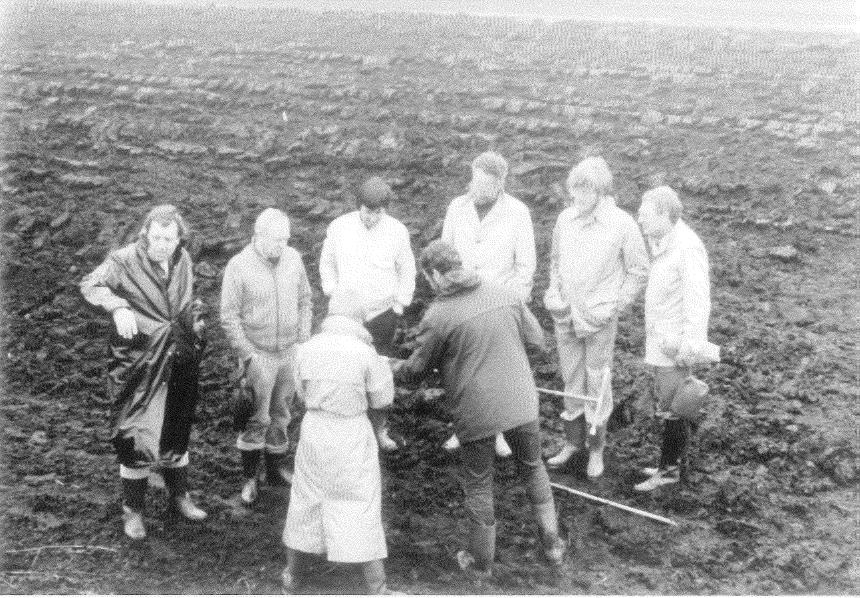
Chair excursion to the peat-area in Drenthe (beginning of the eighties). From left to right: Aart Snel (our secretary), Ad van der Woude, Willibrord Rutte, Jouke Wigboldus, Jaap Buis and Henk Roessingh. On his back with the Edelman-drill: Jan Bieleman. Next to him one of our students. The photo was taken by Anton Schuurman.

By Anton Schuurman, Rural and Environmental History

The fame of the chair group Rural History brought me in 1978 to Wageningen. The Wageningen history group was at that time different from all the others history groups in the Netherlands – it was doing social science history, history as a social science with the methods of the social sciences with as its most characteristic feature the use of quantitative methods and statistics. It is still the message of our group: ‘We apply comparative historical methods to better understand long-term patterns of interdependence between people, institutions and environments. Our empirical work builds on a combination of qualitative sources and large statistical datasets, which we construct from historical archives across the globe.’ – it reads on our internet page. Although nowadays part of the section Economics of the Social Sciences Group – perhaps partly due to the fact that the heirs of Hofstee seem to have lost interest in doing quantitative work – , the chair group owned its existence to the tenacity of the same Hofstee (as so many of the social sciences chairs in Wageningen do) who succeeded finally in 1956 to lure Slicher van Bath away from Groningen to Wageningen.

Hofstee was a history-orientated sociologist (well, social geographer), as was explained earlier in these blogs, who later named his own way of doing sociology: encompassing sociology (differentiële sociologie – see  blog 5. In blog 5 the English translation is differential sociology. I prefer encompassing sociology – a term from Charles Tilly (Tilly, 1984; Schuurman, 1996), which in my view better captures Hofstee’s intention, although I suspect that Hofstee himself saw the title as  a reference to La vocation actuelle de la sociologie. Vers la sociologie différentielle (1957) by Georges Gurvitch).

Hofstee’s work played a large role in our work at RHi– he was our favourite scape goat. As all the sociologist he thought that the world had only changed in the 19th century – the famous process of modernisation, urbanisation and industrialisation. Before that – it were the Middle Ages, people working since time immemorial by the sweat of one’s brow. How wrong he was, how wrong the sociologist are. Slicher revealed the process of proto-industrialisation in Overijssel in the eighteenth century; Roessingh, using Chayanov far before Jan Douwe rediscovered him, demonstrated how the farmers on the Veluwe adapted their farming practices in their search for security; Van der Woude showed that the nuclear family was the default family in seventeenth- and eighteenth-century Holland, Bieleman revealed the many changes in agriculture in Drenthe instead of the eternal rye cultivation  (“eeuwige roggebouw”). I could go on. The sociologists made us feel pretty smart.

I have to confess that my attitude to Hofstee was a bit different. Of course, he was a sociologist and prejudice-ridden, but for my work on the material culture of the Dutch countryside I was inspired by his encompassing sociology. I admired and admire his three-volume book Differentiële sociologie. It can still be used, maybe especially by global sociologists. Hofstee was my hero next to Elias, Bourdieu, Benjamin and Giedeon. But I was also influenced by other Wageningen sociologists – most of all by Rien Munters who had written his book Rising and declining cultural goods (Stijgende en dalende cultuurgoederen) (Munters, 1977). He claimed that in a real open society goods would diffuse in every social direction – but, in fact, even in the famous open society of the seventies he found just one rising good: rolling one’s own tobacco. In the nineteenth century countryside I also found just one: the sewing machine.

Later Munters had an even larger influence on me by letting me join the Giddens-circle, where I read together with Gert Spaargaren, Peter Oosterveer, Jan van Tatenhove, Tuur Mol, Frans von Benda-Beckmann and many others, contemporary sociologists from Giddens to Baumann, Urry  and Elden-Vass. The historian I became, I became because of Wageningen and of the Wageningen sociology group.

PS When I may do a public appeal: Sociology was so much more than Hofstee. I would like to read stories about or from his staff -members – Nooij, Kooy, De Ru, Benvenutti, Van der Ban, Munters, Wichers and many others – who wrote sometimes books that did become classics and who taught and influenced generations of sociologists. I remember Piet Holleman who not only made all the maps for the sociology group, but also for us; Corry Rothuizen who was at the department sociology when Hofstee worked there, and who is still working for Environmental Policy; Henk van Espelo who made the cartophoot-map that is still to see in the Leeuwenborch – there certainly will be other person who could write about them.  I personally have less knowledge of the non-Western sociology group, but I would love to hear, e.g., a story on Rudy van Lier, direct colleague of Hofstee, as non-Western sociologist, but so different from him.

  • Munters, Q. J. (1977). Stijgende en dalende cultuurgoederen. De “open” samenleving ter discussie. Alphen aan den Rijn 1977 Samsom.
  • Schuurman, Anton. (1996). Mensen maken verschil. Sociale theorie, historische sociologie en geschiedenis. Tijdschrift voor Sociale Geschiedenis, 22(2), 168-205.
  • Tilly, Charles. (1984). Big structures, large processes, huge comparisons. New York 1984 Russell sage foundation.
75th Anniversary: 25) De Stad-Platteland Tegenstelling

Door Henk Oostindie

In de jubileum publicatie rondom ons 25 jarig bestaan leverde Lijfering een bijdrage onder de titel ‘het rural-urban continuüm in het licht van sociale veranderingen’. In die bijdrage gaat Leifferink in op de zin en onzin van dichotomisch denken en de noodzaak om de begrippen stad-en platteland als ideaaltypen te beschouwen. Vertrekkende vanuit het centrale begrip menselijke nederzetting, verwijst Lijfering naar de volgende drie dominante onderscheidende kenmerken: het fysieke milieu, de sociale interactie en het cultuurpatroon. Naast deze in zijn ogen verhelderende invalshoeken om stad en platteland als anachronismen nader te duiden, komt Leifering met het voorstel om meer expliciet aandacht te besteden aan wat hij benoemt als ‘functionele stad-platteland patronen’. Continue reading

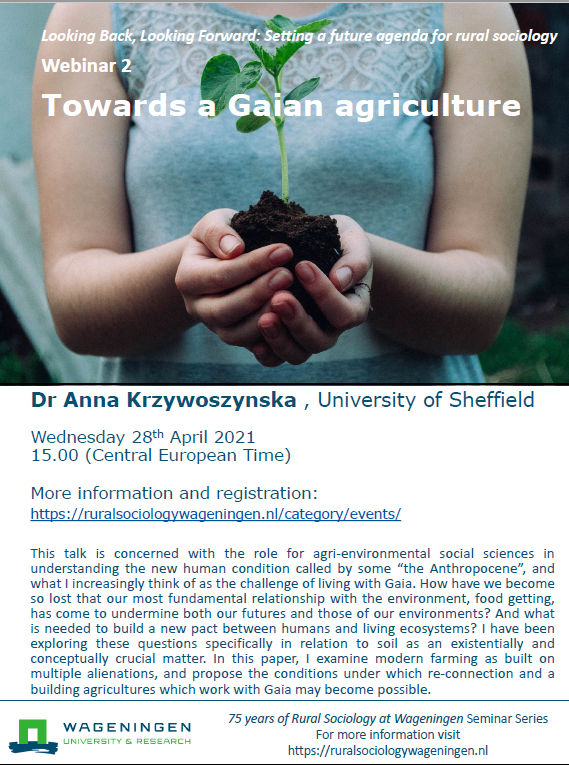
Webinar: Towards a Gaian agriculture

‘Towards a Gaian agriculture’ – Dr Anna Krzywoszynska.

Date: 28th April 2021Time: 15.00 CET

This talk is concerned with the role for agri-environmental social sciences in understanding the new human condition called by some “the Anthropocene”, and what I increasingly think of as the challenge of living with Gaia. How have we become so lost that our most fundamental relationship with the environment, food getting, has come to undermine both our futures and those of our environments? And what is needed to build a new pact between humans and living ecosystems? I have been exploring these questions specifically in relation to soil as an existentially and conceptually crucial matter. In this paper, I examine modern farming as built on multiple alienations, and propose the conditions under which re-connection and a building agricultures which work with Gaia may become possible.

Register online via this link
Or check out the YouTube streaming link

This talk is the second in Wageningen University Rural Sociology Group’s 75 years anniversary seminar series “Looking back, Looking Forward: Setting a future agenda for rural sociology”. For more information see our full agenda here.


YouTube streaming link:

75th Anniversary: 24) Rural Sociology and the making of the Health and Society Group

The inaugural lecture by Maria Koelen upon taking up the post of Professor of Health and Society at Wageningen University on 10 March 2011 (source: Health and Society website)

By Maria Koelen (Professor Emeritus of the chairgroup Health and Society)

Belief it or not, but the young Health and Society Group has its origin in the 75 years old Rural Sociology of Wageningen University. In fact, Professor Evert Willem Hofstee, the founder of Rural Sociologie (1946) as has been mentioned often in this blog, started to pave the road to it. The Agricultural University (at the time Landbouw Hogeschool) developed a lot of scientific, technological and economic insights for farming practice, which was transferred to the farmers through agricultural extension educators employed by the Ministry of Agriculture and Fisheries. The prevailing idea was that farmers would appreciate these insights and, from a kind of self-interest, would apply these insights into their daily practice. However, as Hofstee argued in 1953, just transferring these insights to the farmers would not suffice. He advocated an additional, sociological approach and to pay attention to social groups and culture. This idea caught on with the Ministry of Agriculture and Fisheries. To operationalise the idea, in 1955 the Ministry seconded its employee Anne Van Den Ban to the Rural Sociology group to advance this type of research. With his appointment, the foundation has been laid for a new interdisciplinary field “extension education”, in Dutch “Voorlichtingskunde”. In 1963 Van Den Ban obtained his PhD under supervision of Professor Hofstee and in 1964 he was appointed to be the first professor in this field. Continue reading

75th Anniversary: 23) On RSO education: 75 years teaching rural sociology

Diving into the archives of Wageningen University Library, I stumbled upon overviews and information on education. I was particularly interested in the teaching of rural sociology at the university. This is the first of a few blogs on RSO Education: the historical overview of sociology and specifically rural sociology at the Wageningen University timeline.

The pre-sociology era (1918-1956)

First students at the Landbouwhogeschool in 1879 (source: wur.nl)

In 1918, the Wageningen University was still called the Landbouwhogeschool (Agricultural College). Students could choose 5 study programmes: Dutch Agriculture, Dutch Horticulture, Dutch Forestry, Colonial Agriculture and Colonial Forestry. These remained the study programmes of the university for 24 years. It was not until 1945 that the university evolved into wider oriented institute. In 1946, sociology gained grounds through a new study programme on home economics. In his book chapter, Kooy (1971) calls this an “entrance in disguise” sociology was always marked with the adjective “agrarian”.  This marked the beginning of sociology in the educational programmes of the university. In 1956, The university added 11 new study programmes to the Wageningen university. Two of these additions were the study programmes Agrarian Sociology and Agrarian Sociology of Non-Western Areas. Continue reading