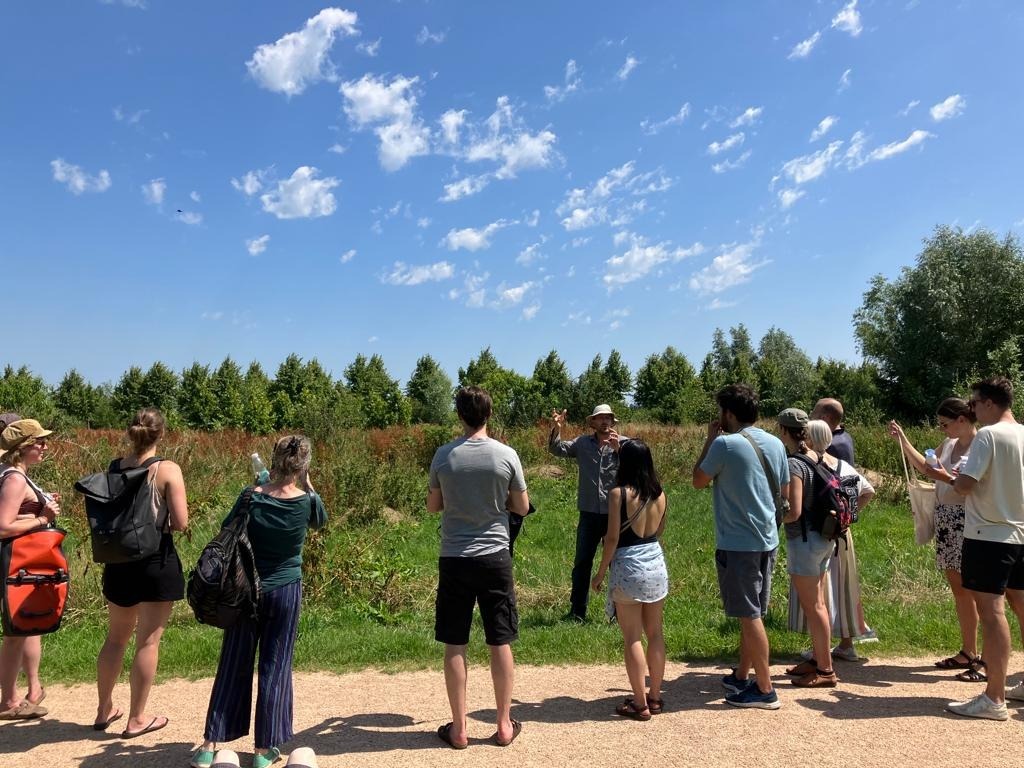
NRC: Drie zij-instromers begonnen een duurzame boerderij: ‘We willen bijdragen aan de voedselproductie én gemeenschapszin’

De NRC publiceerde op 1 september een achtergrondartikel over de Biesterhof, een boerderij die mede is opgericht door RSO-medewerker Howard Koster, samen met Claudi Rudorf en Eline Wilememaker. Met z’n drieën startten zij een regeneratief landbouwbedrijf dat gezonde voeding wil verbouwen, de bodem wil verbeteren, de biodiversiteit wil bevorderen en een gemeenschap wil opbouwen. “Er zijn momenten dat ik de natuur vervloek.”

Lees het volledige artikel hier: https://www.nrc.nl/nieuws/2025/09/01/drie-zij-instromers-begonnen-een-duurzame-boerderij-we-willen-bijdragen-aan-de-voedselproductie-biodiversiteit-en-gemeenschapszin-a4904642

Publication | With whom do you want to be interdependent in producing food?

JAFSCD article by Margriet Goris (Wageningen University & Research) Daphne Schoop (Wageningen Research), Dirk Roep (Wageningen University) en Jan Hassink (Wageningen Research)

Intentionally shifting interdependencies through territorial food networks

Values-based territorial food networks (VTFNs) hold immense potential for reshaping our food supply, but little is known about how they bring about change. In a new JAFSCD article, “Relational autonomy highlights how interdependencies shift in the transformation of food provisioning,” Goris, Schoop, Roep and Hassink present findings from narrative interviews and observations during fieldwork in three different VFTNs in The Netherlands.

They aimed to understand how shifts in interdependencies in VFTNs come about and what this means for autonomy in food provisioning. The scholars show how mutual autonomy is promoted in relations among farmers, livestock, soil life, plants, citizens by creating opportunities, rights, respect, trust, and capacities amongst others. They state that autonomy is not an individual matter but is created in relationships of interdependency.

This helps us explain how people and nature depend on each other. For example, when we stop using agrochemicals, we depend more on natural processes and other market relations. To make this work, farmers and rural workers need to be able to mimic those natural processes, and to be able to create a fairer food market where everyone shares the risks, acknowledging mutual vulnerabilities and interdependencies.

Visit members VOKO Utrecht to food forest by VOKO Utrecht

A Place to Transit: The seasonal migrant workers of Huelva’s strawberry industry

A new article by Merissa Gavin and Joost Jongerden explores the lived experiences of seasonal migrant workers in Lepe, who play an essential yet precarious role in the agri-food industry of southern Spain. By examining their experiences and actions through a temporal lens, this research offers deeper insights into the dynamics that sustain migrant vulnerability and the individualized strategies they employ to navigate these challenges.

Embodying the paradox of being essential yet unprotected, undocumented migrant agri-workers navigate a terrain of precarious in-betweenness. Policy-making affords little urgency to addressing their routine exploitation or facilitating dignified solutions for their working and living conditions. Focusing on seasonal migrant workers in the strawberry fields of Lepe (Huelva, Spain), this article examines how temporality structures endurance, agency, and vulnerability.

Drawing on four months of ethnographic fieldwork—including participant observation, informal conversations, and semi-structured interviews—this study reveals how workers endure exploitation in expectation of future documentation through arraigo policies. However, the temporal horizon of arraigo not only sustains individual endurance but also dampens collective resistance, rendering precarity a structured condition rather than a momentary hardship. Because arraigo systematically encourages endurance over resistance, precarity becomes a long-term structural reality, with temporality actively shaping workers’ vulnerabilities. This process individualises what is essentially a shared struggle, further sedating collective action and reinforcing exploitation. While migrants in Lepe internalise temporality as a survival strategy, disruptions—such as withheld contracts—demonstrate the limits of endurance and trigger resistance.

This study advances scholarship on migrant precarity by shifting the focus from spatial or economic dimensions to the performative construction of sequential time as a mechanism that both sustains and constrains migrant agency. In highlighting how European agricultural policies prioritise productivity while obscuring labour exploitation, these findings underscore the need for interventions addressing both the legal limbo of undocumented workers and the temporal structures that sustain their vulnerability.

Read the full article here: https://www.sciencedirect.com/science/article/pii/S0016718525000661

SWIFT Project: Strengthening Gender and Diversity in Agriculture

Last November, the SWIFT consortium gathered in Geneva for an inspiring and thought-provoking mid-term meeting. Over four days, researchers, farmers, and activists came together to share progress, exchange ideas, and discuss the future of gender and diversity in agriculture. From immersive discussions at Ferme du Lignon to policy debates at the Geneva Graduate Institute, the event highlighted the importance of feminist and queer perspectives in shaping agricultural policies.

Key topics included:
– Building feminist viability indicators with women farmers
– Participatory video-making for agroecological storytelling
– Gendered analysis of the EU’s Common Agricultural Policy
– Strengthening visibility and rights of LGBTQIA+ farmers

Georgia Diamanti and Clara Lina Bader have captured these moments beautifully in their reflections, from engaging panels to farm visits that demonstrated alternative models of agriculture in action. Read their insights on the challenges and opportunities ahead for gender justice in food and farming!

Continue reading

Smallholder farming in Western Bahia, Brazil

Álvaro Schwartz Micheletti

In my MSc thesis, I studied smallholder farming in Western Bahia, a region marked by the expansion of intensive soy production in the Brazilian Northeast. As a part of the area known as MATOPIBA (standing for the parts of the states of Maranhão, Tocantins, Piauí and Bahia covered by the cerrado savannah), Western Bahia has been a crucial space for Brazilian agribusiness development since the 1980s, as it offered abundant land with unclear land titling and high agronomic potential.

Continue reading