Evolution of Rural Development Paradigm in Brazil

In a recent research seminar prof. Sergio Schneider (schneide@ufrgs.br), coordinator of the  Rural Development Post Graduate Program from the Federal University of Rio Grande do Sul (Brazil), presented a telling analysis of major changes in Rural Developments Policies in Brazil in the last twenty years. He explained that the recent evolution in rural development policies, as effectuated by president Lula, has to be understood within the context the evident political struggles on land. Brazil is a large country with traditionally a sharp contrast between the interests of agro-industrial conglomerates and social rural movements of landless people and peasants (e.g. MST).

This is reflected in a dualist agrarian structure between capitalist and entrepreneurial family farming and peasant familiy farming and rural poor (landless) who are struggling for survival and autonomy. In 1995 1 % of the owners with more then 1000 ha owned 45% of all land, while 90% of the owners with less then 100 ha owned only 20%. An unexpected and striking consequence of rural poverty is, that food security in rural areas is significantly lower then in urban areas. In rural areas 26% of the housholds suffers severe food insecurity versus 17% in urban areas. Because of this dualist agrarian structure Brazil is probably the only country in the world with two Ministries of Agriculture, serving different needs.

Continue reading

Smagen af Fyn (the taste of Funen)

250px-storebc3a6ltsbroen_from_sjc3a6lland1

This weekend I stayed in Middelfart on the island Funen between Jutland and Zealand (on which Copenhagen is located). For many Danes, Funen represents the island you simply have to cross by highway to arrive in Copenhagen.

However, it has a really beautiful small scale landscape full of hills! The island is fairly round in shape, around 100 kilometers in diameter and is scattered with villages, old manor houses and wind shielding wood groves and hedgerows. It has a very good sea climate and one of the best soils for farming in Denmark. This is why Funen has a tradition in horticulture. It once served as the Vegetable & Fruit garden of Denmark. Whereas in many other places in Denmark and in Europe the Farm Shop was re-invented during the last decade, here it is a phenomenon which never disappeared. You can find self service shops along the roads and many of them, ranging from horticulture, to dairy and meat, organic as well as conventional, are organized in a network called Smagen af Fyn, which means something like the Taste of Funen. There are quite a number of local food producer networks in Denmark and several researchers at IFUL are studying the various aspects of these networks.

Vrienden van het Platteland – stage

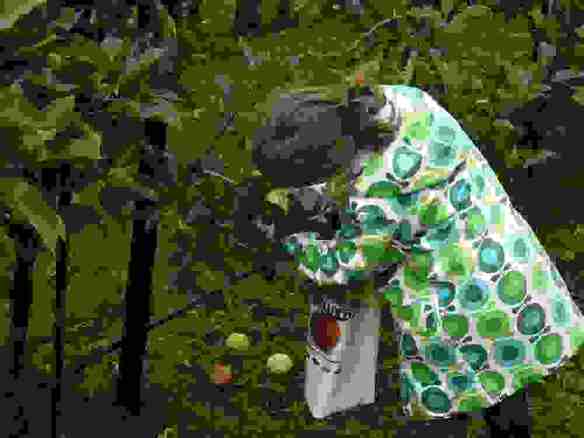
Appelplukdag 2008

Appelplukdag 2008

Door Simone Plantinga – MSc-student 

Van mei tot september 2008 heb ik stage gelopen bij Stichting Vrienden van het Platteland (VvhP) in Wageningen. VvhP is een organisatie die probeert de kloof stad – platteland te dichten door middel van verschillende activiteiten. Onder de noemer ‘Ontdek je band met het Platteland worden er het hele jaar verschillende evenementen (open boerderijdagen en fietstochten) georganiseerd, met als hoogtepunten in september de Appelplukdag en de Dag van het Platteland. De Plattelandsgids is een onderdeel van de website waar  plattelandsondernemers hun verbrede activiteiten kunnen promoten.

Continue reading

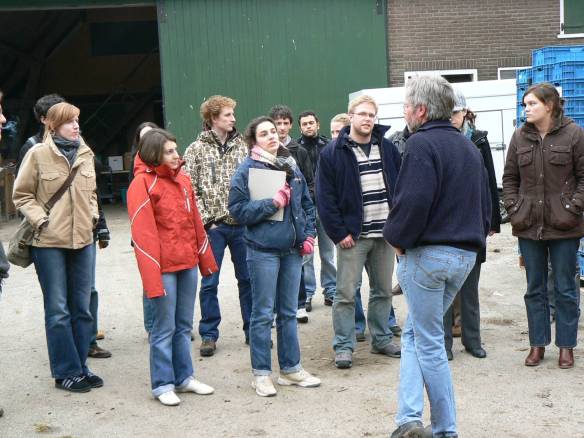
Excursions give real-world examples

Excursion 02-03-2009, Course Globalisation and Sustainability of Food Production and ConsumptionBy Zachary Daly – exchange student at Wageningen University from Guelp University, Canada.

It’s always nice to be able to actually go out and see real-world examples of what you are studying and reading about in class. During the course Globalisation and Sustainability of Food Production and Consumption we had the opportunity to visit some farms. As such it was very interesting to see and talk to two organic farmers that are involved in alternative food provisioning networks, but work in a quite different way. The first farmer, Gerrit Marsman, has a mixed farm called De Eerste with a cheese factory and home delivery service, employing about 10 persons. He was ideologically very dedicated to what he was doing, talking about the madness of the global trade in feed and food, the health problems that the use of chemicals in agriculture cause, and the problem of a short-term and money-oriented economy leading to financial crisis. The second farmer, Rene de Lange, appeared to be less ideological motivated and more pragmatic. His family owns has a brand new farm with milking sheep in national park De Weerribben, a protected landscape of high cultural and natural value. A high milk production per sheep is important to him and his wife, as well as a hygiene-proof processing unit to make cheese, yoghurt, and ‘feta’. They market their products under the label of Weerribben Schapenzuivel (sheep dairy), through a wholesaler, to organic food shops all over The Netherlands, and even for export.

Landschapskwaliteit en verbrede landbouw

Schaalvergroting van agrarische bedrijven zal veel kernkwaliteiten van Nationale Landschappen verder onder druk zetten, zo luid de conclusie van het in 2008 gepubliceerde WOT-rapport Helpt boeren de Nationale Landschappen. De negatieve effecten van schaalvergroting kunnen deels opgevangen worden door meer verbredingsactiviteiten in te passen als aanvulling op het inkomen. Bij hervormingen in het Gemeenschappelijk Landbouwbeleid van de Europese Unie kan gerichte inkomenssteun voor maatschappelijke diensten ingezet worden.

neven-voorpagina-thesis3Er zijn volop potenties, maar de relatie tussen verbrede (of multifunctionele) landbouw en landschapskwaliteit is niet zo eenduidig en evenmin vanzelfsprekend, zo bleek uit een afstudeeronderzoek van Kees Neven in het Groene Woud. Wil verbrede landbouw bijdragen aan landschapskwaliteit dan moet daar zowel op bedrijfsniveau als op gebiedsniveau richting aan worden gegeven. In Het Groene Woud doet probeert men dat met een Streekmerk, maar ook andere gebieden als de Noordelijke Friese Wouden is op zoek hoe dat handen en voeten te geven. Het belonen van (hoogwaardige) groene diensten die bijdragen aan landschapskwaliteit kan ondernemers hierin stimuleren.