Comparing farming in China and Europe

I’m a PhD candidate from China Agricultural University. I have a major in rural development and management. Now I am a visiting researcher at the Rural Sociology Group for one year and I like it very much. Each eduaction period I attend one or two courses.

yong-dsc056362

Chinese farm

Recently, I wrote an article about a Chinese farmer’s note book, with my supervisor prof. Jan Douwe van der Ploeg. I encountered this note book during my field work in Northeast China in July 2008. It’s been nearly three months since we began writing this article. Today, we finally finish the article, both in English and Chinese. In this farmer’s note book, monetary expenses and monetary entrances are all registered in a chronological order. Meanwhile, it also shows some of the networks the farm is embedded in. We also make some comparisons between China and Holland (or Europe). The data show that there is considerable dynamism; they also make clear that basically we are dealing here with a peasant-like way of farming. The article concludes with an overview of the structure of the rural economy in this part of China. I will write more about that in later blogs.

To be honest, I think there are many research experiences in rural sociology we should learn from Wageningen, especially in the field of sociology of farming. At the same time, I mind to consider the differences in social context between Western countries and China. The main problems in rural China we concluded are about “farm, farmer and farming”, which are also the hot research topics in academic field. Take farmer for example: there are about 0.73 billion of people living in rural area, but they don’t have enough land to sustain their livelihood, so many farmers go to urban as migrant workers and leave their family members home. These family members are left-behind population. My college members did a lot research on this group of people. As for my PhD thesis, I focus on applying the social capital theory in the context of rural China. To quote Jan Douwe van der Ploeg: “the theories are not in the air, they are in the people’s everyday life”. I will this mind during my research.
Steeds meer zorgboeren

Steeds meer zorgboeren – aldus berichte RTL Nieuws naar aanleiding van de Dag van de Zorglandbouw op 21 april 2009. De dag was door de Taskforce Multifuntionele Landbouw opgezet. Op de blog van Guus.net worden een aantal deelnemers gevolgd door Dorine Ruter, waaronder Pieter Seuneke van onze leerstoelgroep Rurale Sociologie. Pieter werkt op het project ‘Dynamiek en Robuustheid van Multifunctionele Landbouw‘, waarover al eerder is bericht in een blog.

Excursions Understanding Rural Development

As a part off the course Understanding Rural Development (RSO 31806) we went on a field trip to de Eemlandhoeve in Bunschoten and explored the inner-city of Utrecht. By this excursion we visited a number of interesting expressions of urban-rural relationships, from a rural and an urban perspective.

De Eemlandhoeve

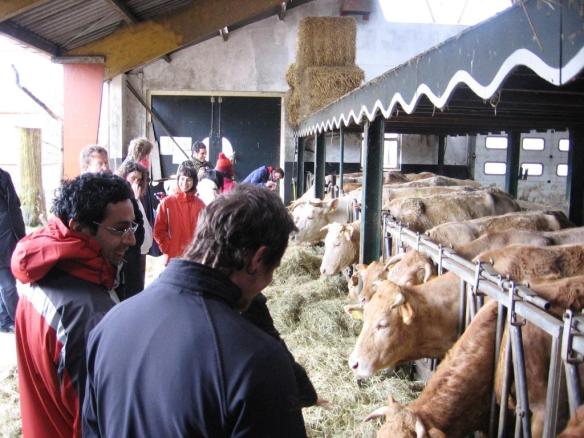
De Eemlandhoeve, owned by farmer, rural entrepreneur and philosopher Jan Huijgen, can be considered as an extreme example of a multifunctional farm enterprise. The group of Blonde d’Aquitaine’s form the centre of a rural enterprise which includes a large number of activities like a farm shop, care facilities, meeting and office facilities, an education garden and even a farmer’s cinema under construction.Blonde d'Aquitaines at the Eemlandhoeve

Next of being a multifunctional entrepreneur Jan Huijgen is a well known personality in Dutch rural development, active on a local, national, international (and maybe in the near future on a global) level. The farm residents a rural innovation centre and last October de Eemlandhoeve hosted the EEconference or Europese Eemlandconference, veelzijdig platteland.

On the excursion owner Jan Huijgen told us about his inspiration, motives and future plans with his farm. After his presentation we had an interesting discussion and were showed around the place.

Local food in the city of Utrecht

The second trip brought us to a rather different surrounding; the historical inner-city of Utrecht. On de Eemlandhoeve our focus was on the rural side of urban-rural relationships, in Utrecht we looked upon it from an urban perspective.

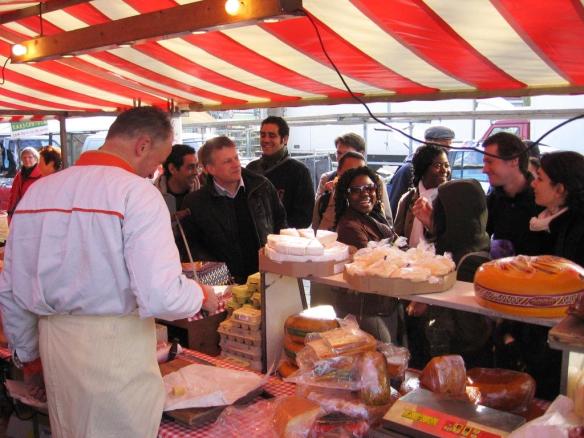
Cheese stall at the Vredenburg MarketTogether with our guide Frank Verhoeven (see his website)  we first went to the Wednesday Vredenburg Market. On this market we visited a cheese seller linked to the organization called Dutch Cheese Centre (website under construction). The stallholder told us about some typical Dutch cheeses and the trade in locally produced ones. After some tasting we set out for the traditional bakery Bakkerij Blom were owner Theo Blom showed us around and told about his bakery, traditional products and production.  

Our last stop was a visit to the five star hotel and restaurant Karel V for a number of short presentations. In the hotel our guide Frank Verhoeven started by telling us about his ‘Boerenbox’ initiative and his vision on a more locally based production and consumption. Secondly, one of the Karel V chefs explained us about the way they work with seasonal products originating solely from regional grounds and local suppliers. Lastly, Arie Bosma, one of the initiators of the campaign ‘Lekker Utregs’, told us about the initiative to reconnect the city of Utrecht with its surrounding countryside by establishing a so called Green Participation Society.

By the fieldtrips we got acquainted with several interesting expressions of urban-rural relationships, from a rural and an urban perspective. It was a nice and inspiring way of linking theory from class to reality by ‘tasting’ real life examples in ‘the field’.

Kracht van koeien – vier ontwerpen voor een duurzame melkveehouderij

Brochure 'Kracht van koeien' Gisteren is het resultaat van het project ‘Kracht van koeien‘ gepresenteerd: een prachtig geillustreerde brochure met vier ontwerpen voor een duurzame melkveehouderij, waarmee zowel de wensen en eisen van de koe, de ondernemer, het milieu als de burger gediend zijn. De ontwerpen zijn gebaseerd op een vernieuwende ontwerp-aanpak voor systeeminnovaties in de veehouderij ontwikkeld door prof.dr.ir. Peter Grootkoerkamp (peter.grootkoerkamp@wur.nl) en dr. Bram Bos (bram.bos@wur.nl)  van Wageningen UR. 

Zo doen de projectleiders in Kracht van Koeien afstand van een traditionele stal voor melkvee. Ze stellen dat het beter is als koeien zelf kunnen kiezen of ze buiten staan of onder een beschutting. Ook maken ze werk van het opvangen van mest en urine. Die komen weer van pas als kunstmestvervanger. ‘In Kracht van Koeien doen we voorstellen voor anders denken en anders doen’, zegt Groot Koerkamp. ‘Ze vormen de basis van de ontwerpen. Let wel: geen van die voorstellen is speciaal ons idee. Allerlei onderzoekers, boeren en andere praktijkmensen zijn er al jaren mee bezig. Wij zetten ze alleen in samenhang om te laten zien dat ze mét elkaar een meervoudige sprong in duurzaamheid bereiken.’

Places worth caring about

This week I have discussed, in my MSc course Understanding Rural Development, the modernization of Europe’s agriculture and rural areas in the post World War II era. By showing pictures, tables and figures I have tried to demonstrate how drastically the rural landscape, the agrarian structure and the food supply chain have changed in a period of several decades. Multifunctional countrysides were transformed into places for specialized and high-tech forms of food and fibre production, the number of farms decreased by some 80% in 50 years time, the average farm size increased enormously, agricultural employment decreased drastically, an ever increasing part of the agricultural products are processed by the food processing industry and the supermarket has become the dominant outlet for most food products. There are, of course, differences between regions and countries, but this is the prevailing development trend in EU member states that have been subject to the EU’s original Common Agricultural Policy. The agricultural modernization project has been very successful in terms of creating food self sufficiency in Europe at low prices for consumers, but this has also come at a cost. By the 1990s the negative side-effects of modernization became widely acknowledged. When talking about negative side-effects topics as environmental pollution, degradation of biodiversity, declining farmers’ incomes, animal welfare concerns and consumers’ distrust in the modern food system are usually brought to the fore.

Inspired by a humorous and thought-proviking presentation of James Howard Kunstler at the TED 2004 conference (“The tragedy of suburbia” ) as the analogy between suburbian development and agricultural modernization is astonishing, another side-effect came to mind: the loss of a sense of place and a sense of belonging due to the (feeling of) expropriation of local self control (e.g. due to centralized spatial planning) and due to the eradication of many specific and distinctive regional assets (cultural history, landscape, traditional products and processing techniques, etc…). Rural regions that were subject to the agricultural modernization project have de facto become non-places and are thus easily interchangeable. And as a result many rural regions have become, quoting Kunstler, places not worth caring about … and places not worth caring about are places not worth protecting or defending.

Looking at rural development from this point of view sheds an interesting light on its dynamics. Continue reading