
Urban agriculture blogs

http://www.buildinggreen.com/auth/article.cfm/2009/1/29/Growing-Food-Locally-Integrating-Agriculture-Into-the-Built-Environment/

City Farm Chicago

Urban agriculture, city farming  or in Dutch ‘stadslandbouw‘ is getting more and more into the spotlight. Even though not new, it’s getting new significance and seem to be a growing phenomenon worldwide. One of the ways to keep in touch with new iniatives around the world is to take a RRS-feed on a blog, as I recently discovered myself.  Interesting blogs are e.g. City Farming News, covering news on worldwide initiatives with photo’s and video’s, and the  Dutch ‘Stadslandbouwblog‘ initiated by ‘Eetbaar Rotterdam‘ covering iniatives in and around Rotterdam but also from far away.

Collective approach to farmer marketing – recommendations

Dutch Initiative Van Eigen ErfRecently our rural sociology group finished an European research project on collective farmers marketing initiatives. The COFAMI project identified a broad set of enabling and limiting factors to explain the emergence of and dynamics within farmers’ driven collective action and developed a methodology to assess their impacts on different types of territorial capital assets. Empirial material from Italy, Germany, Latvia, Austria, Czech Republic, Switzerland and The Netherlands covers collective farmers initiatives in fields as high quality food production, provision of new rural goods and services and region branding. A summary of recommendations, reports and other project material can be downloaded from www.cofami.org.

Fordhall Community Land Initiative – Shropshire (UK)

By Sophie Hopkins – Fordhall Community Land Initiative in the rural county of Shropshire, England, is a pioneering venture in land acquisition and rural development (an example of Community Land Trust). 

Community Supported Agriculture
The project is an Industrial and Provident Society (‘run by the community, for the community’)  which was established to save 140 acres of land that had been organically farmed since WWII. Fordhall Farm (the family business) is today famous  for its meats, but was also the first place to produce yoghurt in UK. It uses the traditional method of foggage  farming, leaving grass-fed cattle outdoors all year. The family had been farming the land for generations but only as tenants, so when faced with eviction and development threats in 2004 the brother and  sister team (aged 19 and 21 respectively), and many others, decided to fight to secure the land. Working with local to global supporters and with the concept of Community Supported Agriculture, they devised a method to involve people in the food production chain, whilst still maintaining ownership of the farming practices. Continue reading

New Project – Dynamics and Robustness of Multifunctional Agriculture

On the first of February the Rural Sociology Group, in collaboration with the Education and Competence Studies Group, will start with a large research programme entitled ‘Dynamics and Robustness of Multifunctional Agriculture’. This project is financed by the Dutch Ministry of Agriculture, Nature and Food Quality and supported by the Task Force Multifunctional Agriculture. The programme aims to deepen our understanding of the critical factors that exert an influence on the dynamics of multifunctional agriculture. Factors that could play a role are for instance the Continue reading

Rural development in Brazil

fabio_kesslerProf. Fabio dal Soglio from the Federal University of Rio Grande de Sul (UFRGS) is currently our guest. He is one of the professors working in the Post-Graduate Programme on Rural Development (PGDR) and he has a particular interest in agro-ecology.

The  UFRGS and the PGDR-group in particular wants to extend collaboration with the Rural Sociology Group, as initiated by prof. van der Ploeg, by the exchange of staff, exchange of MSc and PhD-students and by joint research.

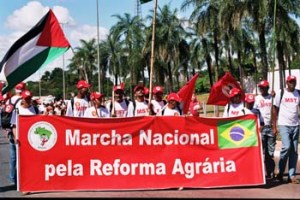
As part of an assignment for the MSc-course Sociology in Development, a group of MSc-students grasped the occasion and interviewed prof. Fabio dal Soglio on the Landless Workers Movement (MST) in Brazil and their struggle for land and land reforms.
mst-21Quoted from the MST-website (English edition):

 The MST is the largest social movement in Latin America with an estimated 1.5 million landless members organized in 23 out 27 states. The MST carries out long-overdue land reform in a country mired by unjust land distribution. In Brazil, 1.6% of the landowners control roughly half (46.8%) of the land on which crops could be grown. Just 3% of the population owns two-thirds of all arable lands.

Since 1985, the MST has peacefully occupied unused land where they have established cooperative farms, constructed houses, schools for children and adults and clinics, promoted indigenous cultures and a healthy and sustainable environment and gender equality. The MST has won land titles for more than 350,000 families in 2,000 settlements as a result of MST actions, and 180,000 encamped families currently await government recognition. Land occupations are rooted in the Brazilian Constitution, which says land that remains unproductive should be used for a larger social function.

 The MST’s success lies in its ability to organize and educate. Members have not only managed to secure land, therefore food security for their families, but also continue to develop a sustainable socio-economic model that offers a concrete alternative to today’s globalization that puts profits before people and humanity.