
 Are you a student of Wageningen University and interested in food? Then, you might be eligible for a new Intensive Programme in which the Rural Sociology Group participates. During two intensive weeks in Cluj (Rumania) you will be introduced to traditional foods in a multidisciplinary setting. Students and lecturers from various European countries (France, Greece, Denmark, Ireland, Italy, Rumania, Belgium, Slovenia, Poland) will discuss in an inspiring setting the relationship between microorganisms and traditional food; are they partners or competitors? The background of the students and staff varies from economy to food microbiology, geography, agro-forestry, food safety, animal product processing and of course rural sociology. For more information, please contact Els Hegger. Continue reading
Category Archives: Education
CS: Food crisis? Strategies to transform our food system: course outline
 On the 16th of October it is World Food Day. The theme this year 2011 is ‘Food prices –from crisis to stability’. Price swings, upswings in particular, represent a major threat to food security in developing countries. It is predicted that instability in the world food economy will continue during the decade to come. What can we do? How can we create resilient food systems? The World Food Day has inspired the NGO’s Otherwise, RUW and the Boerengroep, to jointly organise a series of activities and lectures: Food, Farmers and Forks: moving beyond the crisis in agriculture.
In collaboration with Petra Derkzen of the chairgroup Rural Sociology (RSO) the series can be followed as one of the learning activities in this Capita Selecta course under the code RSO 51303 ‘Agricultural and Rural Innovation Processes’. The Food Farmer Fork lecture series together with the book: Food movements Unite! Strategies to Transform Our Food System (ed. Eric Holt-Giménez; see foodfirst.org) and a written essay form the basis of the course.
So, listen to critical lectures on the role that social movements can play in rural development, the future for European farmers after the CAP, the contribution of urban agriculture to food security and consider your own Ecological Footprint in the Food Farmer Fork series! And, the course literature consists of a just released and super timely book which gives the necessary background and concepts to understand the relationships between food sovereignty, resilient food systems and social movements. We will read Part I. You will learn to formulate your own vision on these relationships through the course essay assignment. The full course outline will be available soon.
Credits: 3. See under this link the course outline: Capita Selecta RSO 51303 v2
Language: English
Start: Tuesday evening 1th of November. Lectures/activities; every tuesday evening until 13th of December. Deadline essay delivery 14 of December.
Subscribe to the course until 31 of October at Boerengroep st.boerengroep@wur.nl
Education overview 2011-2012
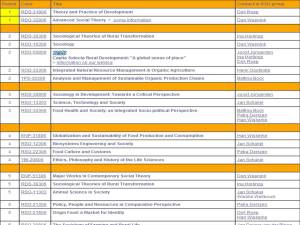 The new education overview of the Rural Sociology group for the new academic year is available now. Please visit our website for the complete overview. For this year we offer two new courses on Sustainable place-based development (see earlier post for more information), as well as a capita selecta course on Strategies to transform our food system (see earlier post). Furthermore, we participate in a new Bachelor minor called ‘Tourism, conservation and development‘. If you have a question about any education related issue, please contact our education coordinators (education.rso@wur.nl).
Capita Selecta ‘A global sense of place’
In the 2nd WU education period running, starting October 31, Rural Sociology will again offer the Capita Selecta course ‘A Global sense of place’ (course code RSO-50806). Course outline is available here.
The course offers a comparative perspective on place-based approaches in rural and spatial development. Next to lectures and readings on place-based development, five guest lecturers are invited to present a case and discuss the relevance of place-based development.
The interdisciplinary course is open to MSc-students from different Master programs that want to broaden their understanding of place-based approaches for sustainable development. The course aims to make students acquainted with different disciplinary approaches to study and understand the sustainable development of places, necessary for thoroughly understanding transformation processes, rural and territorial development.
From the course outline:
A global sense of place gives a critical overview of approaches and discourses on sustainable place-based development and is a constituent and contingent expression of three interrelated, interdependent and relational processes: economic, ecological and social-cultural. Places can then be seen as the constructs wherein the varied interactions between these three interconnected processes are expressed. We will focus on an action-perspectives based on ecological and cultural processes as a starting point, which can create autonomy and a repositioning of economic relations, a regrounding in ecological capital and self-efficacy in the cultural sphere.
We will focus on two main approaches: 1) places as arenas for negotiation, conflicting interests and power struggles, influenced by capital and global forces, where place-based struggles occur as multi-scale, network-oriented subaltern strategies of localization; 2) Spaces endowed with meaning and the constitution of identities, subjectivities and difference.
The themes for the six weeks and invited quest lecturers are:
Week 1 Analysis of place-based development (Dirk Roep)
This lecture introduces an analytical model for sustainable place-based development where place-shaping is a constituent and contingent expression of three interrelated, interdependent and relational processes: economic, ecological and social-cultural. Places can then be seen as the constructs wherein the varied interactions between these three interconnected processes are expressed. The lecture deals with the issue how place-based development based on an action-perspective takes practices based on ecological and cultural processes as a starting point, with the aim of creating autonomy and a repositioning of economic powers, a regrounding in ecological capita and self-efficacy in the cultural sphere. Continue reading
Surinam bami, Georgian beet-salad and Turkish baklava
 The allotment gardeners of De Koekelt have gathered for a potluck in De Koekelt on Saturday, third of September. Surinam, Turkish, Italian, Georgian, and Dutch gardeners prepared food with the vegetables of their garden which, all together, made a very tasty and varied lunch.
I am doing my thesis on De Koekelt, trying to find out how to strengthen sense of community and participation of the gardeners. De Koekelt is an allotment garden in Ede with gardeners of twelve different nationalities. By walking around one can recognize great differences between the gardens. Some grow more flowers, others more vegetables, some gardeners build a place to sit down and enjoy, while others use their space in the most efficient way to produce as much food as possible.
These differences are appreciated by the gardeners, but create friction as well: “Why do foreigners need to grow so many beans?” or “Why do Dutch women only grow flowers and weeds on their garden?”
With help from three gardeners, I organized the potluck, where the gardeners had a chance to appreciate the differences between themselves, by tasting the different meals each gardener proudly prepared from their own garden products. By eating together, they used the opportunity to speak with gardeners they usually never spoke with. For example, a Georgian woman and a Turkish man discovered that they used to be neighbours, since the villages they come from are both situated on the border of Georgia and Turkey.
The board of De Koekelt, who was sceptical about this activity (“do you really think the gardeners will do all this effort of cooking and bringing their own plates?”) was also present and enjoyed the gathering. They had experienced a sense of losing control, but they seemed to realize that gardeners initiative should be stimulated, not constrained. They saw how little organization is needed to bring the gardeners together, and although they initially objected against this activity, they concluded that this should be organized more often
Lise Alix, MSc-student Rural Sociology

