PUREFOOD – 12 vacancies for ESRs are open

As mentioned in an earlier post on this weblog, the Rural Sociology Group has been granted the the coordination of a Marie Curie Initial Training Network  entitled ‘Urban, peri-urban and regional food dynamics: toward an integrated and territorial approach to food (PUREFOOD)’ funded by the European Commission’s Seventh Framework PEOPLE program. The objective of PUREFOOD is to train a pool of 12 early-stage researchers (ESRs) in the socio-economic and socio-spatial dynamics of the (peri-)urban and regional foodscape. The PUREFOOD network is centred around food as an integrated and territorial mode of governance and studies the emergence of the (peri-)urban foodscape as an alternative (as opposed to a globalised) geography of food, including the ways in which, and the extent to which, sustainability aspects generally considered to be intrinsic to the alternative food geography are incorporated by the more conventional food companies.

As of now all 12 PUREFOOD research vacancies have been published (or soon will be) by the host universities. For information about the ESR vacancies and application guidelines, you can download the PUREFOOD vacancies leaflet. For more information about the objectives, training and research approach and training program of PUREFOOD you can download the PUREFOOD information pack for prospective ESRs. The deadline for application is 3 January 2011.

Eligibility criteria

The enhancement of transnational mobility to improve career perspectives of early stage researchers is the main goal of the Marie Curie Initial Training funding. To achieve this objective the following eligibility criteria for prospective ESRs have been formulated:

  • You are eligible as an ESR if you are, at the time of recruitment (i) in possession of a university degree, and (ii) have a maximum of four years of full-time research experience, including any period of research training. This is measured from the date when you obtained the degree which formally entitles you to embark on a doctorate, either in the country in which the degree was obtained or in the country in which the research training is provided. Please not that ESRs cannot be PhD holders.
  • You are eligible to the position if, at the time of the selection by the host university, you did not reside or carry out your main activity (work, studies, etc) in the country of the host university for more than 12 months in the 3 years immediately prior to your recruitment.

If you have any questions about a vacancy please contact the contact person mentioned in the vacancy announcement. For general question about PUREFOOD please contact me (han.wiskerke@wur.nl).
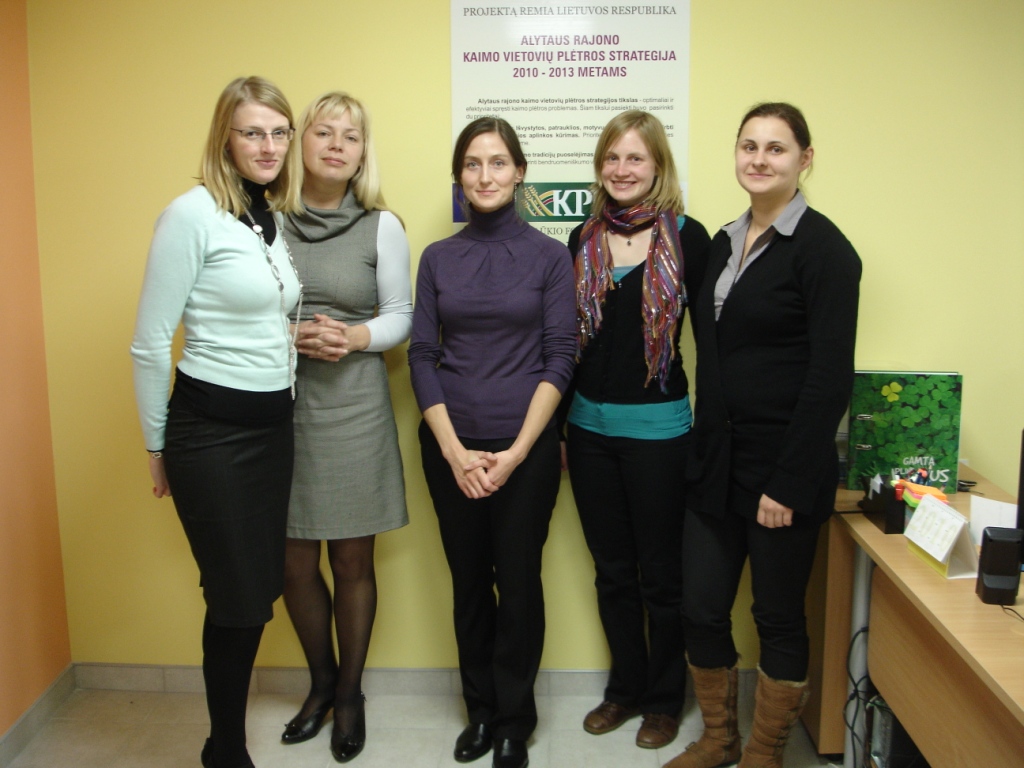
Rural regional learning in Alytus County, Lithuania

Last week (October 21-22, 2010), I was given the opportunity to visit our DERREG project partner Emilija Kairyte (Institute NeVork) in her case study area of Alytus County in the South of Lithuania. In this blog, Emilija and I would like to share our experiences.

Like the Dutch DERREG case study region Westerkwartier in the province of Groningen, Alytus County comprises four rural municipalities. In terms of demography and economy, both areas are very different from each other. For example, the Westerkwartier has a population density of 173.4 inhabitants/ km², whereas the population density of Alytus County is estimated as 32.6 inhabitants/ km². While the Westerkwartier has witnessed an increase in citizens over the last years, amongst them a large number of young families, rural development in Alytus County is strongly affected by an increasing out-migration and an aging population. Living standards differ considerably. In the Westerkwartier, the GDP per capita was estimated as 55.400 Euro in 2006 while the GDP in Alytus County was estimated as 19.100 Litai in 2007 (equals 5.531,74 Euro, October 2010). Also in geographical terms the two regions are very different. The Westerkwartier is characterized by open grasslands in the North and small fields with framing hedgerows in the South. Alytus County is renowned for its vast forests and lakes.

During my visit to Alytus County, I accompanied Emilija to two workshops, one for the LAG and other public administration authorities on the 21st of October and one for rural initators and actors on the 22nd of October, which she organized in order to evaluate existing arrangements for support and facilitation of joint learning-by-doing activities within rural development initiatives. At these workshops, I presented supportive arrangements and benefiting rural development initiatives that we found during our investigations in the Westerkwartier and which we evaluated together with local stakeholders at a workshop organized by the Rural Sociology Group in the Westerkwartier on the 18th of October.

Meeting with rural development initiative supporters in Alytus District LAG office, Alytus

To my surprise, both regional learning supporters (including the LAG) and rural initiators did not see striking differences between the existing arrangements and support given to rural development initiatives in Alytus County and the Westerkwartier. Emilija and I however learned that there are some basic differences in the foundation and operation of the Countryside House (Plattelandshuis) in Westerkwartier and Seniūnija (NUTS5) in Alytus County. Continue reading →

Authority and efficiency – Jan Schakel in Rennes – Part 6

Last weeks, I have seen some wonderful examples of higher education. Like during the ‘Stage du terrain’ in Plouha, where there was a good balance between theory and practice, and between the classroom and the field. The students were very pleased with the high number of professors: 40 students, with over 12 staff members! Also the way how tools and techniques were taught and practiced in the laboratory as well as under the open sky, was of high quality. And of course above all: the integrated and multidisciplinary approach. At least 5 different disciplines (like in hydrology, biology, architecture, economics, sociology) were mixed up in transversal groups to integrate the different types of knowledge.

This week, again the course was very well structured and all kinds of methodologies and techniques were practiced. Really fascinating was the application of the IDEA tool (“Methodes d’Evalation de la Durabilité en Agriculture “). After a long day outside in the fields (together with farmers, researchers, agronomists etc), the next day a workshop took place (for almost 10 hours), where all the information, gathered in the field, was interpreted and assessed  in terms of ‘indicators’. Almost 200 indicators past by. First divided into three categories: ‘échelle de durabilité agro écologique’, then ‘échelle de durabilité économique’ and finally the ’échelle de durabilité socio-territoriale’. But within every category, again indicators were distinguished on a lower level, and again theseat a lower level, etc. So all together there were over 200 indicators. With different researchers within the classroom, the whole group of (30) students, analyzed their findings in the field within this framework; a really intensive but also very efficient way of dealing with data from different sources and different disciplines.

Continue reading →

Fez Noz and Black Cross… – Jan Schakel in Rennes – Part 5

Last week, I was asked to take part of a jury to assess  a thesis (‘memoire’), and it was a great experience. The classroom was filled up with many students (rather unusual), but that was due to the topic:  the performing arts in rural Brittany). The title of Alice Varagnat’s (the student) thesis was: “Le spectacle vivant dans le milieu rural en Ill-et-Vilaine” . Before I go into the ‘rural-urban’ aspect of her topic, it is good to mention that again I was too biased (or unaware) about this event. It was a real ‘defense’, even more then we are used to in Wageningen. There was a solid presentation, and after that, there was a real argument between the candidate and the committee (of 4 staff members, including me). Both took at least one hour. After that, the committee (likewise a real  PhD-thesis defense) went into ‘retraite’, and evaluated the thesis, presentation and defense. I was really pleased with the quantity and quality of the data, of her resources, findings, presentations, etc., but I had some serious comments on the structure of her report: there was no hypothesis, no methodology, no theoretical framework, no reflection, etc. But my comments didn’t make sense, because I was not participating a Master-thesis defense, but the ‘Memoires de fin d’études’, which  has more the character of an internship then from a scientific research project.  Again I had to find out that the degree of d’Ingénieur  is very different from a Masters degree. Alice’s thesis was not a scientific prove of competences, but a practical one: the report covers the ‘stage’, and shows that you’re able to organize your activities in a professional way. When I realized, that this was the context of her research (and findings), I was even more enthusiastic about it. So I proposed a high mark… just like the rest of the committee did. Finally her mark was a 17,5 (so almost belong to the best 5%), so really good!

The topic attracted many students. Rennes is a city with a lot of concerts and other cultural events. But also the rural area is famous because of an old British or even Celtic tradition: folk music, in bars and village halls, sometimes whole weekends or late in the evening. Festivals during the night, ‘feast at night’, so in Breton language called: ‘Fez Noz’ are very popular!  Alice’s study was on much more then jus this phenomenon of Fez Noz (she looked at cabaret, theater, dancing etc; see her report if you are interested), and the results of her empirical study were rather impressing: there is a vivid world of ‘spectacle vivant’ in the’ very’ rural Brittany (in areas far from the city). When I tried to compare these findings with my experiences in Holland, I couldn’t think about more or other things like the “Zwarte cross”(a multi performance and cultural motorcycle event), the “boeren bruiloften” (Farmers weddings) or “zuipketen” (no translation…). When I talked about this with the other members of the jury, they said they had the same idea before this project started. Part of the rural identity was the tradition of the ‘spectacle vivant’, and everybody thought it had disappeared, so the main goal of this project was to find out ‘why so’ and ‘what to do’ to restore this tradition (by means of infrastructural or economical or institutional arrangements), etc. But –to everybody’s surprise-, it turned out that there still is a rural identity in Brittany in terms of these cultural traditions. Maybe a topic for a thesis at the RSO-group in Wageningen?

Continue reading →

Inclusion and exclusion of the rural… – Jan Schakel in Rennes – Part 4

As I wrote before, there are many relations between the urban and the rural. I just mentioned some of them: the markets, the food,  the regional identity, the life histories of families and …. biking trails… Although many people (in Rennes) don’t recognize this aspect, they do agree when I explain it to them. Maybe it’s too familiar to them –it might be in their backbone. But maybe also, because many Rennes’ peoples are getting very global: they just travel by car, TGV, Thalys or plane. Not any more by bike. Anyway, every day –after work- I’ll take my Batavus, and start roaming around. But when sunsets starts, I go to the écluse de St Martin’ (“shiplock”),  just nearby the Agrocampus. It is exactly on the edge of the city and the countryside. I go there, just to experience a beautiful phenomenon. I am not the only one that goes to that place. When it’s getting dawn, I see ten, hundred, thousand and ten thousands, maybe even millions of birds (starlings) coming back from the countryside. I don’t know where they have been all day, but every night the gather together on the electricity pylons and its wires; they come from everywhere, with thousands and thousands. Like me, but I’m there just to watch them. It almost takes an hour when they’re “all there”..(although I do not count them).  And then, suddenly (who said to leave; which bird took the initiative; and why?) they disappear, and they all go into the city. I’ve been told that they always go to the same places, and that hundreds of  trees are fully loaded with birds, really: fully loaded, and you can listen all night to their talks and stories…you can’t even sleep. But the next morning: they all have left. Where have they gone? Fascinating. But even more astonishing is the fact that this daily rural-urban migration became part of an urban ‘exclusion’ policy. The birds are not welcome anymore in the city, at least: not everywhere. For example, in the luxurious  Avenue de Jean Janvier (just opposite the central railway station)all trees are covered with nets(see picture), so the birds can’t have their sleep there anymore. I noticed these nets one morning on my daily trip to the station to buy my “de Volkskrant”. Rennes is changing … Anyway; the peoples who I asked about these nets, they just shook their head; they didn’t understand it either. Why exclude the birds…?

Some years ago, Rudolf van Broekhuizen and I did some research on “breeding and culture” as part of the EU funded project called “Sustainable Farm Animal Breeding and Reproduction” (SEFABAR). We studied the cultural context of breeding (for four species: poultry, pigs, ruminants and aquaculture)in 6 different countries.  France was one of them, together with the USA, Thailand, Norway, Italy and the Netherlands (by the way: why do I have to say in French that ‘je suis Hollandais, je parle Neerlandais, et je habit a Pays Bas’? Three words for one nationality; rather complicated!). Anyway, breeding can be embedded in or intertwined with culture in many ways and with different meanings. Although we noticed –especially in breeding – an ongoing process of globalization, we also noticed processes of (re-)localization. Our main conclusion was: culture and context still do matter! In Italy for example, breeding is strongly related to food, and in France breeding still is deeply rooted in the region: ‘origine’, ‘identity’ and ‘terroir’ are the keywords  to understand the cultural context of French breeding.

Continue reading →