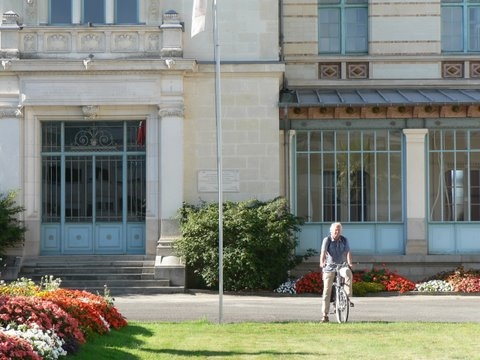
Jan Schakel in Rennes – Part 2

So, pronouncing and understanding French words in an English way and visa versa can be rather tricky. Moreover, because in France they try to keep their language ‘clean and pure’, so you can not use or pronounce words like computer, laptop or cell phone in French or in a French way (you have to know that they’re called ordinateur, portable, etc). The more surprising it is to find out that words in French sometimes do have the same meaning and structure as for example in Dutch. The English word ‘data’ for example is in Dutch ‘gegevens’, and in French ‘données’. These words have exactly the same structure, which might be caused by it’s origin: a positivistic way of thinking in both cultures. In my workshop “How to tackle reality and complexity” I could make clear to the audience that facts and data or ‘no gift from nature’, and that they or not ‘given to us’, but that it is mankind who takes information from nature in an active way and in this process it creates and constructs fact and data. So no ‘gegevens’ or ‘données’ at all!

Not only knowledge of languages is important to ‘survive’ in a different country (like knowing the difference between chamber, salle and bureau…), but also insight in their cultural and institutional history. I do work almost ten years now within an international framework on education (like IMRD, Erasmus Mundus, Intensive Programs), so I’m rather familiar with differences in educational systems between and within the European countries. But again I was too biased when I tried to understand what’s going on here in Agrocampus Ouest. For example: courses can last over 6 month, and the only way to understand the course and to get access to the content of it, is to join (‘assister’) the course. There are (hardly) any course outlines, no books, no readers, etc. Everything is taking place within the classroom and students have class during the whole day (2 x 4 hours), during the whole week, and this last week after week after week… So the professor himself is very important; not only in research but also in education. He is the authority, and the student really serves his apprenticeship with the professor. The French word for education is ‘formation’ –like word ‘vorming’ in Dutch- and indeed this educational system forms and shapes the student in a traditional way.
Continue reading →

Reality is an illusion – Jan Schakel in Rennes – Part 1

“Reality is an illusion, caused by a lack of drugs”. I found this rather philosophical text somewhere written on the wall in one of Rennes’ universities. It made me smile; not only because of it’s statement (very original), but also because I had to give a workshop the day after. The title of this event was: “How to tackle reality and complexity?”. I was wandering what to do? Should I present my 70 slides (as planned) with comments during the four hours of the workshop? Or should I ask the students to use some drugs? Maybe it was even a better way to ‘tackle reality’, according to the quotation on the wall. It was for sure a thrilling idea! I decide not to do so. So I worked with my class through all the slides, and I think I did the right thing. Drugs are forbidden anyway in France! (‘See the PDF-file Rennes handout 2010 for a brief summery of the content of this workshop).

I am in France for some weeks, being a ‘visiting teacher’ from Wageningen University, now working at the Agrocamups Ouest. One week I was supervising 40 students during a “Stage de Terrain” at  the Cote d’Armor (North Brittany), and next week I will do the same during a practical in Villarceaux, west of Paris (just very nearby Giverny). This ‘stage du terrain’ will focus on ‘Identifying sustainable indicators for Rural Development’. In between I am living and working in Rennes for three weeks. Rennes is the capital of Brittany. It is a beautiful city! With almost 200.000 inhabitants, including over 60.000 (!) students, it indeed is a cultural and intellectual city. Besides that, the city is rather wealthy and ‘good-looking’: it represents a rich history, with many important and impressive institutes, and almost no ‘heavy industry’ (except the automobile industry). Rennes is a leading centre in telecommunications and other knowledge based industries. But in spite of that, Rennes also has a different atmosphere, what sometimes makes me remember to my hometown. Rennes is ‘maxi-Wageningen’ (whereas Agrocampus Ouest really looks like a ‘mini-Wageningen’). Rennes isn’t just a very intellectual city; it also is very multi-cultural, very international and also very ‘alternative’. So a good place to be. (Have a look –for example- at www.salonbio.fr and www.legoutdici.com where you can find information on the 9th edition of the three days lasting manifestation on ‘ La Terre est Mon Metier’. I will come back later on the special relationship between Rennes and these organic initiatives in the rural area).

Continue reading →

PUREFOOD research and training network

The Rural Sociology Group has been granted the coordination of a Marie Curie Initial Training Network  entitled ‘Urban, peri-urban and regional food dynamics: toward an integrated and territorial approach to food (PUREFOOD)’ funded by the European Commission’s Seventh Framework PEOPLE program. The PUREFOOD research and training programme aims to reduce the enormous knowledge and skills deficit that is negatively affecting the capacity to design and deliver appropriate political and developmental solutions in the crucial supra-disciplinary fields of food security, public food procurement, public health and sustainable urban and regional development. Hence, the objective of PUREFOOD is to train a pool of 12 early-stage researchers (ESRs) in the socio-economic and socio-spatial dynamics of the (peri-)urban and regional foodscape. The research and training program will therefore provide knowledge and innovation for the Commission’s aim to deal with economic, social and environmental policies in “mutually reinforcing ways” which reflects the core of the Lisbon and Gothenburg agenda’s call for integrated solutions towards economic prosperity, social cohesion and environmental sustainability. The PUREFOOD network is centred around food as an integrated and territorial mode of governance and studies the emergence of the (peri-)urban foodscape as an alternative (as opposed to a globalised) geography of food, including the ways in which, and the extent to which, sustainability aspects generally considered to be intrinsic to the alternative food geography are incorporated by the more conventional food companies.

The PUREFOOD Initial Training Network consists of 7  university partners who will each host one or more ESRs:

  1. Wageningen University – Rural Sociology Group (The Netherlands)
  2. Cardiff University – School of City and Regional Planning (United Kingdom)
  3. Pisa University – Department of Agronomy and Agro-ecosystem Management (Italy)
  4. Latvia University – Faculty of Social Sciences (Latvia)
  5. City University London – Centre for Food Policy (United Kingdom)
  6. Federal University of Rio Grande do Sul – Postgraduate Program in Rural Development (Brazil)
  7. Makerere University School of Public Health – Department of Community Health and Behavioural Sciences (Uganda)

In addition to these universities as full consortium partners, the PUREFOOD network consists of 8 associated partners, a combination of private firms, public authorities and civil society organisations:

  1. Peri-Urban Regions Platform Europe (PURPLE)
  2. Sustainable Agriculture Initiative (SAI) Platform
  3. Sodexo UK
  4. Willem&Drees
  5. Slow Food Study Center
  6. Stroom Den Haag
  7. Sustain – the alliance for better food and farming
  8. Tukums municipality

The associated partners will contribute to the PUREFOOD training program by contributing to courses, participating in Communities of Practice and by hosting ESRs for a secondment. The active involvement of these associated partners is also of great importance for safeguarding the practical applicability of scientific research in the commercial, public as well as civic realm and for the dissemination of results.

The seven universities have opened (or soon will open) vacancies for 12 early-stage research positions. The launch of the vacancies has been announced on this weblog. As of now the PUREFOOD vacancy brochure with information about ESR projects, eligibility criteria, contact persons for additional information and addresses for submitting applications is available. For potential prospective ESRs an information pack has been compiled with information about the PUREFOOD research and training programme, the individual ESR projects, the timeline of the project and short descriptions of the full and associated consortium partners.

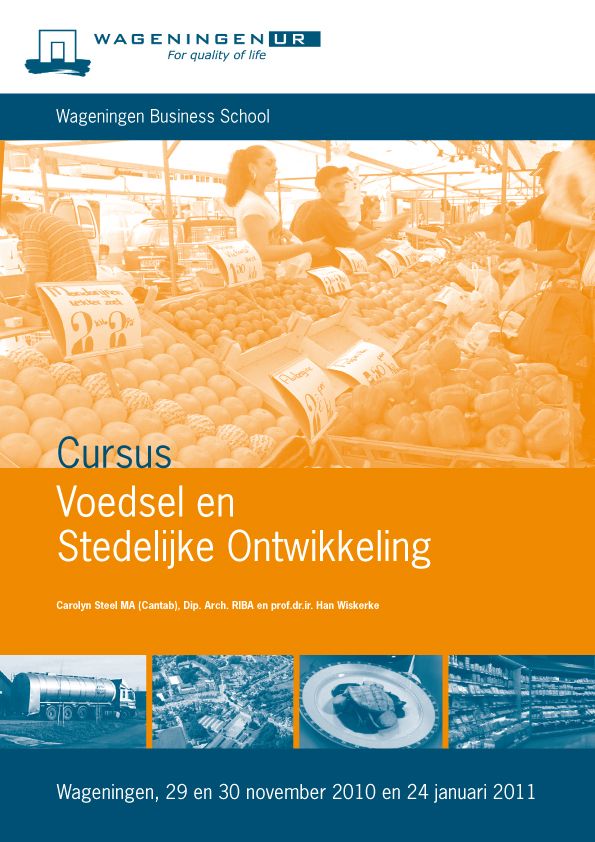
Cursus ‘Voedsel en Stedelijke Ontwikkeling’

Op 29 en 30 november 2010 en 24 januari 2011 verzorgen Carolyn Steel en ik voor Wageningen Business School een cursus over de relatie tussen voedsel en stedelijke ontwikkeling. Deze cursus is toegankelijk voor een breed publiek: beleidsmakers, architecten, landschapsarchitecten, stedelijk ontwerpers, eco-ontwerpers, docenten en mensen die in de landbouw, voedingsmiddelen- of gezondheidsindustrie werken. Daarnaast is iedereen die geïnteresseerd is in duurzame (stedelijke) ontwikkeling van harte welkom.

De aanleiding voor deze cursus is gelegen in de trend van bevolkingsgroei en voortschrijdende verstedelijking en het daarmee samenhangende spectrum aan sociale, economische en ecologische uitdagingen. Klimaatverandering, slinkende olie voorraden en het uitputten van natuurlijke hulpbronnen, gecombineerd met sociale kwesties als armoede, honger en obesitas, vormen de achtergrond voor complexe beleids- en planningsvraagstukken. De verbindende vraag in deze is hoe steden in de toekomst te voeden op een rechtvaardige en duurzame manier.

Als de toekomst inderdaad verstedelijkt is, moeten we dringend (her)definiëren wat dit inhoudt. Huidige aannames over verstedelijking, ontstaan in een tijd die voornamelijk ruraal was, zijn verouderd. We hebben een nieuwe visie nodig op steden en de relatie die zij hebben met het platteland dat hen moet voeden. Als wijzelf en onze toekomstige generaties “goed” willen kunnen leven, moeten we nieuwe inzichten ontwikkelen met betrekking tot wonen, ontwerpen en samenwerkingsverbanden. Hoe we dat moeten doen, is de kern van deze cursus.

Deze cursus is gebaseerd op en geïnspireerd door het boek Hungry City van Carolyn Steel. Hierin analyseert ze stedelijke ontwikkeling vanuit het perspectief van voedsel. Voedsel is de verbindende factor tussen tal van stedelijke uitdagingen, variërend van de ecologische footprint en klimaatverandering tot welzijn en gezondheidsvraagstukken. Door de verbinding met voedsel zichtbaar te maken, krijgen planners en beleidsmakers een middel in handen om hun aanpak te herdefiniëren en deze meer toe te spitsen op een duurzame stedelijke en rurale ontwikkeling. Cursisten leren door dit perspectief de relatie te zien tussen voedsel en verschillende publieke domeinen. Door deze relatie te begrijpen, wordt inzicht verkregen in de kwaliteit van beleid, in de samenhang van beleidsterreinen en in de verbanden tussen lokale en globale kwesties. Cursisten leren werken in multi-disciplinaire teams, waarbij voedsel als gemeenschappelijke taal en verbindende factor gebruikt.

Klik op de volgende links om je in te schrijven of om de cursusfolder te downloaden.

Afstudeerscriptie Alternative Food Geography Amersfoort

Waar komt ons voedsel eigenlijk vandaan? Steeds meer consumenten stellen die vraag en gaan op zoek naar alternatieven wanneer zij niet tevreden zijn met de gangbare antwoorden. Steeds meer steden zijn ook bezig met dit vraagstuk. Het besef dringt door dat veel autokilometers te maken hebben met supermarkt bezoek, dat ons eetpatroon te maken heeft met hoe we ons verhouden tot voedsel, dat eten en koken het wijkwerk ondersteunt, dat stadslandbouw meer dan één publieke functie kan vervullen. Vaak ontbreekt veel kennis over hoe de stad zich tot haar dagelijkse maaltijd verhoudt. Zo ook in Amersfoort. Een succesvolle brainstormbijeenkomst op 17 juni jl (zie eerder blog) door enkele initiatiefnemers (o.a. Transition Town Amersfoort) heeft het stadsbestuur geinteresseerd. Wellicht is de eerste stap gezet naar een Amersfoortse voedselstrategie. Een voedselstrategie

“richt zich op het totale complexe voedselsysteem dat dagelijks voorziet in de behoeften van een regio. Dit voedselsysteem omvat primaire productie, transport, verwerking, opslag en distributie, verkoop en marketing, restverwerking en dienstverlening en maakt deel uit van wereldwijde netwerken.” Cleo van Rijk, Startdocument CoP voedselstrategie voor gemeenten 2010.

DE VRAAG:

De initiatiefnemers in Amersfoort zijn in het kader van de ontwikkeling van een Amersfoortse Voedselstrategie op zoek naar afstudeerstudenten die alle uitingen van alternatieve vormen binnen alle facetten van dit complexe voedselsysteem in kaart willen brengen. Dus ontwikkelt zich in Amersfoort een alternatief voedsel netwerk? En zo ja, wie zijn de spelers, wat zijn de hoeveelheden, waar vindt het plaats en wat zijn de kenmerken?

Historisch Amersfoort

Ben je geinteresseerd? Neem dan contact op met Edgar van Groningen voor meer informatie. Email: edgarvangroningen@gmail.com