Who’s ‘the’ farmer?

Yesterday (Tuesday) 42 first year students , Paul Hebinck and I visited two Dutch farms for the course ‘Agricultural and Rural Development: Sociological Perspectives’ (RSO 20806 ).

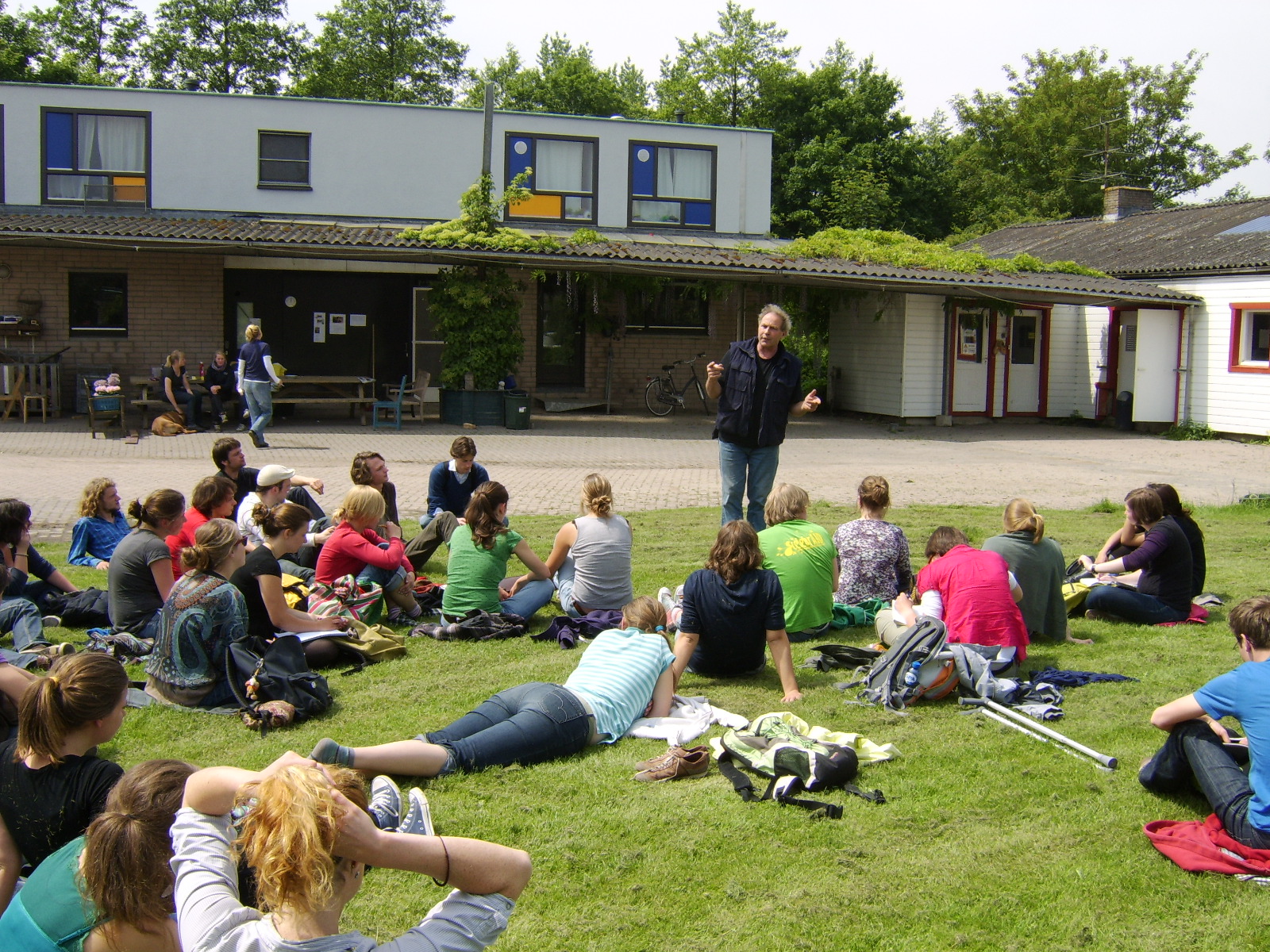
We firstly visited the multifunctional farm ‘Eemlandhoeve’ of Jan Huigen. In an inspiring talk, Jan explained about the development of the Eemlandhoeve and the future plans. The farm has different functions, such as care farming, recreation, herb production, beef production and education for schoolchildren. After a nice walk around the farm and the calming farm yard (see picture), we walked to the neighbouring farm. 

The neighbouring farm ‘Hoeve ‘t Witte Schaap’ follows another path of development: a large scale dairy farm, with about 300 dairy cows and four milking robots. For most students, it was the first time they visited such a large dairy farm. The shed is large and high, with a lot of light and fresh air. Gerrit (the farmer) talked engaged about his farm, including the technology and animals. Two workers take care of the cows and by feeding them and looking after their health. The cows are fed with grass and maize of the farm and hardly received any concentrates (only in the milking robot). The farmer applies all the manure on his land. In fact, his way of farming is not that far from organic regulations.

After both visits we gathered, where Drees of ‘Willem & Drees’ gave an inspiring talk about regional production and sale of fruit and vegetables in five regions the Netherlands.

During the discussion, the students raised interesting questions. Firstly, one of the students asked Jan Huigen ‘How much of your income comes from food production?’ This – of course – was a limited amount and several students seemed concluded that he was not ‘a real farmer’, but more an entrepreneur in the countryside. Thereafter, the large scale farmer was asked how often he was actually among his animals, which was limited, since he had two workers to take care of the animals. The students seemed to conclude that he was neither ‘a real farmer’, because he had limited animal contact. Instead, he was more a ‘manager’.

To conclude, it was an inspiring excursion, which showed two very different development paths of contemporary farming in the Netherlands and gave students a great opportunity to think about the question what a farmer is nowadays.

Intensive Program Slovakia

By Marlies Meijer, MSc student

When I first heard about the Intensive Programme in Slovakia, I did not really know what to expect. The core of my MSc lies at land use planning, but for my thesis I choose a combination with rural sociology. What triggered me the most was the country. I’ve never been to Eastern (or Central) Europe and saw in the IP a great opportunity to experience transition from communism to capitalism and into EU-membership recently. On the first day the exchange with other students (about 40 from 12 universities, and even more countries) turned out to be just as interesting. Encouraged by cheap beer we had long discussions about everything, but still, mostly about the role of agriculture in the different countries.

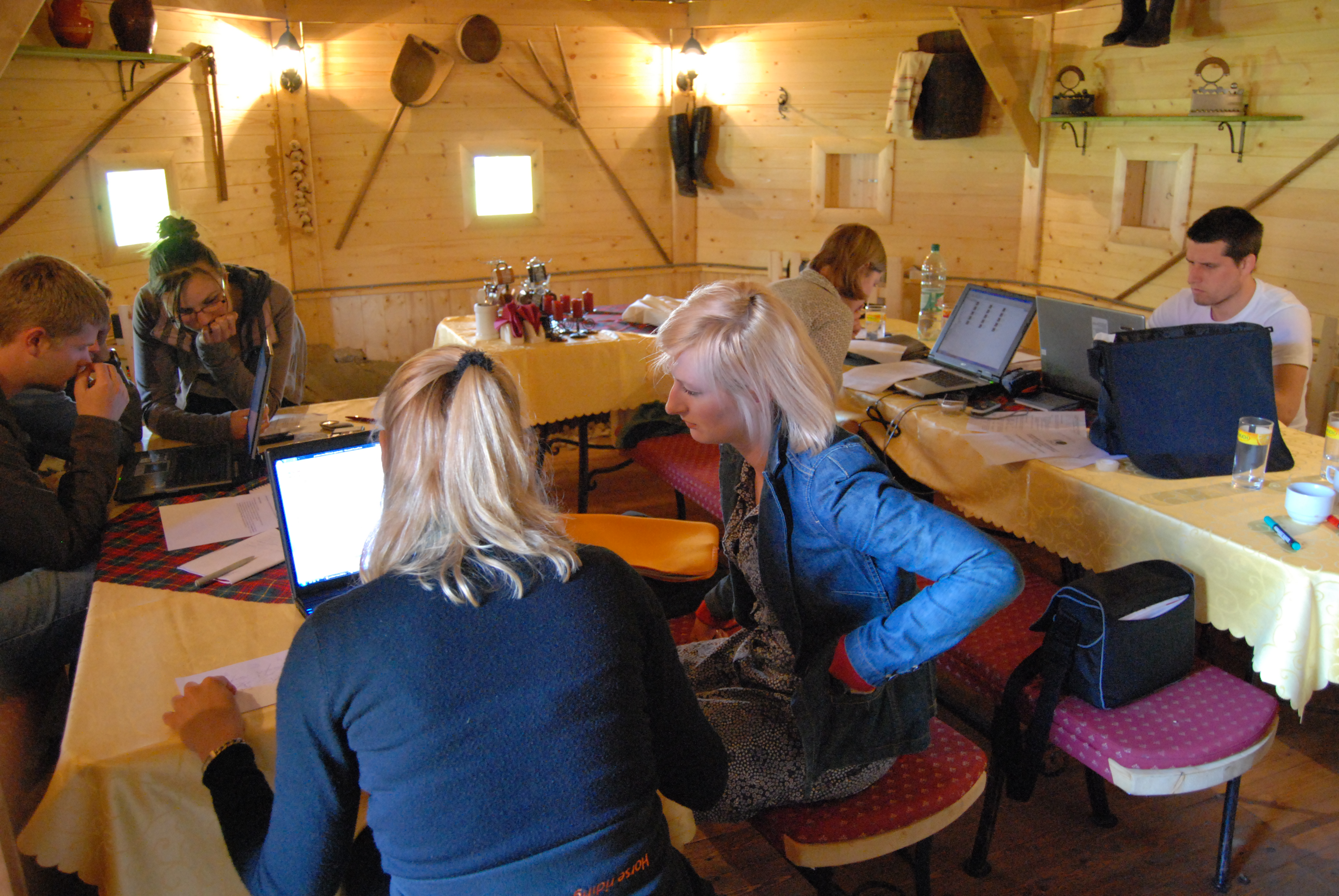
For me the three day excursion to different villages in the Nitra-region was definitely a highlight. We were divided into small groups, each with a different region. My group stayed in a small cottage, north of Nitra. We were introduced to mayors of the small villages. I liked to see the differences between the Dutch planning system, where everything is arranged from paving stone to strategic master plans for 2030; and the project-based development in the little Slovakian villages: “if we have the money, we’ll think about constructing a sewerage system next year”. It makes all problems we have on the Dutch countryside (like “verrommeling”) relatively small.

The second day we went to a large cooperative farm. The size was overwhelming: 3000 ha., 120 employees, 800 cows and immense fields of rapeseed. But this was not everything; the cooperative farm (a legacy from communist times) had supporting departments in almost all layers of the market. We visited a bakery, a tool shop and a local grocery store (“Our Home”), all embodied in the cooperative. It put quite a different perspective on the development of short-supply-linkages. Small farms struggle in Slovakia, and we did not see many small scale (innovative) initiatives. What surprised me the most was that agriculture seemed to be disintegrated from all kinds of regional developments. There were no relations between local administration and the agricultural sector, and agriculture was not seen as a positive contribution (or even part of) to the landscape. Moreover the EU LEADER programme focussed in this region on social and economic developments; agriculture was not mentioned in the main objectives. Not surprisingly, since many villages suffer from more urgent problems, like ageing, unemployment, depopulation and a lack of basic social services.

But still, it pointed out that rural development cannot be just about agriculture, it is about the development of rural region entirely as well. Apart from farmers there are so many local actors that also could and should be included. For me it also pointed out that land use planning and rural development are not so different in essence. While approaches could be different, in the end it is about the same: sustainable development of (rural) regions.

Repeasantisation in Araponga, Brazil – a quest for space

By Leonardo Ayabe van den Berg, MSc graduate International Development Studies

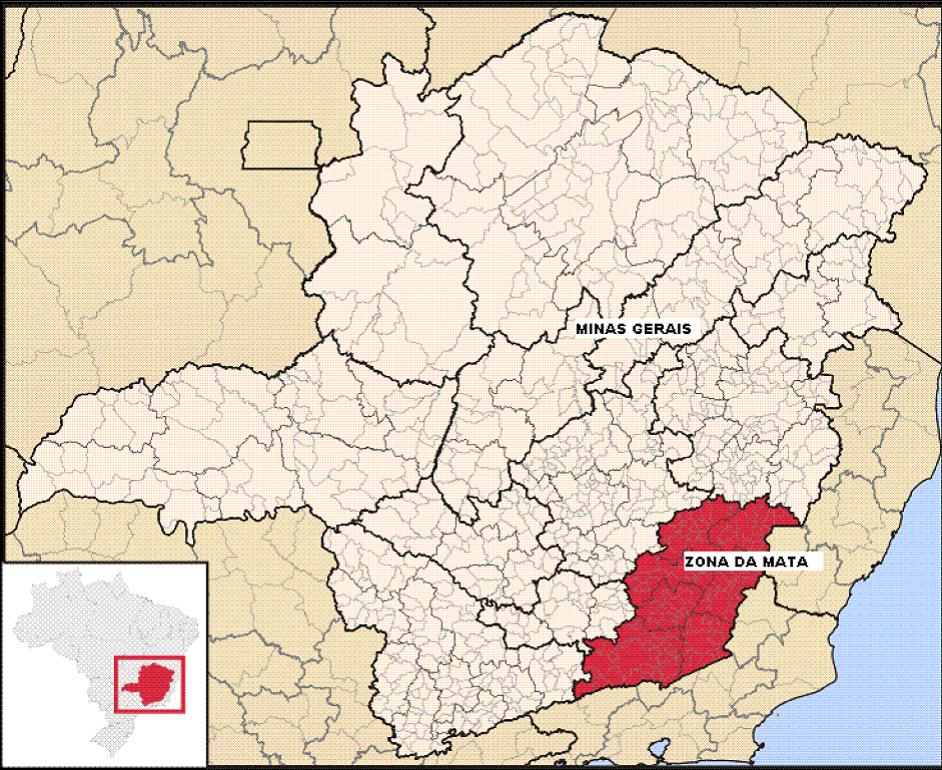
Recently I completed my MSc-thesis. The thesis research is set in the municipality of Araponga in Brazil, where (re)peasantisation occurred and continues to occur. Here I describe some of the findings of my research.  When interested you can downlaod a pdf of my thesis ‘Invisible peasant movements: A case study of (re)peasantisation in Brazil‘.

Araponga

Araponga

When I started to read about the peasantry there were two major things that occurred to me as striking. First, in policy peasants are often considered as a group of laggards: who are unable to take care of themselves and therefore need social assistance; who rely on primitive forms of technology and therefore must be modernized; or who are impeded by a stagnant, traditional mentality and must therefore be converted into small entrepreneurs. The peasant mode of farming is seldomly considered in its own right. Second, in academic theory peasants are predicted to disappear, weaken or live a life of poverty as a result of their inferior mode of production and their helplessness. Departing from the assumption that actors are driven by a specific economic-rational logic, neo-liberal approaches roughly theorise that peasants commoditize, compete with other farms as a result of which there will be regional growth. Tradition or culture can block economic rationality and the transition from peasant to entrepreneur. The peasant will then be doomed to poverty. In contrast to the neo-liberal approach, neo-Marxist approaches, most of which also assume that the peasant is driven by an economic logic and commoditize, theorise that commoditization will either lead to the destruction of the peasant enterprise or to a fate of poverty. This is the result of price fluctuations, squeeze in agriculture (caused by the trend of decreasing produce prices and increasing input prices for farmers), or newly emerging food networks (through which income from weaker, peasant, parts of the chain are squeezed in favour of the more powerful, retailers, part of the chain). These predictions and preconceptions contradict with what happened in Araponga, a rural municipality in the state of Minas Gerais in Brazil where there was a rise in the number of peasants and an increase in welfare. The objective of this thesis was to find out how this was possible: how had (re)peasantisation occurred in Araponga. Continue reading

Local food at the Rhederoord estate – gastronomic highlight II

Earlier MSc-student Renee Ciulla added a post on our gastronomic field trip to the Rhederoord Estate. I made a video clip of the display of local food and explanation by patron cuisinier Gerhard van den Broek of the Rhederoord Estate. As I shot the clip with a regular photo-camera, by way of experiment. The quality is not excellent, also because of the yellow atmospheric light, but still the food look very tasty and the explanation whets your appetite. Rhederoord was indeed a gastronomic highlight for the students and myself!

You can watch more video clips on Rhederoord at http://www.youtube.com/user/rhederoordnl

Local food at the Rhederoord estate – gastronomic highlight

By Renee Ciulla  – Msc-student attending the course Origin Food: a market for identity

On April 8th, the Origin Food course (see earlier post) was treated to a gastronomic excursion to the Rhederoord estate near the town of Arnhem in De Steeg. Located on 12 ha, the estate provides a magnificent view over the foothills of the IJssel valley and Veluwe forests. The Rhederoord  is mainly known for it’s restaurant which offers a fine dining experience, sourcing most of their products from the surrounding countryside or within the Netherlands. However, the estate also caters events, hosts weddings and can accommodate over 250 guests in their 22 rooms. Possibilities also exist to book business and private meetings.

Despite the snowy morning, grey clouds and traffic delays in Arnhem, our group was in high spirits when we saw what greeted us in the foyer of the Rhederoord: a cheerful group of staff awaited to take us to a tastefully decorated coat room followed by a delicious estate-made apple tart on a delicate butter crust. As we mingled with our steaming cups of coffee, the sounds of clinking forks and laughter drifted up the wood-paneled walls and out the large paned windows to the manicured gardens and rolling fields. After our mid-morning feast we sat for an entertaining and inspiring history of the Rhederoord. The goals are to support local farmers and producers in every culinary aspect of their restaurant which they believe is reflected in the flavors and visual appeal. Additionally, the estate tries to educate other chefs and visitors about how to grow their own vegetables and herbs. A garden near the entrance of the restaurant displays various herbs, strawberries and vegetables enabling chefs to see first-hand what these foods look like in their growing state. Sheep and cows are also owned by the estate for their own supply of local meat.

Buffet of local food at the Rhederoord estate

After our outdoor tour we couldn’t have been more surprised when we saw the buffet that welcomed us downstairs. Glowing in the atmospheric, perfectly positioned lights was an assortment of local gastronomic gems: pates, organic sheep, goat and cow cheeses, savory thinly-sliced ham, loaves of freshly baked breads with Dutch wheat, and mounds of warm rolls. Local greens and cabbage made some delicious salads. Meats included blood sausage, sea bass and river lobsters. The food was bursting with flavor and succulent textures- the entire room fell silent during our first ten minutes of eating as everyone floated in their personal eating heaven. A wine tasting of foud Dutch wines followed with ample joking about the quality of Netherlands wine. As for me, I was too distracted with the dessert still sitting on the buffet table: beautiful croissant-type cream puffs filled with fresh-egg custard and pieces of dark chocolate; every bite melted in my mouth.

The entire experience to Rhederoord was reminiscent of a family Christmas dinner. We all left feeling extremely grateful for the learning experience and culinary delights. Thanks to Dirk for organizing a spectacular and delicious trip!