The Ukraine grain deal and the resumption of food exports from Ukraine’s Black Sea ports has been accompanied by strong narratives heralding the global food security and humanitarian impacts. However, export data suggest that Western countries, the food industry, and Turkey, are among the main beneficiaries, and not those who are food insecure.
Black Sea Grain Initiative
On the back of the impacts of the pandemic on global food systems, the Russian invasion of Ukraine in February 2022 and subsequent ongoing conflict has raised fears of global food shortages and price rises. This is because of the prominent role of Ukraine in the global food system as a major exporter of food grains and oilseeds. Most of Ukraine’s food exports leave the country via the major Black Sea ports of Odesa, Chornomorsk, and Yuzhny/Pivdennyi. These ports, however, were forced to close in the early days of the invasion, cutting off Ukrainian grain and oilseed from the global market. Under the narrative of humanitarian and global food security concerns, the UN, Russia, Turkey and Ukraine have launched the Black Sea Grain Initiative (BSGI). The Initiative is based on a UN-proposed agreement signed in July 2022 between Russia and Ukraine, brokered by Turkey, to enable the safe resumption of Ukrainian grain exports through the Black Sea.
To authorize, coordinate and monitor the export of food commodities, a Joint Coordination Centre (JCC) of representatives of Turkey, the Russian Federation, Ukraine and the United Nations was established. It was also agreed upon that the JCC protects a route between the Ukrainian Ports and Turkey, where the ships are inspected, and provides vessel movement information. Under the agreement, cargo ships carrying Ukrainian grain are escorted by Ukrainian vessels to international waters, proceeding on to the Bosphorous strait for inspection by Turkish authorities. The first shipment of grain under the Initiative left Ukraine on 1st August 2022 to much international fanfare. In recent days, the Initiative has been back in the news, with Russia announcing its intention to withdraw from the agreement on 29th October 2022, only to wind back that threat, under pressure from Turkey and other international actors, a couple of days later.
While the geopolitical intrigue around the agreement has dominated the news, what is interesting for us as critical food system scholars is the discourse regarding food, hunger and farming that has accompanied the Black Sea Grain Initiative. To our mind, this has involved the deepening/reproduction of dominant narratives of the global food system, including that of global food crisis and the appropriate responses that should follow. Taking cues from ideas around disaster capitalism and food regime theory, in this blog post we aim to disentangle the complex narratives of crisis, food security, conflict and trade that have accompanied the Black Sea Grain Initiative. To do this, we take a deep dive into the UN’s own data that documents the cargo, tonnage and port of destination of all grain ships that have left Ukrainian ports under the Initiative. We compare the picture that this data paints to the narratives about food systems and food security promoted by proponents of the Initiative, and consider what the disjuncture between data and narrative means for the broader politics of our food system. It seems to us that dominant food system actors are using the narrative of crisis as a pretext to double down on the unjust governing structures of global food that give rise to food crises in the first place. We should instead use this moment to not only advocate for an end to violent conflict in Ukraine and justice for Ukrainian farmers, but to also reimagine a just and emancipatory future food system that would radically reshape how we think about food, hunger, conflict and trade.
Unpacking food security narratives
The Black Sea Grain Initiative and the resumption of food exports from Ukraine’s Black Sea ports has been accompanied by strong narratives heralding the global food security and humanitarian impacts. In particular, a strong narrative has emerged that the resumption of Ukrainian grain exports has been vital to alleviating hunger in the world’s poorest regions in a time of food crisis. The Initiative has likewise been framed as a major victory for the UN and as ”a beacon of hope” and an “unprecedented agreement” and that the agreement would “stabilize spiraling” food prices and “stave off famine”. We do not challenge the importance of international efforts to eliminate hunger and food insecurity, and we are strong advocates for supporting Ukrainian farmers. However, we also believe it is important to scrutinize the ways in which such efforts are discursively represented, the links between discourse and actual events and movement of food crops on the ground, and the other political work regarding our global food system that dominant discourses might perform. Here, we identify three prominent narratives presented in the media and via international organizations and subject them to further scrutiny. These narratives each make claims, often presented unproblematically, about different causal mechanisms between Ukrainian grain exports and efforts to alleviate global food insecurity: first, the impact the BSGI will have on the supply of food aid; second, the impact the BSGI will have on calming global food prices; and third, the composition of exports realized under the BSGI as being about ensuring the circulation of food (and in particular, wheat) in contrast to the circulation of commodities.
Food Security and WFP
Perhaps the most emotive and compelling narrative put forward about the BSGI is that the resumption of grain exports from Ukraine is critical to addressing famine and acute food insecurity amongst vulnerable populations in ‘food deficit’ countries, particularly in North Africa, Asia and the Middle East. In other words, the BSGI is presented as crucial for ‘feeding the world’ in a time of food crisis. At the center of this narrative is the World Food Programme (WFP) – the key international actor in emergency famine relief, food aid and food security programmes more generally. In August, the Executive Director of the WFP said that “getting the Black Sea Ports open is the single most important thing we can do right now to help the world’s hungry”. This narrative rests on the fact that Ukraine is an important source country for WFP food aid procurement, particularly wheat. In 2020, for example, the WFP procured 424,000 tons of grain from Ukraine, representing 13% of total WFP procurement that year. So, no doubt Ukraine grain is important to WFP operations. Yet, the BSGI is represented as being overwhelmingly about addressing the food crisis, famine and global food insecurity. Much attention has been given in the media to the role of the WFP in the Initiative, with the impression that a majority of the BSGI grain is really going to those ‘most in need’. UN press releases have focused on the WFP vessels leaving Ukrainian ports, and this narrative has been reinforced in the media. For example, CNN reported that on 31 October, 2022, Turkish President Recep Tayyip Erdogan said of the BSGI that “one third of the world’s wheat is produced by Russia and Ukraine. You are the closest witnesses of our efforts to deliver this wheat to the countries facing the threat of famine”. In the same article, which reported Russia’s erstwhile threat to withdraw from the agreement, the director of USAID, Samantha Power, was quoted as saying that “any attempt to undermine the agreement is an attack on hungry families around the world whose lives and livelihoods are dependent on this initiative”. In August, another CNN article quoted the US Embassy in Kyiv that “the world will be watching for continued implementation of this agreement to feed people around the world with millions of tons of trapped Ukrainian grain”.
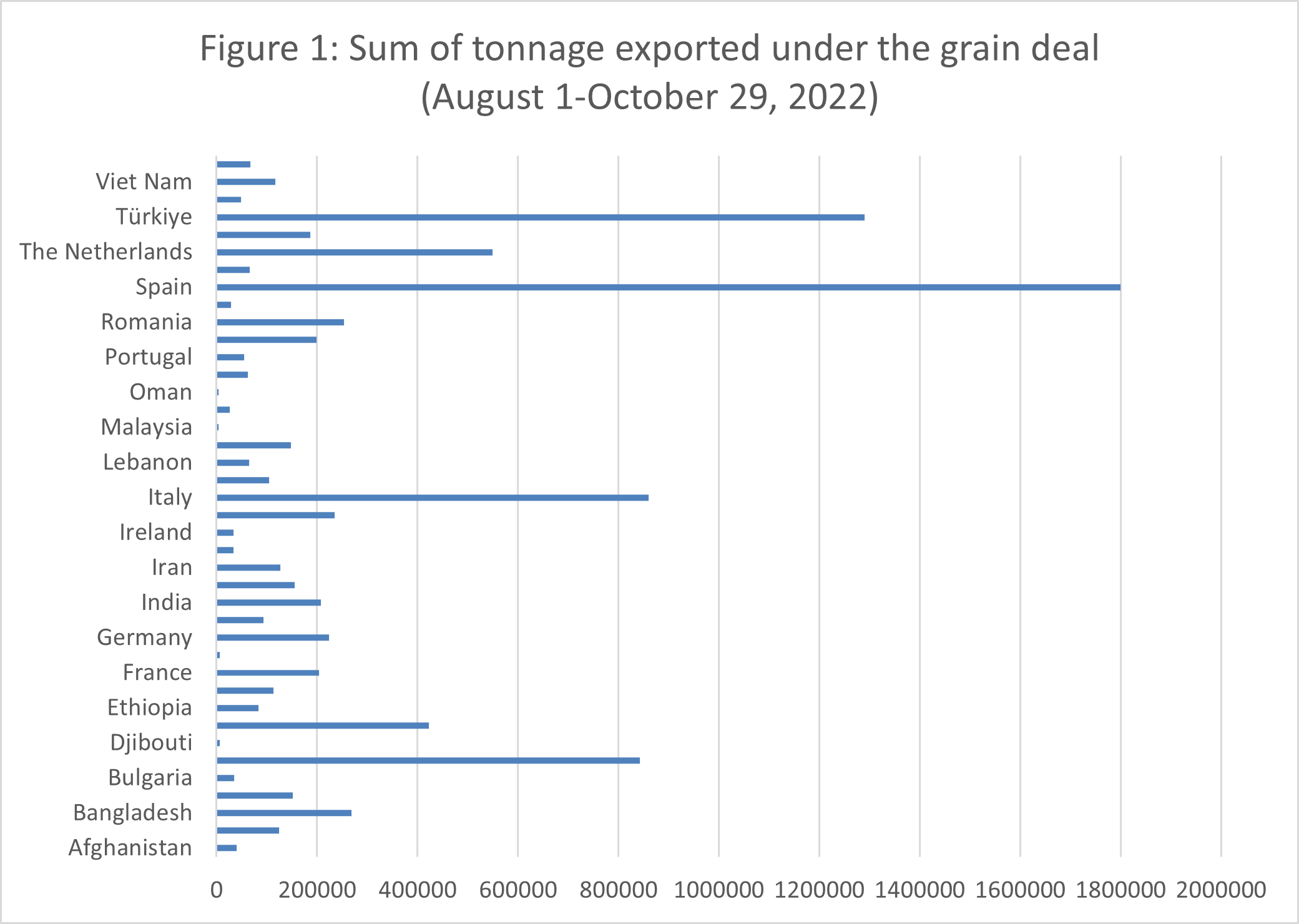
Yet the UN’s own data on the export of grain under the BSGI paints a different picture. The inspection check-list includes lading and cargo plan. On August 1, 2022 the first vessel left the port in Odessa. The ship carried 26,527 tons of corn for a number of countries, which were not specified by name. The ships that followed brought corn to Ireland, Italy, Turkey and Iran respectively. Next came shipments of sunflower meal and sunflower oil, soya beans and then wheat. On August 16, 2022, more than two weeks after the food commodity trade under the flag of Black Sea Grain Initiative was resumed, and following 19 vessels bound for China, Iran, Ireland, Italy, South Korea, and Turkey, the first vessel chartered by the World Food Program (WFP) left a port in the Ukraine. It carried wheat as part of the WFP’s “drought response in the Horn of Africa”. On August 30, a second chartered vessel left Ukraine with wheat for Yemen, after being milled in the flour in Turkey. On September 17, a third and fourth vessel brought wheat to Ethiopia and Djibouti respectively for humanitarian aid in the Horn of Africa. On September 22 and October 7 wheat vessels left with the destination Afghanistan and Somalia. This makes 6 shipments out of a total of 408. The total amount of BSGI wheat purchased by WFP was 150,800 tons. On a total of 2,674,156 tons of wheat leaving the Ukrainian ports, this is less than 5% of the total amount of wheat shipped. Up to now, in fact, 61% of the grain exported under the BSGI has gone to European countries, followed by 26% to Asian countries (mostly to China), and only 13% to African countries. Figure 1 breaks down the total grain exports per destination country, showing that Spain, Turkey, Italy, China, and the Netherlands have received the most grain shipments under the Initiative. When we break down these numbers per commodity, Spain is the main beneficiary of corn, and Turkey the main beneficiary of wheat. As a broker and protector of the grain deal, Turkey has been given priority in the export of wheat from Ukraine. Turkey’s Minister of Agriculture claimed that the country receives a 25% discount on wheat from Ukraine, yet this has been denied by the United Nations.
Food Security and Prices
The claims that the Black Sea Grain Initiative will alleviate global hunger is not only based on the supposed direct shipment of grain to those who are food insecure. Various UN institutions have suggested a direct link between the Black Sea Grain Initiative, lower food prices, and food security, where lower world market prices would improve food access for food insecure populations. The UNCTAD may have been most explicit about this relation between prices and hunger, stating that “[t]he Initiative has helped to stabilize and subsequently lower global food prices, and move precious grain from one of the world’s breadbaskets to the tables of those in need.” (UNCTAD, 2022: 3). In a news update on the initiative, explaining its “importance for the world”, the United Nations declared “all of the grain coming out of the Ukrainian ports thanks to the Initiative benefits people in need, as it helps to calm markets, and limit food price inflation” (emphasis in the original). Others have warned that a collapse of the agreement made under the Black Sea Grain Initiative would be “an attack on hungry families around the world whose lives and livelihoods are dependent on this initiative,” according to an USAID Administrator.
Yet, precaution is required when assessing the relation between the Black Sea Grain Initiative and food prices. First, the UN and others seem to deploy language to actively avoid making any claims about causality between the Black Sea Grain Initiative and global food prices. Yet by putting the two together a causal link is implied. Second, others have questioned this relation explicitly. The International Crisis Group stated that the effect of the agreement under the Black Sea Grain Initiative on global food prices is expected to be limited. Third, critical food system scholars have long argued that price volatility in general is linked to the financialization (Clapp & Helleiner, 2012) and speculative trading of food, particularly in futures markets (Ghosh, Heintz, & Pollin, 2012). Crises provide a fruitful context for food commodity speculation (Baines, 2017). Fourth, attention should be given to other voices and visions of how to solve world hunger outside of the same tired market and trade-based solutions proposed by dominant narratives. For example the need for a prioritization of ”actions boosting production of locally grown nutritious food and making agriculture more resilient” and strategies of local farmers to address, for example, wheat shortages. Research from Wageningen Economic Research (WEcR) also argues that when wheat prices rise, local farmers often respond byproducing locally appropriate alternatives, such as cassava. These are the types of locally grounded responses that are often sidelined in the dominant global discourse on food systems and food security.
Food Security and Corn
While the Black Sea Grain Initiative has been heralded for moving grain from a cradle of wheat production to the tables of those who are food insecure (UNCTAD, 2022: 3), corn has in fact been the main crop exported (see figure 2). Between August 1 and October 29, a total of 4,001,897 tons of corn left the ports in the Ukraine compared to 2,674,156,695 tons of wheat, approximately a ratio of 3:2. Spain has been the main destination of Ukraine’s corn exports under the Initiative, receiving 833,356 tons of corn, or 30% of the total, up to now. Corn imported by Spain is mainly used as animal feed and feedstock for bioethanol production, the latter a controversial use of a food crop.
Zooming in on the Netherlands, 355,043 tons of corn, or about 9% of the total amount of corn exported in the August-October period, was sent to the Netherlands. Though no information is available for the corn specifically imported from the Ukraine, 65% of all the corn imported by the Netherlands is processed into animal feed and 15% of the corn is processed into biofuel. The remaining 20% is for human consumption. The possibility that this corn has been used to alleviate hunger in food insecure regions is low. Though, again, no statistics are available for corn in particular, and also not for corn from the Ukraine, ninety percent of Dutch cereal exports go to other EU countries (Jukema, Ramaekers, & (Red.), 2021: 98). The dominance of corn exports in the BSGI problematizes the dominant humanitarian discourse around the Initiative. Instead, the BSGI seems much more about reinforcing and shoring up the global industrial food value chains that are a hallmark of our current corporate industrial food system. Again, our goal here is not to challenge the necessity of supporting Ukrainian farmers or reopening Ukrainian ports, but instead to also encourage a deeper reflection of the broader food system politics that are at play.
Conclusions
The discourse around the Black Sea Grain Initiative suggests that the deal contributes to global food security. However, data provided by the Joint Coordination Center of the Black Sea Grain Initiative suggests otherwise. The commodities exported and the destination of these exports suggest western countries, the food industry, and Turkey are the main beneficiaries, and not those who are food insecure. Yet more research is needed, and the authors of this blog are happy to supervise WUR MSc thesis students interested in researching the relation between the Black Sea Grain Initiative or similar responses to food crisis, the restoration of international (corporate) value chains, and food (in)security, and the implications for the broader politics of our current food system and alternative futures.
Bibliography
Baines, J. (2017). Accumulating through food crisis? Farmers, commodity traders and the distributional politics of financialization. Review of International Political Economy, 24(3), 497-537. doi:10.1080/09692290.2017.1304434
Clapp, J., & Helleiner, E. (2012). Troubled futures? The global food crisis and the politics of agricultural derivatives regulation. Review of International Political Economy, 19(2), 181-207. doi:10.1080/09692290.2010.514528
Ghosh, J., Heintz, J., & Pollin, R. (2012). Speculation on Commodities Futures Markets and Destabilization of Global Food Prices: Exploring the Connections. International Journal of Health Services, 42(3), 465-483. doi:10.2190/HS.42.3.f
Jukema, G. D., Ramaekers, P., & (Red.), P. B. (2021). De Nederlandse agrarische sector in internationaal verband Wageningen: Wageningen Economic Research en Centraal Bureau voor de Statistiek.
UNCTAD. (2022). A Trade of Hope: The role of the Black Grain Grain Initiative in Bringing Ukraine Grain to the World. Geneva: United Nations Conference on Trade and Development.
On 13 May 2022, we celebrated the 75th anniversary of the Rural Sociology Group of Wageningen University with a public event entitled “Rural Sociology: past, present and future”. The event took place in Akoesticum in Ede and was attended by approximately 130 people: current and former staff members, current and former MSc and PhD students, and current and former collaborators in (inter)national research projects. In addition to this event we wrote and edited a book entitled ‘On Meaningful Diversity: Past, present and future of Wageningen rural sociology’ and a group of (former) PhD students put together a PhD magazine. Both are open access publications.
The entire anniversary event was filmed and a 16 minute compilation video of the day can be found here:
Compilation video of the 75th anniversary event of the Rural Sociology Group
In addition all presentations and talks are available online in order of the program of the day:
Opening by Arthur Mol (Rector Magnificus of Wageningen University)
Keynote by Han Wiskerke: Meaningful diversity: Past, present and future of rural sociology
Keynote by Haroon Akram-Lodhi: From peasant studies to critical agrarian studies
Rural Talk Show: Interactive session including invited guests and audience participation. The Talk Show was chaired by Matt Reed, with Jan Douwe van der Ploeg as a permanent table guest, and changing table guests around the following three themes:
Session 1– Societal engagement or academic distance; with Jessica Duncan, Aya Kimura, Han Wiskerke
Session 2 – Discussing the rural-urban dichotomy; with Henk Oostindie, Sally Shortall, Esther Veen
Session 3 – A continuing debate: agency and structure; with Bettina Bock, Bram Büscher, Mark Vicol
Keynote by Hannah Wittman: Bridging rural and urban through agroecological networks: cultivating agrarian citizenship in a climate crisis
Presentation of Research Agendas: Imagining the next 25 years of rural sociology. Interactive session around three research agendas, briefly pitched by RSO staff, followed by an open floor exchange of ideas and discussion:
Examining urban agriculture projects in Rotterdam between 2008 and 2018, my research looks at the practice of urban food planning, its strategies, the actors involved and their roles and relations. Central to the research is the observation that in Western European society today, the increased participation of civic initiatives confronts planning with challenges related to governance, decision-making and representation. Sustainable urban food planning can be seen as a laboratory for planning concepts that deal with these challenges.
The purpose of my research is to investigate which conceptualisations of planning are relevant when 1) planning in and for a pluralistic, participative society and 2) planning for sustainable goals related to an unknown future. As there is no consensus in the planning field on what planning is or what it should do, conceptualisations of planning can range widely, from systems planning to advocacy planning and from collaborative to complexity planning. I work with a primary hypothesis that these concepts of planning are complementary rather than mutually exclusive and that in a complex, pluralistic society, different concepts of planning can be relevant in different circumstances.
The main research questions are as follows: What concepts of planning are effective in spatial planning for a common sustainable future when including multiple actors and stakeholders with a variety of frames and perspectives on sustainable food systems? How are different actors, their respective roles and action perspectives included in the decision-making process? What is the role of the planning practitioner in this, and what is the role of governmental planning at different levels?
The research is informed by my own position as a practitioner. Undertaking a professional PhD as an external researcher at RSO allows me to reflect upon and put in perspective my personal experiences in the field of spatial planning and design. Fifteen years of experience with promoting, researching, designing, planning and practicing urban food production in Rotterdam left me (and colleagues from the field) with many ideas and hypotheses on what municipal planners and urban food initiatives should and should not do when planning urban food production. Can municipal planning include the initiatives of societal actors (like myself and fellow urban farmers and activists) in their planning agenda? Would it be possible to do this in a way that respects the diverse world views of these actors? And can societal actors themselves operate in a way that aligns them with governmental planning agendas without losing sight of their own goals?
OLYMPUS DIGITAL CAMERA
Civic urban food initiatives represent a diversity of approaches to what a sustainable food system should be and how planning can contribute, but planners at different government levels struggle to facilitate and include these initiatives and their diverse approaches in their planning efforts. This has become apparent in Rotterdam but is also exemplary of a more general gap between bottom-up societal initiatives and top-down governmental planning in the Netherlands. Through a study of the Rotterdam urban agriculture movement – and taking the role of participant-observer – I examine this gap and address the questions above.
The case study of Rotterdam considers projects in which urban food production has been realised and focuses on the people involved in the planning process and their agendas and strategies, with a special emphasis on spatial planning. To avoid any bias due to my personal involvement in the object of study, I use a range of sources, including grey literature and interviews with different planners and societal actors. In terms of method, I combine this sociological approach with plan analyses (of the projects) derived from the discipline of urban planning. In combining different sources and methods from different disciplines, I try to incorporate the views of different actors and gain a more complete picture of what has happened during these past years and what lessons can be learnt for planners and urban food initiatives..
While the PhD is designed as a retrospective, transdisciplinary case study, it inevitably involves and interacts with my own practice as a designer/planner and, more recently, urban food forester. Interviewing planners about their ideas and influences and writing down their accounts of events has already provided insights that are informing my current work in urban agriculture and food forestry (including advocacy, design and realisation). Although this can sometimes be problematic, the meeting of practical experience with academic and applied research is developing a relevant knowledge base. A professional PhD makes knowledge from practice available to academic research and offers a place of reflection to practitioners.