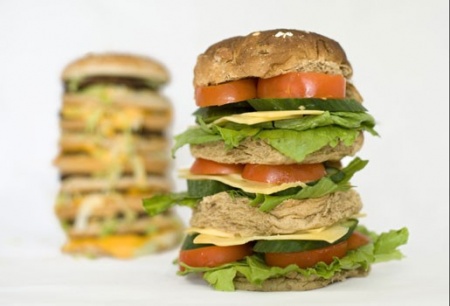
University Food Culture

source: crystalinks.com

Last week I ordered Italian at the new and growing campus lunch food market. What started with some Chinese dishes from a scooter has evolved into a small food market with multiple Chinese and also an Italian warm meal provider and long queue’s at the clock of twelve. The new market is popular, especially among Chinese students but more generally among foreign students. Apparently, a latent market is being tapped into, or how would the business economics department analyse this case.

But I guess it is also a matter of both institutional choices and food culture. The dominance of the Dutch lunch culture revolving around (home brought) sandwiches and milk lacks a true appreciation for the full warm lunch meal. Although university catering is trying to provide a ‘warm option’ to the large amount of foreign students and employees, somehow it stays an additional service rather than a serious business. The rather expensive warm dishes often with ‘exotic’ recipes somehow lack a cultural code which is present in the simplicity of the affordable lunch meals in the new food market.

Wanted: student for an intensive experience in Slovakia

Are you a student with a Major, Minor and/or internship in Rural Sociology/Rural Planning/Rural Development? Then we offer the possibility for a 2 week intensive experience in Slovakia. With an international group of students from various European countries (a.o. Portugal, Poland, Germany, Italy, Spain, Belgium, Lithuania, Slovenia) you will work out a case study about the Role of agricutlure in territorial identity and competitiveness of rural areas in Slovakia. You will acquire knowledge about rural development through lectures and field trips as well as experiencing working in an international diverse group with various background knowlegde. The programme will take place near Nitra (Slovakia) from 18-30 April. Travel and subsistence costs will be reimbursed by the programme. Are you interested? Please contact Els Hegger (els.hegger@wur.nl).

Continue reading

Ook puber op platteland heeft veel problemen – onderzoek UMCG

Uit een onderzoek van Universitair Medisch Centrum Groningen (UMCG), waarover wordt bericht op de website Zorg en Welzijn,  blijkt dat jonge pubers in achterstandsgebieden bijna tweemaal zo vaak gedragsproblemen hebben als leeftijdgenoten in welvarende regio’s. En daarbij maakt het niet uit of iemand in de stad of op het platteland woont. Alleen is er voor probleemjeugd op het platteland nauwelijks aandacht.  Hieronder een deel van het bericht door José van der Waerden:

Wapens

Dat ook op het platteland gedragsproblemen vooral voorkomen in achterstandsgebieden, kwam voor de onderzoekers niet uit de lucht vallen, erkent onderzoeksleider Menno Reijneveld. ‘Vooraf hadden we daar al wel een “basisgevoel” over, vanuit gesprekken met hulp- en zorgverleners. Dat de problemen even groot zouden zijn als in steden, hadden we niet verwacht. Agressief en delinquent gedrag blijkt even vaak voor te komen in Amsterdam-West als in Oost-Groningen.’

De getoetste gedragsproblemen beslaan een breed gebied: van liegen, pesten en zwartrijden tot vechten, heling en dreigen met wapens. Omdat elke puber wel eens problematisch gedrag vertoont, gaan de vragenlijsten uit van een ‘norm’. Kinderen die erboven zitten, vallen in de categorie met ‘gedragsproblemen’. De onderzoeksuitkomsten laten zien dat in achterstandsgebieden 14 procent van de jeugd boven de norm zit. In welvarende gebieden is dat 7,5 procent. Die verschillen zijn voor jongens en meisjes vrijwel gelijk.

Voor meer zie het bericht op Zorg en Welzijn.

Sustainable food planning conference

AESOP logoOn 9 and 10 October 2009 the first Sustainable Food Planning Conference will be held. This conference is an initiative of the AESOP (Association of European Schools of Planning), the ISOMUL (International Studygroup On Multiple Use of Land) and the Rural Sociology Group of Wageningen University.

The sustainable food planning conference is organized to examine the role of food in urban and regional planning. Although political, societal and academic interests in food and the city are rapidly increasing, food largely remains a stranger to the field of urban and regional planning, spatial planning policies and planning studies. Recently the American Planning Association launched its Policy Guide on Community and Regional Food Planning. Inspired by this policy guide, this conference seeks to explore ways in which food can and should be incorporated in planning practices, policies and research and develop strategies for enhancing sustainable food planning in Europe. The character of the conference is primarily agenda-setting by establishing a network of planning practitioners, policymakers and agrifood and planning scholars in Europe and beyond.

.

Restaurant and meeting centre De Kemphaan (source: http://www.restaurantdekemphaan.nl/content/ons_bedrijf)

Restaurant and meeting centre De Kemphaan (source: http://www.restaurantdekemphaan.nl/content/ons_bedrijf)

The conference will take place at De Kemphaan in the city of Almere in the Netherlands. If you are interested to participate in this conference, please apply by e-mail to corine.diepeveen@wur.nl. Costs for participation are € 100,- (incl. drinks, lunches and diner). The number of participants is limited to 50 persons. For more information have a look at the conference programme below:


Day 1 – Generating ideas, exchanging experiences and comparing perspectives

09.00 – 09.30

Welcome and coffee/tea

09.30 – 09.45 Food and planning: an introduction to the conference Prof. Kevin Morgan (Professor of Governance & Development, Cardiff University, UK)
09.45 – 10.00 Including food and agriculture in urban planning: the Almere approach Mr. Henk Mulder (Almere municipality – director urban development and planning) 
10.00 – 10.30 An integrated and territorial perspective on food studies, policy and planning Prof. Han Wiskerke (Chair of Rural Sociology – Wageningen University, NL)
10.30 – 11.00

Coffee/tea break

11.00 – 12.00

Session 1: Agri-food policy issues

11.00 – 11.30 Food and agriculture in Europe’s peri-urban regions Mrs. Dwarshuis (President of Peri-Urban Regions Platform Europe – PURPLE)
11.30 – 12.00 Feeding the city: practices, challenges and lessons from developing countries Mr. Henk de Zeeuw (director RUAF foundation)
12.00 – 13.00

Session 2: Urban food planning practices

12.00 – 12.20 The practice of food planning in New York City Dr. Nevin Cohen (Associate Professor in Urban Studies at the New School for Liberal Arts, New York
12.20 – 12.40 The practice of food planning in New York State Mr. Bob Lewis (Senior Planner New York State)
12.40 – 13.00 Amsterdam’s food strategy (“Proeftuin Amsterdam) Mr. Bart Pijnenburg(Programme manager Proeftuin Amsterdam)
13.00 – 14.00

Lunch break

14.00 – 15.30

Session 3: Theoretical perspectives and academic issues

14.00 – 14.30 Reconnecting consumers and producers:  dynamics, diversity and potentials of alternative food networks Prof. Gianluca Brunori (Professor of Agriculture Economics – Pisa University, Italy)
14.30 – 15.00 Urban Food and Public Spaces: Planning for Security and Sustainability Dr. Roberta Sonnino (Lecturer in Environmental Planning – Cardiff University, UK)
15.00 – 15.30 Food and the city: the links between food, public health and sustainable urban development Dr. Martin Caraher (Reader in Food & Health Policies, City University London, UK)
15.30 – 16.00

Coffee/tea break

16.00 – 18.00 Excursion to City Farm Almere Tineke van den Berg (urban farmer)
19.30 – 22.30

Drinks & Diner

Day 2 – Towards an agenda for sustainable food planning

09.00 – 09.30

Welcome and coffee/tea

09.30 – 10.00 Including food in planning studies and planning practices: experiences from the USA Prof. Jerry Kaufman (Professor Emeritus of Urban and Regional Planning – University of Wisconsin-Madison, USA)
10.00 – 10.45 Issues, topics, themes for a sustainable food planning agenda (plenary inventory) Moderated by Prof. Arnold van der Valk (Professor of Land Use Planning – Wageningen University, The Netherlands)
10.45 – 11.15

Coffee/tea break

11.15 – 12.45 Developing the building blocks for a sustainable food planning agenda (parallel working sessions)
12.45 – 14.00

Lunch break

14.00 – 14.45 Plenary presentation of and discussion about results of parallel working sessions Moderated by Prof. Terry Marsden (Professor of Environmental Policy – Cardiff University, UK)
14.45 – 15.00 Sustainable food planning in Europe: concluding reflection and look ahead Prof. Kevin Morgan (Professor of Governance & Development, Cardiff University, UK)
15.00

Coffee & tea / end of conference

The comeback of Action Research?

This year’s European Rural Sociology meeting in Vaasa, Finland  aired a remarkable optimism. With the crisis in the real world, the identity crisis of rural sociologists seems over. In times of crisis, there  seems more space for social change.

One of the conference themes was “the rural bites back”.  Well, “the rural never went away” Michael Bell said, “we only need to consider the political conditions of our work”. Time for the activist/scientist to stand up. This resonates very well with how I experienced the spirit of the local and sustainable food community in the US. No wonder, Michael Bell is based in Madison, Wisconsin.

In his opening keynote speech, Philip Lowe, from Newcastle University, UK, explained the history and differences between the American and European rural sociology societies. Despite the historically more distant and observant EU tradition, he too urged for us to engage and deal with the “mess” of reality. And in yet another plenary session, the comeback of action research was observed.

Although some of us never did anything different, there was a general vibe of action readiness for social change in the conference. Have the years of ‘Critique’ only passed? Certainly, new engagement and involvement urge us to take position and to be the “political scientists of the rural” as Michael Bell put it.