
There is a real Dutch looking town in Iowa, people kept telling me about. “Go and see it, it will be fun”. So I did, and, it was. When turning off the highway 163, I immediately saw what everybody meant. Even in the shopping mall strip outside the downtown area all buildings had some kind of a “Dutch” front. It made the well know fast food restaurants look funny. Signs with a symbol of a little mill guided me to downtown, alongside the road an abundance of flowers in the lawns. Downtown, all houses looked somehow 19th century, with reference to Dutch fronts such as the ‘trapgevel’. A huge tulip arch could not be overlooked and next to it a small replica of a mill housing the tourist information. Further down, a working mill for grinding wheat (korenmolen) could be visited. It was late afternoon, too late for the last tour. I ended up chatting to the lady in the mill visiting centre.
Like some other towns in the Iowa, or in the US, a large number of the population is from one particular country in Europe, in this case, the Netherlands. Early immigrants often went to places where fellow countrymen could be found. Somebody estimated that nowadays some 85% of the Pella population (between 10 and 15 thousand people) has Dutch ancestors. 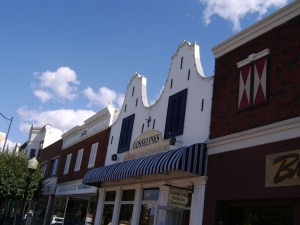 Therefore, the section starting with a ‘V’ is the biggest section in the telephone guide, listing all the “Van Something” such as the Vander Ploeg family running a bakery.
But unlike other towns, why did the people of Pella hold on to 19th century Dutch looks? Well, it turns out, they did not hold on to their original Dutch way of building. They reinvented it. And the reinvention story, I guess, says more about the Dutch mentality than the 19th century looking fronts. Before the 1960s Pella was just a regular American looking town. Except for a small period in the spring, when the tulips flowered. The reinvention started, therefore, with the increasing number of visitors to a longstanding local tulip festival. The people in town figured that a distinct Dutch look would be a unique selling point, a tourist attraction serving the local economy.
 After good Dutch tradition, the town council imposed planning regulation in the 1960s; each building in Pella had to have a Dutch looking front. This, of course, met opposition. However, a local bank helped ease the pain by lending money against no interest for the refurbishment of the fronts. Gradually all fronts turned into ‘historical’ fronts and new buildings have to be approved by the council before they receive planning permission. Community engagement helped to establish a Dutch ‘klokkenspel’, which was finished in 1984, with bells singing regularly. I found a replica of a Dutch canal, half a meter deep, with a blue painted concrete floor and crystal clear water accompanied with a sign saying “water is chemically treated P- E – SE, stay out!”.
Nowadays the Tulip Festival is the biggest festival in Iowa and an attraction to people from everywhere. Last year the town welcomed 165.000 visitors for the festival alone.  The woman in the mill visiting centre showed me the visitor’s book which had 160 new entries that day, from people from many different, mostly neighboring states. Quite an achievement for a town 45 miles from Des Moines and not located at an Interstate Highway.


