
Steeds meer zorgboeren – aldus berichte RTL Nieuws naar aanleiding van de Dag van de Zorglandbouw op 21 april 2009. De dag was door de Taskforce Multifuntionele Landbouw opgezet. Op de blog van Guus.net worden een aantal deelnemers gevolgd door Dorine Ruter, waaronder Pieter Seuneke van onze leerstoelgroep Rurale Sociologie. Pieter werkt op het project ‘Dynamiek en Robuustheid van Multifunctionele Landbouw‘, waarover al eerder is bericht in een blog.
Category Archives: Multifunctionality
Excursions Understanding Rural Development
As a part off the course Understanding Rural Development (RSO 31806) we went on a field trip to de Eemlandhoeve in Bunschoten and explored the inner-city of Utrecht. By this excursion we visited a number of interesting expressions of urban-rural relationships, from a rural and an urban perspective.
De Eemlandhoeve
De Eemlandhoeve, owned by farmer, rural entrepreneur and philosopher Jan Huijgen, can be considered as an extreme example of a multifunctional farm enterprise. The group of Blonde d’Aquitaine’s form the centre of a rural enterprise which includes a large number of activities like a farm shop, care facilities, meeting and office facilities, an education garden and even a farmer’s cinema under construction.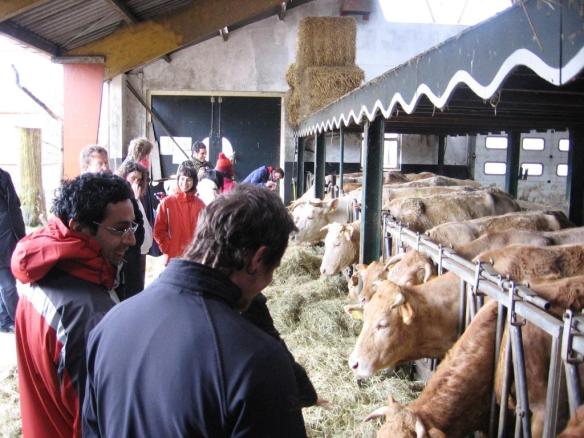
Next of being a multifunctional entrepreneur Jan Huijgen is a well known personality in Dutch rural development, active on a local, national, international (and maybe in the near future on a global) level. The farm residents a rural innovation centre and last October de Eemlandhoeve hosted the EEconference or Europese Eemlandconference, veelzijdig platteland.
On the excursion owner Jan Huijgen told us about his inspiration, motives and future plans with his farm. After his presentation we had an interesting discussion and were showed around the place.
Local food in the city of Utrecht
The second trip brought us to a rather different surrounding; the historical inner-city of Utrecht. On de Eemlandhoeve our focus was on the rural side of urban-rural relationships, in Utrecht we looked upon it from an urban perspective.
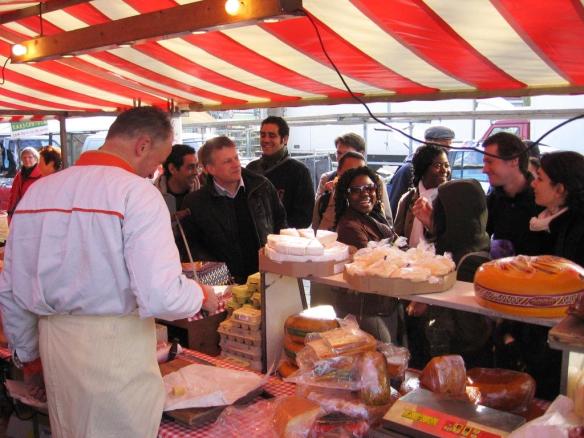 Together with our guide Frank Verhoeven (see his website) we first went to the Wednesday Vredenburg Market. On this market we visited a cheese seller linked to the organization called Dutch Cheese Centre (website under construction). The stallholder told us about some typical Dutch cheeses and the trade in locally produced ones. After some tasting we set out for the traditional bakery Bakkerij Blom were owner Theo Blom showed us around and told about his bakery, traditional products and production.
Our last stop was a visit to the five star hotel and restaurant Karel V for a number of short presentations. In the hotel our guide Frank Verhoeven started by telling us about his ‘Boerenbox’ initiative and his vision on a more locally based production and consumption. Secondly, one of the Karel V chefs explained us about the way they work with seasonal products originating solely from regional grounds and local suppliers. Lastly, Arie Bosma, one of the initiators of the campaign ‘Lekker Utregs’, told us about the initiative to reconnect the city of Utrecht with its surrounding countryside by establishing a so called Green Participation Society.
By the fieldtrips we got acquainted with several interesting expressions of urban-rural relationships, from a rural and an urban perspective. It was a nice and inspiring way of linking theory from class to reality by ‘tasting’ real life examples in ‘the field’.
Places worth caring about
This week I have discussed, in my MSc course Understanding Rural Development, the modernization of Europe’s agriculture and rural areas in the post World War II era. By showing pictures, tables and figures I have tried to demonstrate how drastically the rural landscape, the agrarian structure and the food supply chain have changed in a period of several decades. Multifunctional countrysides were transformed into places for specialized and high-tech forms of food and fibre production, the number of farms decreased by some 80% in 50 years time, the average farm size increased enormously, agricultural employment decreased drastically, an ever increasing part of the agricultural products are processed by the food processing industry and the supermarket has become the dominant outlet for most food products. There are, of course, differences between regions and countries, but this is the prevailing development trend in EU member states that have been subject to the EU’s original Common Agricultural Policy. The agricultural modernization project has been very successful in terms of creating food self sufficiency in Europe at low prices for consumers, but this has also come at a cost. By the 1990s the negative side-effects of modernization became widely acknowledged. When talking about negative side-effects topics as environmental pollution, degradation of biodiversity, declining farmers’ incomes, animal welfare concerns and consumers’ distrust in the modern food system are usually brought to the fore.
Inspired by a humorous and thought-proviking presentation of James Howard Kunstler at the TED 2004 conference (“The tragedy of suburbia” ) as the analogy between suburbian development and agricultural modernization is astonishing, another side-effect came to mind: the loss of a sense of place and a sense of belonging due to the (feeling of) expropriation of local self control (e.g. due to centralized spatial planning) and due to the eradication of many specific and distinctive regional assets (cultural history, landscape, traditional products and processing techniques, etc…). Rural regions that were subject to the agricultural modernization project have de facto become non-places and are thus easily interchangeable. And as a result many rural regions have become, quoting Kunstler, places not worth caring about … and places not worth caring about are places not worth protecting or defending.
Looking at rural development from this point of view sheds an interesting light on its dynamics. Continue reading
Landschapskwaliteit en verbrede landbouw
Schaalvergroting van agrarische bedrijven zal veel kernkwaliteiten van Nationale Landschappen verder onder druk zetten, zo luid de conclusie van het in 2008 gepubliceerde WOT-rapport Helpt boeren de Nationale Landschappen. De negatieve effecten van schaalvergroting kunnen deels opgevangen worden door meer verbredingsactiviteiten in te passen als aanvulling op het inkomen. Bij hervormingen in het Gemeenschappelijk Landbouwbeleid van de Europese Unie kan gerichte inkomenssteun voor maatschappelijke diensten ingezet worden.
 Er zijn volop potenties, maar de relatie tussen verbrede (of multifunctionele) landbouw en landschapskwaliteit is niet zo eenduidig en evenmin vanzelfsprekend, zo bleek uit een afstudeeronderzoek van Kees Neven in het Groene Woud. Wil verbrede landbouw bijdragen aan landschapskwaliteit dan moet daar zowel op bedrijfsniveau als op gebiedsniveau richting aan worden gegeven. In Het Groene Woud doet probeert men dat met een Streekmerk, maar ook andere gebieden als de Noordelijke Friese Wouden is op zoek hoe dat handen en voeten te geven. Het belonen van (hoogwaardige) groene diensten die bijdragen aan landschapskwaliteit kan ondernemers hierin stimuleren.
New Project – Dynamics and Robustness of Multifunctional Agriculture
On the first of February the Rural Sociology Group, in collaboration with the Education and Competence Studies Group, will start with a large research programme entitled ‘Dynamics and Robustness of Multifunctional Agriculture’. This project is financed by the Dutch Ministry of Agriculture, Nature and Food Quality and supported by the Task Force Multifunctional Agriculture. The programme aims to deepen our understanding of the critical factors that exert an influence on the dynamics of multifunctional agriculture. Factors that could play a role are for instance the Continue reading
 Rural Sociology Wageningen University