Inspiring encounters in the Westerkwartier

On Wednesday evening, I participated in a Plattelandscafé (countryside-café) at the Natuurboerderij Lammerburen (nature development farm) in Oldehove, Westerkwartier, Groningen. The aim of the gathering was to present results of past projects, ongoing projects and project ideas aimed at ensuring the sustainability of the predominantly rural Westerkwartier. Jan Oomkes, chairmen of the LAG Westerkwartier (LEADER) and alderman of Zuidhorn municipality, opened the evening with a summary of activities in the Westerkwartier, including activities of the citizen action group (WSI), the Westerkwartier as LEADER-region, the community house in Grootegast and numerous projects which have been realised using money from the EU (LEADER), the Rural Area Programme of the province of Groningen as well as the different municipalities. Thereafter, the word was given to different project leaders and the present 60 visitors were informed about ongoing projects and activities.

With regard to my upcoming DERREG  (see previous post) research activities on rural business networks and the support of rural initiatives and regional learning in the Westerkwartier, the presented projects were highly interesting. For instance, one suggested project idea described the construction of hiking routes through the Westerkwartier, improving the touristic infrastructure and stimulating tourism as a new economic source for the region. Potentially, the project would thus provide possibilities for farmers to engage in side activities such as farm cafés and touristic accommodation and would help to establish networks between different stakeholders of similar interest. A further interesting project that was introduced is a new network for local business women (Wichterwest). Since the DERREG project aims to put special emphasis on the role of women in rural development, the newly formed network would be an interesting idea to study and could act as a best practise example for other rural areas throughout Europe.
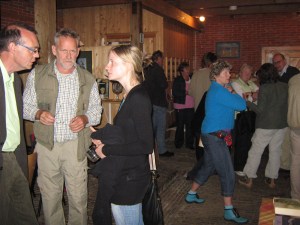
Conversations at the plattlandscafé

Conversations at the plattlandscafé

The evening was accompanied by guitar music- including a self-composed song about the Westerkwartier-, drinks and snacks. The inspiring atmosphere provided a good opportunity for everyone to exchange thoughts and ideas about the development of the Westerkwartier. Considering the enthusiasm of the people present at the gathering and their commitment to the development of their region, the event was also for me a motivating experience, highlighting once again the significance of research towards ensuring the sustainability of rural regions in the era of globalization.

Rural development driven by unfolding rural webs

Today the main outcomes of the EU-funded project ETUDE were presented by our colleagues Jan Douwe van der Ploeg (scientific coordinator of ETUDE), Rudolf van Broekhuizen (project-coordinator) and Henk Oostindie (senior researcher).  Main finding is that neither policy, nor markets or grass root rural development activities are by itself decisive for successful rural development, but the web of different and increasingly interlinked networks. Or as Jan Douwe van der Ploeg states:

Successful rural development is rooted in a myriad of encounters, transactions, interactions and networks that link people, resources, activities and markets. (Source: E-magazine by British Publisher, pp. 64-65). 

Van der Ploeg & Marsden (in ‘Some Final Reflections’, the concluding chapter in the book ‘Unfolding webs’ , p 227) refer to these rural web as emerging counter-structures: 

because rural development processes (that are grounded upon and resulting from this web) are essentially transitional: they represent a major shift that takes many years to occur and which proceeds through changing conditions of invisibility and confusion. Visibility, coherence and comprehension only occur during, and as an effect of, this transition. We also refer to the rural web as a counter-structure because it increasingly helps to deal with complexity (especially Chapter 8 of this Volume), creating simultaneously new patterns of coherence. All this relates to the contested nature of rural development: what might be highly meaningful in terms of the rural web, might be insignificant or even ludicrous at the level of the dominant structure. What we are beginning to conceptually explain here, therefore, are the particular dynamic qualities (both new coherences and contestations) of web formation. These are, indeed, built out of the seeming contradiction between creating counter-structures to prevailing conditions, at the same time as re-creating new coherences out of these very deviations and ruptures.

The project has come to a closure. The findings and recommendations will soon be published in a second book. Earlier publications, such as the chapters of the first book ‘Unfolding webs’, edited by Jan Douwe van der Ploeg & Terry Marsden and published by Royal Van Gorcum, and deliverables (e.g. case study reports) can be downloaded at the ETUDE-website.

For more information on the outcomes you can contact one of the colleagues.

DERREG-website is online

The website of the EU-funded research project DERREG (see blog of January 22) is now online: www.derreg.eu. Basic information about the project is now available and further information will be published as the project proceeds.

Kennis arrangeren voor gebiedsontwikkeling

Binnenkort verschijnt het LEI-rapport  ‘Kennis maken met regionale kennisarrangementen: de werkvloer van een Kennisnetwerk Vitaal Platteland’.

Het doet verslag van een leerzame tocht van de landelijke werkgroep Kennisnetwerk Vitaal Platteland langs beloftevolle kennisarrangementen in de Veenkolonien (Werkplaats), Eemland (Regionaal Innovatie Centrum en Plattelandsacademie) en Westerkwartier (Countryside Exchange). Een werkbezoek aan het Kennisloket in Kempenland werd afgelast, maar het Kennisloket is wel meegenomen in de analyse. De gezamelijke bevindingen zijn omgezet in aanbevelingen richting opdrachtgever Directie Platteland van LNV hoe gebiedsontwikkeling vanuit onderwijs en onderzoek op structurele kan worden ondersteund met raad en daad. Aangezien het rapport is goedgekeurd en de aanbevelingen inmiddels ter hand worden genomen, wil ik als een van de samenstellers van het rapport de Samenvatting alvast breed delen.

Overigens was hier al eerder een artikel (‘Kennis in de regio’) over verschenen in het tijdschrift Landwerk van Ina Horlings, werkzaam bij Telos, die ook aan de werkbezoeken heeft meegedaan en samen met Eelke Wielinga (LEI) en mij het eindrapport heeft samengesteld.

Hieronder volgen vijf passages uit de Samenvatting:

Continue reading

Terugblik Dag van de Zorglandbouw

Dinsdag 21 april bezocht ik, in het kader van ons onlangs opgestarte onderzoek ‘dynamiek en robuustheid multifunctionele landbouw’, de Dag van de Zorglandbouw. Onderweg naar Apeldoorn kwam er via Radio 1 al een opwarmertje langs. Een Brabantse zorgboerin sprak in het interview haar zorgen uit over de gevolgen van de wijzigingen in de AWBZ (Algemene Wet Bijzondere Ziektekosten). Ook één van de Tweede Kamerleden gaf een voorproefje op de dag. Ik zat er al helemaal in en dat terwijl het programma nog moest gaan beginnen! Continue reading